Vegetable · Fabaceae
Fava Bean
Vicia faba
Press the broad seeds into cold spring soil, give them sun and steady water, and these stout, upright plants crop early while the weather stays cool.
Full sun
Every 5–7 days
75–90 days
USDA 3–8
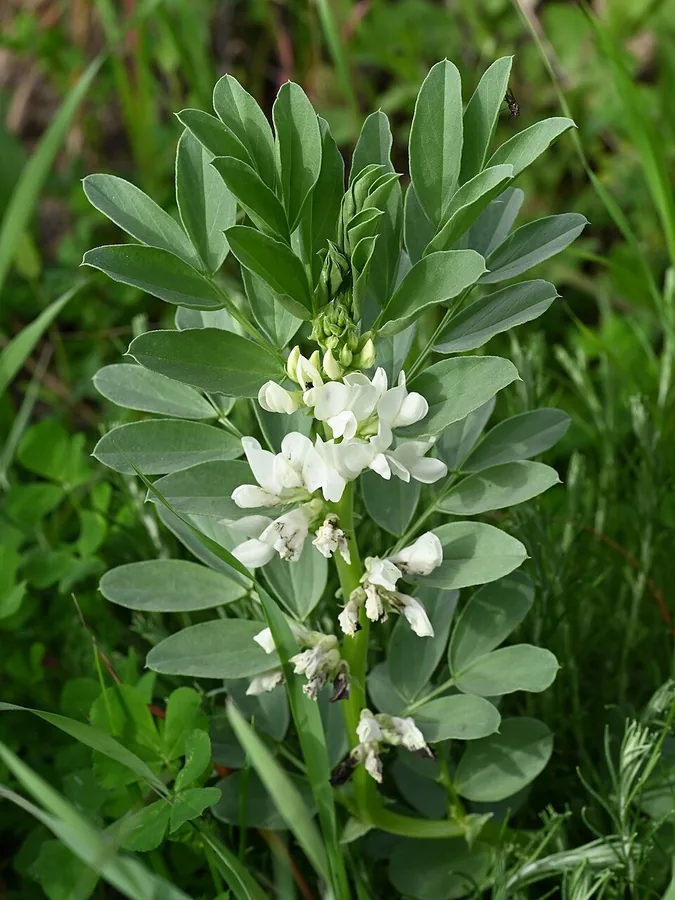
Overview
The fava bean is one of the oldest crops in cultivation, a cool-season legume that takes cold far better than most vegetables. The plant stands tall and stiffly upright on a thick, squarish stem, almost four-cornered to the touch, and it carries its flowers and heavy pods snug against that frame rather than sprawling. Its other name, broad bean, names the seed itself: wide and flat, each one tucked into a pod whose inner wall is lined with a soft, velvety white tissue.
Cold is what the plant is made for. The seed goes down weeks ahead of most beans, into early-spring ground as soon as it can be worked, or in fall where winters stay mild. As a nitrogen-fixing legume, the fava draws much of its own nitrogen from its roots and leaves the soil richer for whatever grows there next.
It asks little and bears early. Set in good ground and kept evenly moist through bloom and pod fill, the plant fattens its pods steadily while black aphids crowd the soft new tips up top. Time the sowing so the flowers open in cool air, and the tender pods and beans swell and come ready from late spring into early summer.
Care
The short version: the fava wants full sun and cool weather, a deep well-drained soil thick with organic matter, and steady moisture through flowering and pod fill, with little feeding needed since the roots fix their own nitrogen.
Light
The fava colors up and crops best in full sun, though it will take a little partial shade and still set pods. Full light keeps the tall, four-cornered stems standing firm and the flowering heavy along them.
Water
The soil stays evenly moist through germination, flowering, and pod fill, which works out to a deep soak every 5 to 7 days. Swings between bone dry and soggy do harm, and cold, wet ground wants less, since waterlogging rots the plump seed before it splits.
Soil
The plant roots into deep, well-drained loam thick with organic matter. A pH from 6.0 to 7.5 suits it, and the deep, free-draining ground gives the heavy taproot room to drive straight down.
Temperature
This is a true cool-season crop, hardy to about 14°F (-10°C) and at its best below 77°F (25°C). Heat at flowering is the enemy, since it loosens the open blossoms and drops them before any pod can swell.
Humidity
Ordinary outdoor air at 40% to 60% is fine, so there is no figure to chase. Air moving through the leaves matters more, since a crowded, damp canopy is where the dark chocolate-spot lesions take hold.
Feeding
As a nitrogen-fixing legume, the fava draws its own nitrogen from the roots and rarely needs more. Thin ground takes a little phosphorus and potassium worked in at planting, and nothing further.
Pruning
Once the lowest pods begin to swell, the soft green growing tips are pinched out. That strips the tender shoots the black aphids cluster on and turns the plant's strength down into the filling pods.
Size & spacing
The plant rises 3 to 5 feet (90 to 150 cm) on its stout stem while holding a narrow base of 12 to 18 inches (30 to 45 cm) across. That much room lets air pass between the leaves so the chocolate-spot fungus finds less of a foothold.
When to plant
The fava is built for the very cold that stops most beans short. The seed goes straight into the ground in early spring as soon as the soil can be worked, or in fall where winters stay mild, and the swelling pods come ready to pick from late spring into early summer, before the heat closes the season.
Northern hemisphere
Southern hemisphere
Typical months for a temperate climate: start earlier in warm zones, later where spring frosts linger.
- Plant: Direct-sow in early spring as soon as soil is workable, or sow in fall in mild-winter (zone 7+) climates for overwintering.
- Harvest: Harvest tender pods/seeds in late spring to early summer.
Hardiness
USDA hardiness zones: 3–8
Temperature: down to -40°C
Troubleshooting
Most of what goes wrong with a fava shows on the soft new growth at the crown of the plant or on the lower leaves once the weather turns wet. Spotted early, the marks and the massing insects stay small and easy to read. Match the look of the plant below, then step in while it still counts.
Rounded reddish-brown spots that run together and blacken the leaves
Small rounded lesions in reddish-brown to deep chocolate, scattered across the leaf and along the stems, mark the start of chocolate spot. In cool, wet weather the spots swell and bleed into one another until whole leaves turn black. Wider spacing to dry the foliage, stripping the worst-flecked leaves away, and keeping water off the canopy slow it, and sound drainage with restrained nitrogen holds the spotting back.
Fix:
- Improve air circulation by wider spacing
- Remove and destroy badly affected foliage
- Avoid overhead watering
Black aphids crusting the soft upper shoots
Those packed black specks crowding the topmost shoots are black bean aphids, soft-bodied and dark, massed thick over the tenderest new tips and upper stems. A shiny film of honeydew slicks the growth beneath them and blackens into sooty mold, with ants threading up and down the stems. Pinching off the worst-encrusted tips, a hard jet of water, and insecticidal soap on what clings on clear them away.
Fix:
- Pinch off and destroy heavily infested growing tips
- Dislodge colonies with a strong water spray
- Use insecticidal soap on persistent infestations
Blossoms dropping from green plants with no pods behind them
When the foliage stands green and full yet the blossoms loosen and fall, leaving bare nodes where pods should swell, the cause is usually heat during flowering. This cool-season plant sheds its open flowers once a hot spell strikes at bloom. Even soil moisture through flowering eases the loss, the few pods that form are worth picking, and timing the sowing so the flowers open in cool weather is the real cure.
Fix:
- Maintain even soil moisture during bloom
- Harvest existing pods promptly to encourage continued set
Toxicity
The fava is a food crop, and the plant itself is safe around cats, dogs, horses, rabbits, livestock, and poultry. For people, the cooked beans are wholesome and nourishing, with one real exception: anyone with the inherited G6PD enzyme deficiency can suffer a serious blood reaction called favism from eating the beans or even breathing the pollen, and they should keep away from the plant entirely.
Safe for
People · Cats · Dogs · Horses · Rabbits · Livestock · Birds
Cats None
A cat that bites into a leaf or a green pod faces no poisoning risk from the fava, so the nibble is harmless.
Dogs None
Dogs come to no harm among the plants, and the ASPCA does not list the fava as toxic. A jaw-full of raw beans tends to pass as little more than gas or a loosened stool.
Horses Safe
Horses crop the leafy growth without ill effect, and that long-standing taste for the foliage is what fixed the old name horse bean.
Rabbits Safe
Rabbits nibble the leaves and the soft green pods without harm; bring in any new green a little at a time, as with all fresh forage.
Livestock Safe
Cattle, goats, and sheep eat the beans and haulm as a feed and fodder crop, so the plant carries no real danger in the field.
Birds Safe
Backyard poultry peck the beans and greens safely, and in places the fava is grown outright as a bird feed.
People Safe
Cooked fava beans are wholesome food for most people. The one real exception is anyone with the inherited G6PD enzyme deficiency, in whom eating the beans or even breathing the pollen can set off a serious blood reaction called favism, so that person must keep clear of the plant entirely.
Human food-safety note: people with the inherited enzyme deficiency G6PD (favism) can develop acute hemolytic anemia from eating fava beans or even inhaling the pollen. This is a human genetic-condition concern, not a pet toxicity or general toxicity issue.
Varieties
Many fava varieties exist, but a few keep their place in home gardens, each set apart by the shape of its pod or the size of its plant. These are the ones worth knowing by name.
Aquadulce
A very hardy type whose long pods make it the bean reached for when sowing in autumn to overwinter in mild climates.
Windsor
The classic bean of broad, flat seeds set in short pods, grown above all for the richness of its flavor.
The Sutton
A dwarf that holds to about 12 inches (30 cm) of low, stocky growth, which suits it to small beds and windy, exposed sites.
Companions
Fava beans pair well with hungry crops that draw on the nitrogen they leave behind, and sit poorly next to onions and garlic, which many gardeners find hold legumes back.
Plant near
brassicas: As a nitrogen-fixing legume, fava beans can precede or accompany heavy-feeding brassicas that benefit from improved soil nitrogen.
Keep apart
onions and garlic (alliums): Alliums are commonly cited as poor companions for beans and other legumes.
How to propagate
The fava grows easily from its own large, flat seed, dropped straight into the ground where the plant will stand for its whole short life.
SeedEasy
Direct-sow in early spring as soon as soil is workable, or in fall in mild-winter climates. · 1 to 2 weeks to germinate in cool soil
Each large, flat seed goes straight into the ground where the plant will stand, since the fava roots in fast and resents being lifted. Press the seed about 2 inches (5 cm) deep into cool, workable soil in early spring, or sow in fall where winters stay mild. The first shoot breaks the surface in 1 to 2 weeks, even with cold still in the ground.
Myths
Fava beans are toxic to everyone and unsafe to eat.
Cooked fava beans are a safe, nourishing food for most people. The real exception is anyone born with the G6PD enzyme deficiency, in whom eating the beans or breathing in the pollen can trigger a serious blood reaction called favism. That is an inherited human condition, not a poison built into the plant itself.