Vegetable · Fabaceae
Snap Pea
Pisum sativum var. macrocarpon
Rounded pods swell tight along the vine, their walls crisp and sweet enough to eat whole.
Full sun
Every 5–7 days
39–75°F · 4–24°C
55–70 days
Overview
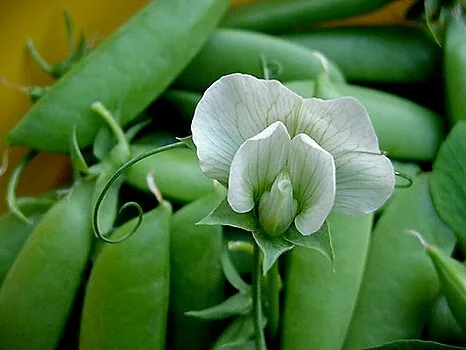
The snap pea forms plump, rounded pods that fill out until the walls press tight around the seeds inside. It is a cool-season legume, the result of crossing the flat-podded snow pea with the round-seeded shelling pea, and the pod shows both parents: rounded like one, sweet and crisp like the promise of the other. Snap one and it breaks with a clean crack, wall and seed eaten together.
The plant climbs on slender green vines that run 5 to 6 feet up a trellis, or holds to a low, bushy frame near 2 feet, keeping a narrow footprint either way. The pods hang along the stems, swelling from slim and flat to full and rounded as the seeds within grow plump. Picked young, the pod wall is tender and yielding to the touch.
Left too long, that same pod changes in the hand: the seeds swell hard, the wall turns stringy and starchy, and the crispness gives way to a fibrous chew. The tender young pod and the tough old one are the same plant at two moments, which is why the snap pea is picked at the exact point when it is round, filled, and still snapping crisp.
Care
The short version: grow snap peas in full sun with an early-spring sowing, well-drained soil, about an inch of water a week, little nitrogen, and a trellis for the tall vines.
Light
In full sun the vine grows sturdy and sets its pods thickly; in a little partial shade it still crops, useful where spring warms fast. Starved of light, the stems draw out thin and leggy and the pods grow few.
Water
About 1 inch of water a week soaks the soil several inches deep and keeps it evenly moist as the flowers open and the pods fill. Water laid at the soil line leaves the leaves dry, and dry leaves resist disease.
Soil
The roots run best in well-drained loam at a pH of 6.0 to 7.5. Cold, waterlogged ground is what browns and rots them, so drainage is the detail that counts.
Temperature
Cool air between 39°F and 75°F (4°C to 24°C) keeps the plant firm and growing. As the heat climbs into the mid-80s the flowers falter and the vine slackens, which is why the seed goes in early.
Humidity
Plain outdoor humidity of 40% to 70% is all the pods and leaves need. What matters is the air around them: still, close air leaves a film of powdery mildew on the leaves late in the season.
Feeding
The roots carry their own nitrogen, fixed by bacteria living on them, so the plant wants little to no fertilizer. A low-nitrogen mix such as 5-10-10 suits poor ground, while too much nitrogen swells the leaves and thins the pods.
Pruning
The plant needs no cutting; a pinch at the growing tip simply stops a tall vine from reaching higher. When the last pods are gone, the vine is pulled, spent and browning, and composted.
Size & spacing
The plant stands 2 to 6 feet (60 to 180 cm) tall, tall vine or low bush, on a narrow 6 to 12 inches (15 to 30 cm) of spread. The tall vines lean their weight on a trellis, and space between them lets air pass over the leaves.
When to plant
The snap pea is a plant of cool, short days, and its whole growth runs on that window. Seed goes into cold, workable ground in early spring, about 4 to 6 weeks before the last frost, and the rounded pods hang ready from late spring into early summer, before the heat closes the season.
Northern hemisphere
Southern hemisphere
Typical months for a temperate climate: start earlier in warm zones, later where spring frosts linger.
- Sow: Not typically started indoors; direct sow
- Plant: Early spring, as soon as the soil is workable and at least 45°F (7°C); about 4-6 weeks before the last frost
- Harvest: Late spring to early summer, roughly 55-70 days after sowing
Hardiness
USDA hardiness zones: 2–11
Temperature: down to -46°C
Troubleshooting
The snap pea shows its troubles plainly, written on the leaves, the stems, and the pods themselves. A white film, a curl, a yellowing, a dropped flower, a toughened pod: each has a look you can read. Watch for the early signs below and act while the crop still stands.
Lower leaves paling to yellow on a stunted plant
When the lowest leaves fade to yellow and the plant stays small and slack, the roots below have usually gone brown with root rot or Fusarium wilt, set off by cold, sodden soil. Browned roots do not green up again, so the plant is lifted and thrown out. Well-drained ground, a yearly move, and resistant kinds keep the rot from the roots.
Fix:
- Remove and discard affected plants
- Improve soil drainage
A talc-white film dusting the leaf surfaces
The pale, floury coat on the upper leaves is powdery mildew, a fungus that settles in late in the season when warm dry days turn to cool, damp nights. It rubs off at a touch, and beneath it the leaves yellow and dry; clearing the worst vines and opening the air slows it, with sulfur or a labeled fungicide for a stubborn spread. Sowing early, so the pods are in before the heat, keeps the film off.
Fix:
- Remove severely affected vines
- Improve air circulation
- Apply a labeled fungicide or sulfur if needed
Curled, sticky leaves speckled with small green bodies
The small, soft green bodies packed on the shoot tips and leaf undersides are pea aphids, sap-feeders that also carry viruses from plant to plant. Their feeding leaves the leaves curled and tacky; a hard jet of water knocks them off, insecticidal soap clears the rest, and lady beetles hunt the survivors. Lean nitrogen keeps the growth firm rather than soft, which is the growth they crowd onto.
Fix:
- Spray plants with a strong stream of water
- Apply insecticidal soap
- Encourage natural predators such as lady beetles
Flowers dropping from the stem before a pod sets
In the heat past about 85°F (29°C), the flowers loosen and fall from the stem and no pod forms behind them. Nothing brings them back once the warmth sets in, so the last rounded pods are gathered and the row given over to a heat-lover. The plant only flowers cleanly in cool air, which is the whole case for an early sowing.
Fix:
- Harvest any remaining pods promptly
- Replace with a warm-season crop
Pods swelling hard, stringy, and starchy
A pod held too long on the vine swells taut over enlarging seeds, and the wall thickens to stringy, starchy fiber as its sugar turns to starch. Past that point the pod cannot be softened. Gathered every 1 to 3 days, while it is round, filled, and still tender, the pod stays crisp and sweet.
Fix:
- Harvest promptly when pods are plump but still tender
- Pick every 1-3 days
Toxicity
Every part of the snap pea is edible and safe to eat, the plump pods and their seeds, the tender shoots, and the flowers alike. Nothing on the plant poses a risk to people or animals. Only the ornamental sweet pea (Lathyrus), a separate plant, is toxic and must not be eaten.
Safe for
People · Cats · Dogs · Horses · Rabbits · Livestock · Birds
Cats None
The snap pea holds no toxin for a cat, so a chewed vine or a bitten pod does no harm. A cat that swallows a big wad of green leaf may feel briefly off, the way any bulk of greens can sit heavy.
Dogs None
A dog takes no harm from the snap pea, and a fresh pod makes a firm, crunchy mouthful many dogs seek out. The only aftereffect is the ordinary gurgle of a gut met with a sudden pile of vegetables.
Horses Safe
The pods, the leaves, and the green vines are all safe grazing for a horse. The seeds carry a little protein, though the plant suits a handful of treat rather than a full feed.
Rabbits Safe
A rabbit does well on the leaves, pods, and soft shoots of the snap pea, a wholesome green in the mix. Any new forage is best eased in slowly while the gut adjusts.
Livestock Safe
Cattle, goats, and sheep can graze the pea vines without harm, the green foliage a familiar forage. No toxin in the plant caps how much they crop it down.
Birds Safe
Hens and other birds pick freely at the peas and the tender shoots, with nothing on the plant to harm them. The round seeds give them a firm bite of protein.
People Safe
The whole pod, wall and seed together, is grown to be eaten, raw for the crisp snap or lightly cooked. It is a safe, sweet vegetable for everyone at the table, children included.
No special handling needed; this is a safe edible crop.
Varieties
The snap peas below differ in the plant you see, tall vine or low bush, and in the pod itself. These are the ones worth telling apart.
Sugar Snap
The original sugar snap, a vine of 5 to 6 feet strung with plump, rounded pods sweet enough to eat whole straight off the plant.
Sugar Ann
A low, compact bush near 2 feet that fills early and stands with little support.
Snow pea (var. saccharatum)
An edible-pod pea grown for flat, thin, tender pods gathered before the seeds round out, the opposite of the snap pea's plump pod.
Companions
Peas grow well alongside cucumbers and other legumes that share their easygoing habits, and poorly next to onions and their allium kin, which stunt legume growth.
Plant near
cucumbers: Listed as a compatible companion for peas in extension companion-planting guidance.
beans: Other legumes pair well with peas and similarly help build soil nitrogen.
Keep apart
onions: Alliums such as onions can stunt the growth of legumes and should not be interplanted with peas.
How to propagate
The snap pea starts as a hard, round seed pressed straight into the ground where the vine will rise.
SeedEasy
Direct sow in early spring as soon as the soil is workable and at least 45°F (7°C) · Germinates in about 7-14 days; pods ready to harvest in roughly 55-70 days
The snap pea goes in as a hard, round seed rather than a transplant. The seeds press 1 to 1.5 inches deep and 1 to 2 inches apart into workable early-spring ground, with a trellis or netting set for the climbing vines to rise on. A green shoot breaks the surface in about 7 to 14 days, and rounded pods hang ready in roughly 55 to 70 days; a dust of Rhizobium bacteria on the seed feeds the nitrogen-fixing.
Myths
Peas need heavy nitrogen feeding to fill their pods.
The pods fill on nitrogen the plant makes itself, drawn from the air by bacteria on the roots, so feeding is rarely wanted. Pushed with extra nitrogen, the plant runs to leaf and sets fewer pods, green and lush but light on harvest.
Every edible-pod pea looks and eats the same.
The pod tells them apart. Snap peas carry plump, rounded pods eaten whole, snow peas hang flat, thin pods picked before the seeds round out, and shelling peas hold round seeds behind a pod that is opened and thrown away.
The ornamental sweet pea and the snap pea are one and the same.
They are different plants behind similar names. The ornamental sweet pea is Lathyrus, toxic and never a food crop, while the round-podded snap pea is Pisum sativum, grown to be eaten.