Herb · Fabaceae
Fenugreek
Trigonella foenum-graecum
Sown into cool soil, fenugreek unfurls fresh green methi leaves within a month.
Full sun
Every 3–5 days
50–86°F · 10–30°C
90–120 days
Overview
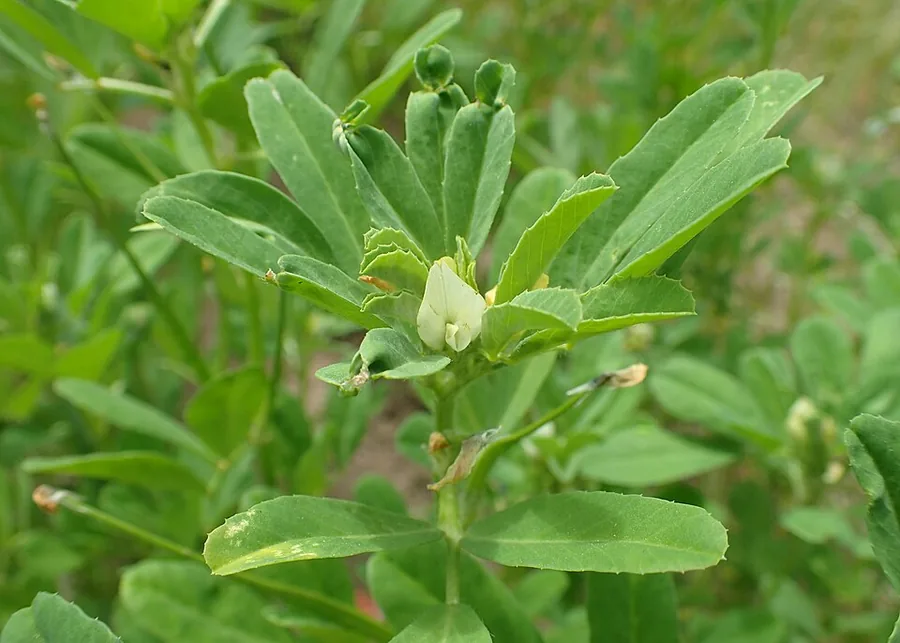
Fenugreek is a small, fast legume that wears two faces at once. Its soft, three-part methi leaves carry a warm, herbal scent, while its seeds, hard and golden and faintly bitter, ripen for the spice jar. The plant sits in the pea and bean family and has been raised across the Mediterranean and South Asia for thousands of years. Sown in cool weather, it greens up from seed to harvest fast.
Underground, this legume quietly feeds itself, the roots beaded with small nodules that fix nitrogen from the air, so it asks for little and even enriches the soil behind it. Above the surface it stays low and slim, knee height at most, its stems carrying clover-like leaflets in fresh green and pale, small flowers that swell into slender, curved seed pods.
For all its delicacy, fenugreek holds one firm dislike, and that is heat. A warm spell tips it out of leaf and into bloom, the stems lengthening and the pale flowers opening before the foliage has thickened, a rush known as bolting. Cool-weather sowing keeps the leaves tender and full and lets the curved pods follow in their own time.
Care
The short version: fenugreek wants full sun and well-drained loam, a direct sowing into cool soil, ground kept evenly moist but never wet, and barely any feeding, since its noduled roots make their own nitrogen.
Light
Fenugreek leafs out fullest in full sun, six hours a day or more, where the green deepens and the seed sets well. It still grows in partial shade, where the leaves stay a touch softer, and a little afternoon shade in warm weather slows the stems' rush to bolt.
Water
The soil stays lightly and evenly moist while the leaves are filling out, taking water every 3 to 5 days. Waterlogged ground turns the roots brown and soft, so that is the one state to avoid. As the curved pods plump and dry to a papery shell, the watering eases off.
Soil
Fenugreek roots into well-drained, fertile loam with a pH of 6.0 to 7.0. Drainage counts for more than richness here, since the plant carries its own nitrogen, and a loose, crumbly bed lets the pale taproot drive straight down.
Temperature
The plant holds its fresh green across 50°F to 86°F (10°C to 30°C) but looks its best at the cooler end. Past roughly 80°F (27°C) the stems lengthen and flower early, so the cool stretches of the year keep it leafy.
Humidity
Plain outdoor humidity near 40% to 60% is all the foliage needs. Moving air counts for more, since crowded, still, damp leaves develop the white film of powdery mildew.
Feeding
Fenugreek needs barely any feeding. The noduled roots fix their own nitrogen, so a single low-nitrogen feed at planting is plenty, with phosphorus or potassium reserved for genuinely poor ground. Too much nitrogen swells soft leaf at the cost of the rest of the plant.
Pruning
Pinching the soft growing tips branches the stems into a fuller, leafier mound, and picking the outer leaves often keeps tender new growth coming. When leaves are the aim, the pale flower stalks are snapped off as they rise so the green stays thick.
Repotting
Fenugreek is never repotted. It lives a single season from seed, so a fresh sowing replaces it rather than a move. In a pot, fine roots threading out of the drainage holes or growth that stalls show it has filled its space.
Size & spacing
The plant stays low and slender, 12 to 24 inches (30 to 60 cm) tall with a narrow spread of just 6 to 12 inches (15 to 30 cm). Seedlings thinned to that spacing let air slip between the leaflets and keep the white mildew off.
When to plant
Fenugreek is a cool-season plant, and once heat builds, its stems stretch and flower instead of leafing out, so timing carries the crop. The seed goes into warm soil after the last spring frost, with a second sowing in late summer for a fall cutting. The tender leaves come in three to six weeks, and the slim curved pods ripen later in the season.
Northern hemisphere
Southern hemisphere
Typical months for a temperate climate: start earlier in warm zones, later where spring frosts linger.
- Sow: Not recommended; fenugreek forms a taproot and resents transplanting, so direct sow.
- Plant: Direct sow after last frost when soil is at least 60°F (15°C); sow in spring or late summer for a cool-season crop.
- Harvest: Leaves ready 20 to 40 days after sowing; small white to pale-yellow flowers, then seed pods harvested at about 90 to 120 days when pods turn yellow.
Hardiness
USDA hardiness zones: 6–9
Temperature: down to -23°C
Troubleshooting
Most of what ails fenugreek shows plainly on the plant itself: leaves losing their green, a dusting of white across the foliage, or seedlings folding at the base. Behind nearly all of it lie two conditions, soil that stays too wet and air that turns too warm. Match the look of the plant below to find the cause.
Lower leaves fading to yellow as the plant droops
The cause is almost always waterlogged ground rather than hunger. When the soil never drains, the roots are starved of air and turn brown and mushy, and root rot follows. Less water, opened-up drainage, and no standing pool around the base bring the plant back.
Fix:
- Improve soil drainage
- Reduce watering frequency
- Avoid standing water around roots
A fine white dust settling over the green leaves
This is powdery mildew, a fungus that powders the foliage when plants crowd together in warm, still air. The pale film rubs away under a finger but returns until the air moves, so wider spacing, removal of the worst-coated leaves, and watering at the base keep the surfaces dry.
Fix:
- Increase plant spacing and airflow
- Remove affected foliage
- Avoid overhead watering
Seedlings flopping at the soil line or scarcely sprouting
Cold, wet soil breeds damping-off, a fungus that pinches the thin young stems at ground level until they topple. Warmth, not extra water, is the answer. Soaked seed, a shallow sowing about 1 cm deep, and soil warmed to 60°F (15°C) keep the seedlings standing.
Fix:
- Sow in warm (60°F or above) well-drained soil
- Avoid overwatering
- Do not sow seed too deep
Pale flowers and seed forming over thin, sparse leaves
Heat is the trigger. Once the air clears about 80°F (27°C), the stems shoot up and open their flowers while the tender leaves thin out, a rush called bolting. A cool-season sowing in early spring or late summer, light afternoon shade in a heat wave, and an early leaf picking head it off.
Fix:
- Harvest leaves before bolting begins
- Sow during the cool season (early spring or late summer)
Toxicity
Fenugreek is a gentle, edible plant from leaf to seed. Its soft green foliage and golden seeds are everyday food for people, recognized by the FDA as a safe spice, and the whole plant has long fed grazing animals. The only part to treat with care is a concentrated seed supplement, which can lower blood sugar in large amounts.
Safe for
People · Cats · Dogs · Horses · Rabbits · Livestock · Birds
Cats None
Safe around cats. A cat that crops a good many of the soft leaves may turn a little gassy or pass a loose stool, which settles on its own.
Dogs None
No real danger from the plant itself. A big mouthful of leaves may bring mild gas, and the concentrated seed supplement is the one thing to keep out of reach, since it can lower blood sugar.
Horses Safe
Safe for horses. The plant is a recognized forage legume, and the green grazes down without trouble.
Rabbits Safe
Rabbits crop the fresh green leaves without harm. Any new green is brought in slowly so the gut adjusts.
Livestock Safe
Long grown as fodder for cattle, sheep, and goats. The whole leafy plant is safe to graze or cut for hay.
Birds Safe
Both the green leaves and the sprouted seeds are safe for poultry and pet birds to peck at.
People Safe
A kitchen plant from soft leaf to hard seed. A heavy dose of the seed can lower blood sugar, a point for anyone managing diabetes.
Leaves and seeds are non-toxic, but seeds eaten in large amounts can lower blood sugar, and concentrated extracts or essential oils should be avoided in pets.
Varieties
Fenugreek divides into types raised for their seeds and types raised for their leaves, and the difference shows in the plant, from upright seed-bearers to low, leafy growers. A few names recur, and the choice follows whether the golden seed or the fresh green leaf is wanted.
Common seed fenugreek
A tall, upright plant grown chiefly for its hard, golden-brown aromatic seeds, the ones dried for use whole or ground as a spice.
Pusa Early Bunching
An Indian cultivar bred for fast, leafy regrowth, putting out flush after flush of soft green for several cuttings in a season.
Kasuri (Qasuri) methi
A small-leaved plant prized for its dried leaves, whose flecks carry a stronger, more aromatic flavor than the fresh herb.
Companions
Fenugreek works best as a soil-builder in rotation. Because it leaves nitrogen behind, the crops that follow it gain the most.
Plant near
Heavy-feeding leafy greens and brassicas grown after fenugreek: Fenugreek fixes atmospheric nitrogen, enriching the soil for subsequent nitrogen-hungry crops.
How to propagate
Fenugreek begins, every time, from seed alone. The single descending taproot rules out cuttings and transplants, so each new stand of clover-like seedlings rises from a fresh sowing in place.
SeedEasy
Spring after last frost or late summer for a fall crop · Germinates in about 5 to 7 days
Fenugreek rises from seed alone, the single taproot ruling out any transplant. The hard seed is soaked for a few hours until its coat softens, then set about 1 cm deep in warm, well-drained soil. Pale shoots break the surface in 5 to 7 days, unfolding their first clover-like leaflets, and the next stand comes from a fresh sowing in place.
Myths
Fenugreek needs heavy nitrogen feeding like leafy vegetables.
It makes its own underground. As a legume, fenugreek fixes nitrogen from the air through the small nodules beaded along its roots, so a heavy feed is wasted. The nitrogen is best skipped and left to the roots, with phosphorus or potassium added only on truly poor ground.
Fenugreek should be started indoors and transplanted.
Moving it checks the plant. A single taproot drives straight down and resents disturbance, so a lifted seedling sulks or fails. A direct sowing where it will stand is the way to grow it.
Fenugreek needs a long, hot growing season.
The reverse is true. It is a quick cool-season plant, seed to harvest in about 90 to 120 days, and warmth only sends the stems bolting into flower. A cool-season sowing in spring or late summer keeps the leaves fullest.