Tree · Juglandaceae
Walnut
Juglans regia
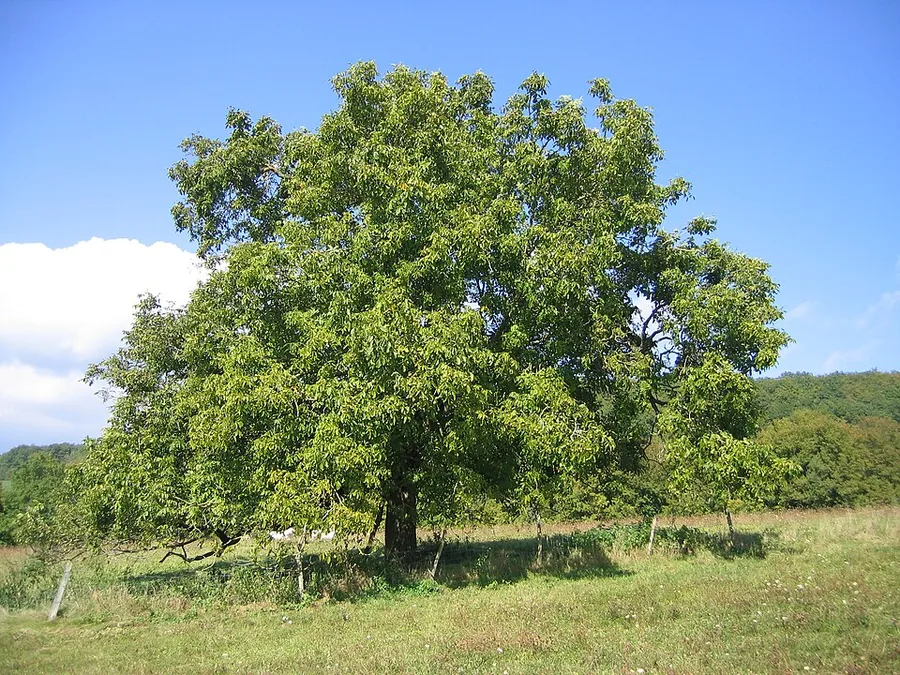
Set in deep soil and full sun, a walnut lifts a broad, open crown that shades the yard for generations and drops husked nuts each fall.
Full sun
Every 7–21 days
USDA 5–9
39–59 ft · 12–18 m
Overview
A walnut is a long-lived shade tree whose wide, open crown spreads on heavy limbs to 60 feet (18 m). It belongs to the walnut family, and each fall it hangs its branches with round nuts wrapped in thick green hulls. Rooted in deep, fertile soil under full sun, that broad canopy shades and crops for generations.
The English or Persian walnut ripens pale, clean-shelled kernels, while the native black walnut carries darker, thick, hard-shelled nuts and close, dark-grained timber. Under the bark and in the fallen hulls, both hold a compound called juglone that seeps into the soil and checks sensitive plants nearby. That hidden chemistry, more than anything you can see, decides what will grow beneath the tree.
Come spring, slender catkins dangle from the twigs and shed pollen on the wind, and by fall the swollen hulls split to let the shells drop. Those hulls stain dark and mark the paving beneath, and the heavy limbs can be brittle, so the tree sits best well clear of the house and walks. What it gives back is a broad crown of shade and baskets of husked nuts each fall.
Care
The short version: full sun and deep, well-drained loam suit it, with deep watering while the trunk is young and only occasional soaks once the roots run wide. Feed in early spring, prune in late summer so the cuts do not weep sap, and leave room for the broad crown.
Light
Walnuts fill out and crop only under full sun, taking just light partial shade. Hemmed in by buildings or taller trees, the crown grows lopsided and thin and sets far fewer nuts, so keep open sky on every side.
Water
Soak young trees deeply every 1 to 3 weeks through the first few seasons while the roots reach down. A grown walnut, its roots running wide, shrugs off dry weather, yet a deep soak now and then through a dry summer swells the fullest crop of nuts.
Soil
Sink the roots into deep, fertile, well-drained loam where the taproot can drive down. A pH of 6.0 to 7.5 fits, and standing water is the one thing it will not bear, so skip any waterlogged or shallow ground that traps moisture around the roots.
Temperature
A walnut stands cold and heat across a wide band, from about -22°F to 95°F (-30°C to 35°C). The soft point is spring: a late frost blackens the tender new shoots and the dangling catkins, which is why later-leafing cultivars hold up better where it turns cold.
Humidity
Open-air humidity of 40% to 70% asks nothing of a walnut. It is wetness on the leaves that counts, since damp, still spring air lets blight spot the young tissue, so an open crown that dries fast beats any gauge.
Feeding
Feed in early spring, before the buds break into their growth flush, with a nitrogen-focused balanced fertilizer set by a soil or leaf test. A walnut draws hard on nitrogen, though a test sets the amount, since the surplus drains off unused.
Pruning
Train the young trunk to a single central leader, then take out the dead, crossing, and low limbs as the crown thickens. Make the cuts in late summer or early fall, because a walnut weeps sap heavily from wounds opened in late winter and spring.
Repotting
A walnut is a wide-rooted landscape and orchard tree, not a pot plant, so once its roots are in the ground there is no repotting. A young tree left too long in a nursery pot shows roots coiling against the sides and stalled top growth, a sign to set it out.
Size & spacing
Give it room for a big frame, 40 to 60 feet (12 to 18 m) tall and a crown spreading 33 to 49 feet (10 to 15 m) across. Set it well clear of buildings, walks, and other trees so the limbs reach out freely and the staining nuts miss the paving.
When to plant
A walnut moves through the year in plain sight. Bare-root or balled trees go into the ground in late winter to early spring, the wind-pollinated catkins hang out in spring, and the hull-wrapped nuts ripen and split in fall for harvest.
Northern hemisphere
Southern hemisphere
Typical months for a temperate climate: start earlier in warm zones, later where spring frosts linger.
- Plant: Plant bare-root or balled-and-burlapped trees during dormancy, late winter to early spring
- Harvest: Wind-pollinated catkins in spring (April to May); nuts ripen and are harvested in fall, September to October
Hardiness
USDA hardiness zones: 5–9
Temperature: down to -29°C
Troubleshooting
Walnut trouble writes itself on the tree: blackened hulls and spotted shells in summer, blotched and yellowing leaves by fall. Reading those marks early lets you protect the crop before the nuts drop. Match the look below, then act while it counts.
Black, slimy husks with maggots inside
Soft, black, slimy husks and dark-stained shells are the mark of the walnut husk fly, whose cream-colored maggots tunnel the husk as it rots to slime. Set yellow sticky traps out by June to time the treatment, then spray a bait insecticide once the catch holds steady. Rake up and destroy the blackened, fallen nuts so no flies carry over.
Fix:
- Monitor with supercharged sticky traps from early summer
- Apply a bait insecticide spray at first sustained fly catch
- Pick up and destroy fallen, infested nuts
Frass in the entry holes and nuts dropping early
A neat hole packed with frass and nuts falling too soon mark the codling moth, whose larvae tunnel straight into the pale kernel. Hang pheromone traps in mid-March, follow the degree-days to time sprays after biofix, and lay mating disruption across the orchard. Clear the tunneled drops and shriveled mummies to thin the next generation.
Fix:
- Use pheromone mating disruption in the orchard
- Time insecticide sprays by degree-day models after biofix
- Remove infested drops and mummies
Grease-slick black flecks blooming across tender green nutlets and soft new growth in wet spells
Greasy, water-soaked black blotches creeping over the small green nuts, catkins, and new shoots in a wet, mild spring are walnut blight, a bacterium that can blacken and drop much of the crop. Time copper-based bactericide with a leaf-wetness model and keep the crown open so the tissue dries fast. A later-leafing cultivar keeps the young nuts clear of the wettest spell.
Fix:
- Apply copper-based bactericide sprays timed by a wet-weather model
- Improve air movement and avoid overhead wetting
Sun-yellow leaves marked with inky angular patches letting go before autumn
Dark, angular blotches spreading on yellowing leaves that then drop early are anthracnose and its leaf-spot kin, deepened by a wet spring or a parched summer. Rake and burn the fallen, spotted leaves to strip out the spores that overwinter. A deep soak through dry spells holds the foliage green and firm enough to carry on.
Fix:
- Rake and destroy fallen leaves to reduce inoculum
- Water deeply during dry spells to limit stress
Toxicity
The pale kernels inside the shell are good to eat and safe for people, but the darker parts of the tree ask for care. The wood and its sawdust carry juglone and cause laminitis in horses, and a moldy, blackened nut off the ground can bring tremors and seizures in dogs. Rake up the drops, bin anything furred with mold, and keep walnut shavings clear of horses.
Toxic to
Cats · Dogs · Horses · Rabbits · Livestock · Birds
Safe for
People
Cats Caution
A clean shelled kernel will not poison a cat, though its oily flesh can bring on vomiting and a loose stomach. Keep the fallen and mold-furred nuts out of reach, since the mold on a walnut carries the very toxins that set off tremors.
Dogs Caution
A pale kernel is not systemically toxic, yet a whole shelled nut can choke a dog or lodge in the gut, and the rich oil alone often brings vomiting. The real danger is a gray, moldy walnut off the ground, which can throw a dog into muscle tremors and seizures within hours.
Horses Severe
Walnut shavings laid down as bedding cause laminitis. Watch for a reluctance to move, swollen lower limbs, heat in the hooves, and a pounding digital pulse, sometimes within a day of contact, and keep the pale sawdust and wood away from any stable.
Rabbits Caution
The rich, fatty kernel has no place in a rabbit's diet. It unsettles a gut shaped for grass and hay, so keep the nuts and their green hulls clear of any hutch.
Livestock Caution
Grazing animals do best off the fallen nuts and split hulls. The oily kernels can sour the rumen, and a heap of blackened, moldy drops carries the same mycotoxins that harm dogs.
Birds Caution
A small piece of clean kernel suits some birds, but the oil mounts up fast and a moldy nut is dangerous. Offer only fresh, pale bits and clear away any nut that has dropped and begun to rot.
People Shelled nuts safe
Shelled walnuts, pale and firm, are a wholesome food and safe to eat. Throw out any kernel that smells musty or shows gray mold, and keep the dark, staining hulls and walnut sawdust off bare skin.
Keep fallen nuts and hulls raked up, discard any moldy nuts, and never use walnut shavings or sawdust as horse bedding.
Helpline numbers

United States
ASPCA Animal Poison Control: (888) 426-4435 (fee applies)

United Kingdom
Animal PoisonLine: 01202 509000 (fee applies)

Australia
Animal Poisons Helpline: 1300 869 738
Varieties
A few cultivars, told apart by their nuts and their leafing, cover most home and orchard plantings. These are the ones worth knowing by sight.
'Chandler'
'Chandler' is a leading lateral-bearing English walnut hung with heavy crops of pale, clean-shelled kernels, and its late-breaking leaves slip past the worst spring frost.
'Franquette'
'Franquette' is a late-leafing French cultivar that sets its nuts at the branch tips and lends pollen as a pollinizer on cooler, frost-prone sites.
Black walnut (Juglans nigra)
Black walnut is the native North American species carrying darker, thick, hard-shelled nuts and close, dark-grained timber; it holds the most juglone, harms horses, and stands as the usual rootstock beneath English walnut.
'Carpathian'
'Carpathian' is a cold-hardy strain of English walnut, its wood and buds tough enough to weather winters down to roughly USDA zone 5.
Companions
Walnuts make life hard for juglone-sensitive plants in their root zone, so the best neighbors are the few species that shrug off juglone and grow happily beneath the canopy.
Keep apart
tomato: Solanaceous crop highly sensitive to juglone; wilts and dies within the walnut root zone.
potato: Juglone-sensitive; stunts and yellows near walnut roots and hulls.
apple: Apple trees decline and can die from juglone exposure near walnuts.
blueberry: Highly juglone-sensitive; foliage yellows and plants collapse near walnuts.
How to propagate
A walnut is grafted for a known crop or grown from the nut itself, though a seedling is slow and its nuts never match the parent.
GraftingDemanding
Late winter to spring (bench grafting or field budding) · About 4-7 years to a meaningful nut crop
Nearly every named walnut grows as a graft. A slim English walnut scion is bound to a black walnut or Paradox rootstock in late winter or spring for the vigor and pest tolerance the roots carry up, and the young tree needs about 4 to 7 years before it hangs a meaningful nut crop.
SeedModerate
Sow stratified nuts in fall, or cold-stratify and sow in spring · Seedlings may take 8-12 or more years to bear and are used mainly as rootstock
A nut sown whole grows readily but slowly and unevenly. Chill the nuts for about 90 to 120 days, then sow in spring, or press stratified nuts straight into fall ground. The seedlings drift from the parent cultivar, bearing mixed nuts after 8 to 12 years or more, so most end up as rootstock for grafting.
Myths
The soil beneath a walnut canopy is a barren dead zone where nothing takes root.
The roots and hulls do leak juglone, and it browns and wilts sensitive plants like tomato, potato, apple, and blueberry, but mostly within the drip line. Many plants tolerate juglone and stay green and full nearby, so the soil under a walnut is no bare dead zone.
A glossy walnut kernel makes a perfectly safe chew for a dog.
A clean, pale kernel will not poison a dog, but its oil-rich flesh upsets the stomach, and a whole shelled nut can choke or jam the gut. A moldy, gray-furred walnut is the true hazard, its mycotoxins setting off tremors and seizures.
Bury a walnut and it grows into an exact copy of the tree that dropped it.
Named English walnuts grow on grafted black walnut or Paradox rootstock, so the kernel inside a nut does not breed true. A seedling is a gamble, throwing nuts of mixed size and shape and waiting many years to bear.