Tree · Anacardiaceae
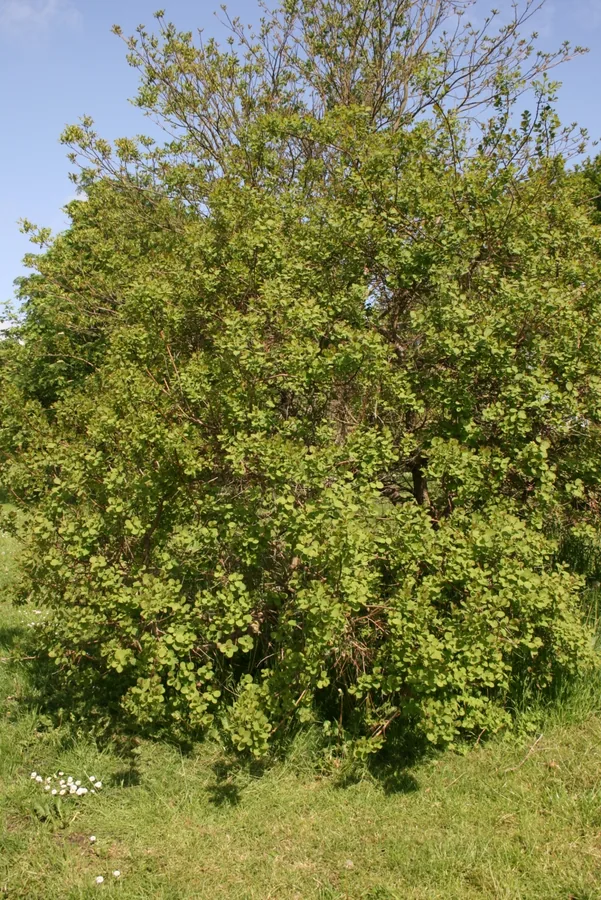
American Smoketree (Tree Form)
Cotinus obovatus
By early summer, hazy smoke-like plumes hover over the branches, and by fall the leaves burn orange, red, and purple.
Full sun
Every 7–21 days
USDA 4–8
20–30 ft · 6.1–9.1 m
Overview
The American smoketree gets its name from what happens in early summer, when loose, airy panicles rise above the branches and hang there like drifting smoke. Trained to a single trunk, it stands 20 to 30 feet (6 to 9 m) tall, taller and more upright in outline than the European smokebush. It sits in the cashew and sumac family, and up close the soft haze of those plumes is unmistakable.
Look closely in summer and the plumes read as a fine, see-through haze held above the leaves, airy enough that the branches show through it. That smoke-like cloud lingers for weeks, softening the whole outline of the crown. It is a slow-growing tree, hardy to -29°F (-34°C), and its trunk and branches build their frame little by little beneath that seasonal veil.
The second act is in the leaves. As the season cools, the foliage shifts into orange, red, and purple, sometimes carrying more than one of those tones across a single crown before the leaves fall. The bare branches left behind sketch the upright frame of a tree that will stand for decades.
Care
The short version: full sun and lean, well-drained soil, with regular water only while the tree is young. Once established it stands up to drought, wants little or no fertilizer, and needs only light pruning to keep its shape.
Light
In full sun the tree carries its heaviest crop of smoke and turns its deepest fall color. In partial sun or light shade the plumes thin out and the autumn tones come in paler, so the difference in sun shows directly on the plant.
Water
While young and rooting in, the tree takes regular water, about every 7 to 21 days by the weather. Once established it is drought tolerant, drawing through dry spells on its own. Wet, soggy soil is the danger, since it opens the way to disease you will later see in the branches.
Soil
The roots take hold in lean, well-drained ground and press into poor, dry, rocky, clay, and even alkaline limestone. Across a wide pH span of 5.5 to 8.5 the tree looks no worse for it, so the soil rarely needs changing.
Temperature
The living wood and buds hold up across a broad range, from -29°F to 100°F (-34°C to 38°C). That span lets the tree keep its form through hard winters and hot summers alike.
Humidity
No particular humidity shows on the plant, since ordinary outdoor air is enough. What you can see the effect of is air movement and dry soil, because in still, damp air the leaves pick up fungal spots and rust.
Feeding
The tree looks its best on hungry soil, so feed lightly or not at all. Heavy feeding dulls the smoke and the fall color, thinning the plumes and washing out the autumn tones, so keep any feeding light and in spring.
Pruning
Prune little and late, at winter's end or in early spring, taking out dead or crossing wood and shaping toward a single trunk. The smoke rides on the previous season's wood, so a hard cut strips away the very branches that would carry the haze.
Repotting
The tree belongs in open ground and seldom needs repotting. In a container, the tell-tale signs to move a young one up are roots circling the edge or pushing out the drainage holes.
Size & spacing
At full size the tree stands 20 to 30 feet (6 to 9 m) tall with a spread to match, a rounded upright crown on a single trunk. Give it that much clear ground so the branches can fill out and air can pass between them.
When to plant
Set the tree out while it is bare and dormant, in spring or fall. The smoke appears in May and June as a haze over the branches and holds through summer, and then, as the days shorten, the leaves take on their orange, red, and purple before dropping.
Northern hemisphere
Southern hemisphere
Typical months for a temperate climate: start earlier in warm zones, later where spring frosts linger.
- Plant: spring or fall
- Harvest: May to June, with the smoky display persisting through summer
Hardiness
USDA hardiness zones: 4–8
Temperature: down to -34°C
Troubleshooting
Most of what troubles this tree shows up plainly on the plant itself, in the branches and the leaves. The two problems below trace back to wet soil or stress, and catching the visible signs early makes a difference.
Whole branches wilting, browning, and dying back
The trouble is verticillium wilt, a soilborne fungus that works up the water-carrying wood until whole branches wilt and die. Cut across a failing limb and the sign is right there: dark streaks staining the sapwood. Nothing cures it, so remove the dead wood well below the streaking, water the tree through drought, and keep a susceptible species out of that soil for good.
Fix:
- Prune out and destroy affected branches well below symptoms
- Keep the tree vigorous with appropriate water during drought
- Do not replant susceptible species in confirmed infested soil
Dark leaf spots and raised orange rust
These are leaf spot and rust fungi, showing as defined spots and small orange pustules across the leaves, mostly on a tree under stress. The marks are only skin deep. Clear the fallen leaves, open the canopy to let air move, and correct whatever stressed the tree, a dry spell or a wet, airless site.
Fix:
- Rake and remove fallen infected leaves
- Improve air circulation and avoid overhead watering
- Reduce plant stress with proper siting and watering
Toxicity
The American smoketree is not toxic to pets or people and stays off the ASPCA poison lists. The one physical hazard is invisible until you cut into it: the sap, shared with its sumac relatives, can leave sensitive skin irritated, so wear gloves when pruning.
Safe for
People · Cats · Dogs · Horses · Rabbits · Livestock · Birds
Cats None
A cat can chew the leaves and take no harm from it, since the tree holds nothing toxic to them.
Dogs None
A dog can mouth a leaf or twig with no poisoning to follow.
Horses Safe
A horse grazing beside the tree is in no danger from it.
Rabbits Safe
Nothing in the leaves will harm a rabbit.
Livestock Safe
Cattle, goats, and sheep take no harm from sharing ground with it.
Birds Safe
Birds among the branches, perched or feeding, face no risk.
People Safe
People face no risk of poisoning, though the sap can leave sensitive skin irritated, which is why gloves are worth wearing to prune.
The plant is in the Anacardiaceae (cashew/sumac) family, and its sap contains urushiol-type compounds that may cause mild contact dermatitis in sensitive people; wear gloves when pruning. This does not affect pet toxicity rating.
Varieties
The smoketrees below differ most in the color of their leaves and their smoke, from the native's fall tones to the deep purples of the European kinds. The three are the ones most often trained into a tree.
Cotinus obovatus (American smoketree, species)
The native species is the largest and most tree-like, its leaves turning a strong orange-red-purple in fall, and it takes readily to dry, rocky, and alkaline ground.
Cotinus coggygria 'Royal Purple'
'Royal Purple' carries purple leaves that deepen to a near-black maroon on a European smoketree, usually multi-stemmed but trainable into a small single-trunk tree.
Cotinus x 'Grace'
'Grace' is a vigorous European-American hybrid with large purple-red leaves and a smoke that comes in showy pink, and it can be grown as a small tree.
How to propagate
A smoketree can be grown from seed, from cuttings, or by layering. Which route fits depends on whether you want the wild species or a named cultivar reproduced exactly.
SeedModerate
Fall (sow outdoors) or stratify for spring · 1-2 growing seasons
Seed is slow work. The seed sits dormant until it gets a cold spell, either sown outdoors in fall or chilled for a spring start, which brings on stronger germination. The species reproduces true from seed, and a seedling takes one to two growing seasons to establish.
Stem cuttingsModerate
Early to mid summer (softwood) · Several weeks to root, then 1-2 seasons
Softwood cuttings pulled in early to midsummer and set under mist root in several weeks, then firm up over the following season or two. Cuttings are the only way to carry a named cultivar's exact leaf and smoke color true to the parent.
LayeringEasy
Spring · 1 growing season or more
Layering is the easiest of the three. A low branch pinned against the soil in spring roots where it lies over a season or more, and is then cut away as a rooted young plant.
Myths
Being kin to poison ivy and poison sumac, the smoketree must be just as poisonous.
The family resemblance stops short of the danger. Cotinus is not listed as toxic to pets and never appears on the ASPCA lists. Only the sap causes trouble, and it can leave sensitive skin irritated, so gloves go on before pruning.
The smoketree looks its best only in rich, fertile, moist soil.
The reverse holds. The tree wants lean, well-drained ground, comes through drought unbothered, and shows its strongest growth on poor, dry, rocky, and alkaline sites. Too much water and fertilizer thin the smoke and fade the fall color.