Tree · Anacardiaceae
Mango
Mangifera indica
Hand a mango heat, sun, and sharply draining soil, and it will cloak a warm garden in leathery leaves and ripening fruit all summer.
Full sun
Every 7–14 days
USDA 10–11
10–49 ft · 3–15 m
Overview
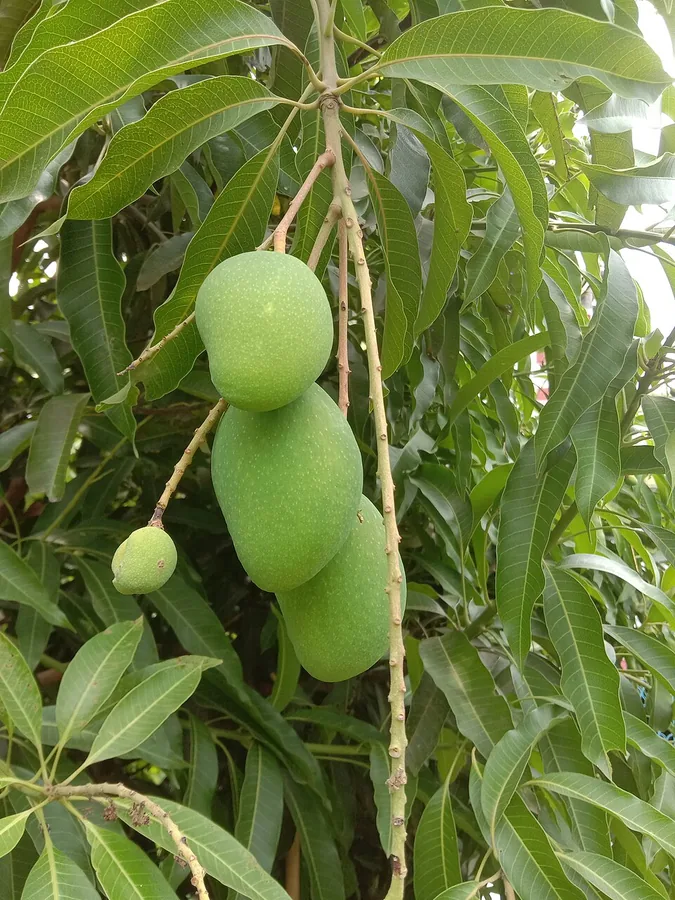
The mango is a large tropical fruit tree that carries its long, leathery leaves the whole year, a dense evergreen crown that can climb 10 to 50 feet (3 to 15 m) on a spread nearly as wide. Through the cool months it throws up airy panicles of tiny flowers above the dark foliage, and through the warmth of late spring and summer those flowers swell into hanging fruit. In the right climate it is a permanent presence, planted once and grown beside for decades.
This is a tree built for real warmth. It fits USDA zones 10 and 11, wants full sun full on its glossy canopy, and needs soil that drains freely, since roots left sitting in wet are one of the few things that will undo it. A young tree drinks steady water as it puts on growth, while a mature one, deep-rooted and thick-leaved, rides out a dry spell and even takes the cool dry stretch before flowering as the signal to break into bloom.
It pays to know the seed you hold in your hand. A grafted named cultivar fruits true to type in a few years, while a tree from a saved stone may take most of a decade and bear fruit unlike the parent. The soft, fragrant flesh is a pleasure to eat, and because the tree sits in the poison-ivy family, its smooth peel, its sap, and its leathery leaves carry an allergen that asks for a careful hand.
Care
The short version: full sun and real warmth, deep well-drained soil, and steady water for a young tree that you ease off as it matures. Feed through the growing season, prune after harvest to keep the leafy canopy open, and never let the roots sit wet.
Light
Mango wants full sun, as much as the day will pour onto its glossy leaves. It will tolerate a bit of partial sun, but light drives strong leafy growth and heavy bloom, so a shaded tree flowers poorly and bears little.
Water
Water a young tree deeply and regularly while it establishes, then ease off as it matures, since an older, deep-rooted mango handles drought well. Hold off water during the cool dry spell before flowering to nudge the panicles out, then resume as the fruit swells. The one thing it will not forgive is waterlogged soil.
Soil
Its roots sink happily into deep, well-drained loam or sandy loam, crumbly and open rather than dense. Mango copes with many kinds of ground but never with soil that stays soggy, and a pH ranging from 5.5 to 7.5 keeps nutrients within reach of the roots.
Temperature
This tropical tree grows across a broad warm band, roughly 32°F to 104°F (0°C to 40°C), but it has no tolerance for hard frost. A freeze blackens young leaves and flowers outright, which is why it is held to zones 10 and 11.
Humidity
Mango likes the air on the humid side, around 50% to 80%, in keeping with its tropical home. Even so, damp, still air clinging to the panicles during bloom is exactly what fungus wants, so airflow matters as much as moisture.
Feeding
Feed through spring and summer while the tree pushes new leaves and fruit, using a balanced fertilizer with micronutrients. A mature mango takes nitrogen along with periodic iron, zinc, and manganese, especially where the soil runs alkaline.
Pruning
Prune after harvest to hold the height down, cut out dead or crossing branches, and open the leafy canopy so light and air reach the center. Tip-prune a young tree to build a sound framework early. Wear gloves, since the sap can irritate skin.
Repotting
A container or dwarf mango wants fresh soil every 2 to 3 years, with a light root-prune at the same time. White roots circling the pot or pushing out the drainage holes, fast drying after a watering, and stalled new growth all say it is time.
Size & spacing
A standard mango is a large tree, reaching 10 to 50 feet (3 to 15 m) tall with a spread of 10 to 40 feet (3 to 12 m) of dense canopy. Give it serious room, well clear of buildings, pavement, and overhead lines, or choose a dwarf cultivar for a small garden.
When to plant
Mango keeps a tropical calendar you can read in its own growth. Slender flower panicles rise in winter to early spring, the green fruitlets that follow swell and ripen from late spring through summer, and the tree goes in the ground in spring once frost is past and the soil has warmed. Where the seasons stay mild and frost-free, that timing reads as a rhythm rather than a deadline.
Northern hemisphere
Southern hemisphere
Typical months for a temperate climate: start earlier in warm zones, later where spring frosts linger.
- Sow: fresh seed started under warmth in spring (seedlings vary; grafted cultivars preferred)
- Plant: spring after all danger of frost has passed and soil is warm
- Harvest: flowers in winter to early spring; fruit ripens late spring through summer
Hardiness
USDA hardiness zones: 10–11
Temperature: down to -1°C
Troubleshooting
Most mango trouble lands on the flower panicles and the pinhead fruitlets during bloom, when wet air and fungus mark the young tissue and decide the crop. Learn to read the spotting and the powder on those panicles and you can step in before the damage spreads. Match what you see below, then act while it still helps.
Dark, sunken pockmarks pitting the blossoms and fruit
Dark, sunken flecks scattered over the flower clusters and long, tear-stained streaks bleeding down the skin of the young fruit are the mark of anthracnose, a fungus that stirs in warm, wet air while the tree blooms. The blackening spreads across panicles, leaves, and fruit and thins the harvest. Opening the canopy by pruning, keeping the flowers dry, and clearing the fallen infected debris all hold it back.
Fix:
- Improve air circulation by pruning
- Apply protective fungicides during flowering and fruit set per label
- Remove and destroy infected plant debris
Chalky white powder coating the blossoms and fruitlets
A chalky white bloom settling like flour over the flower panicles and the pinhead fruitlets signals powdery mildew, which creeps in when the nights turn cool and the days stay dry through flowering. The dusted flowers and tiny fruit darken to black and let go, and the crop is gone before it swells. Watching the panicles as they open and starting sulfur or a labeled spray at the first white haze keeps it in check.
Fix:
- Apply sulfur or labeled fungicides at early bloom
- Repeat applications during flowering as needed
Blossoms in profusion but few fruit taking hold
A tree can carry great sprays of bloom and still shed nearly every tiny green fruitlet when cool, wet, or cloudy weather at flowering stalls pollination and lets disease slip in. The other cause runs deeper: alternate bearing, the tree's habit of resting after a season heavy with fruit. Holding disease off during bloom, feeding in balance without heavy nitrogen, and waiting out the lean years all steady the crop.
Fix:
- Ensure disease control during bloom
- Maintain balanced fertility and avoid excess nitrogen
- Be patient through off-years of alternate bearing
Toxicity
The ripe, juicy flesh is safe and a genuine treat for people, but the rest of the plant asks for respect. Mango sits in the same family as poison ivy, so its smooth skin, its sap, and its leathery leaves carry urushiol, an allergen that can raise an itchy rash on sensitive skin. Around animals the bigger danger is the large, flat, hard pit, a real choking and blockage hazard, so keep stones, peels, and prunings out of reach.
Toxic to
Cats · Dogs · Horses · Rabbits · Livestock · Birds
Safe for
People
Cats Caution
A lick of the soft orange flesh does a cat no harm. The trouble hides in the sap and the smooth peel, which carry the same urushiol that reddens skin and can leave the mouth sore. The large, flat, fibrous pit is the real worry, far too big to pass and able to lodge in the gut, so keep stones and trimmings out of reach.
Dogs Caution
Dogs beg for the sweet, juicy flesh and take a small piece well. The itch begins when one chews the leathery peel or the sap and gets a sore mouth, and the hard, woody pit is worse still, a choking risk or a blockage if it goes down whole.
Horses Caution
A small piece of the peeled fruit sits fine with a horse now and then. The peel and the long, leathery leaves hold irritating urushiol compounds, and the big flat stone is a true choking hazard, so only small, pitted, peeled bites are safe.
Rabbits Caution
A rabbit can nibble a thin sliver of the sugary flesh once in a while, though the sweetness is heavy on a small gut and best kept rare. Leave off the smooth peel and the leaves with their irritating resins, and keep the bulky pit well away.
Livestock Caution
Goats, sheep, and cattle browse the fallen fruit and mostly cope with it. Even so, the urushiol in the peel and leaves can irritate, a bellyful of windfalls brings stomach upset, and the whole hard pits are a choking and blockage risk worth fencing away.
Birds Caution
Many birds tear into the ripe orange flesh, and a little is a fine treat. Keep them off the peel, sap, and leaves with their irritating compounds, and clear away the big pits so a curious bird cannot get hung up on one.
People Flesh safe
The ripe, fragrant flesh is a pleasure and safe to eat. The catch lies in the smooth skin, the sap, and the resin, which carry urushiol, the same allergen as poison ivy, and can raise an itchy rash on sensitive people. Peel with care, wear gloves if your skin reacts, and keep the sap off bare hands.
Mango is in the Anacardiaceae (cashew and poison-ivy family); the sap, peel, and leaves contain urushiol-related compounds (mangol) that can cause contact dermatitis in sensitive people, much like poison ivy. Wear gloves when pruning or peeling, and avoid skin contact with trimmings. The large hard seed/pit is a choking and intestinal-obstruction hazard if swallowed by pets.
Helpline numbers

United States
ASPCA Animal Poison Control: (888) 426-4435 (fee applies)
Poison Control: (800) 222-1222



Canada
Poison Centres: 1-844-764-7669
Varieties
Hundreds of mango cultivars exist, differing in the color, size, and fiber of their fruit, from market workhorses to prized dessert stock. These are the ones you are most likely to meet by name.
Tommy Atkins
The workhorse of the commercial trade, grown everywhere for its firm flesh, its good disease resistance, and the toughness to ship well.
Kent
A late-season favorite for fresh eating, its flesh sweet and nearly free of fiber.
Haden
A historic Florida cultivar known for its brightly colored fruit, though it leans toward anthracnose and tends to bear in alternate years.
Alphonso
The celebrated Indian dessert mango, treasured for flesh that is rich and deeply aromatic, yet it takes frost damage quickly.
Keitt
A large, late-ripening mango whose nearly fiberless flesh hangs well on the tree.
How to propagate
There is more than one way to start a mango, and the method decides how soon it fruits and how true it comes. Grafting and air-layering give a known, faster-bearing tree, while the large flat seed is the easy but patient route.
GraftingModerate
Warm season when bark slips and rootstocks are actively growing · Grafted trees commonly begin fruiting in about 3-4 years
Grafting is the standard commercial way to raise a mango, setting a veneer or cleft scion against seedling rootstock in the warm season, when the bark slips loose from the wood and the stock is in growth. The reward is a tree that comes true to type and starts bearing in roughly 3 to 4 years, years ahead of a seedling.
Air layeringModerate
Warm growing season · Roots form over several weeks to a few months before severing
Air-layering clones a chosen tree onto its own roots, a good option when you want a copy of a favorite. Worked in the warm growing season, the wrapped branch pushes fresh white roots out through the wrapping over several weeks to a few months before it is severed, though it is chosen less often than grafting.
SeedEasy
Sow fresh seed promptly in spring as viability is short · Seedlings can take 5-8 years or more to fruit and may not be true to type
Seed is the easy route, but the large flat mango stone loses viability fast, so sow it fresh in spring as soon as you can. Expect a long wait of 5 to 8 years or more before fruit, and be ready for surprises, since polyembryonic seeds often come up as clones of the parent while monoembryonic ones throw variable hybrids.
Myths
A plant bearing edible fruit must be entirely safe to touch.
Mango belongs to the poison-ivy family, and its sap, its smooth peel, and its leathery leaves carry urushiol-related compounds that can raise an itchy rash on sensitive people. The flesh is safe to eat, but the peel and the rest of the plant deserve a careful hand.
A seed saved from a ripe mango sprouts a tree whose fruit mirrors the parent, and fast.
A monoembryonic seed gives a variable seedling that can take many years to fruit, so what grows may look nothing like the fruit you ate. Grafted named cultivars fruit true to type and far sooner, while polyembryonic seeds can come up as clones of the parent.