Shrub · Anacardiaceae
Smoke Bush
Cotinus coggygria
Give it full sun and sharp drainage, and smoke bush fills with fine pink hairs and leaves that burn orange and red.
Full sun
Every 7–14 days
USDA 4–8
10–15 ft · 3–4.6 m
Overview
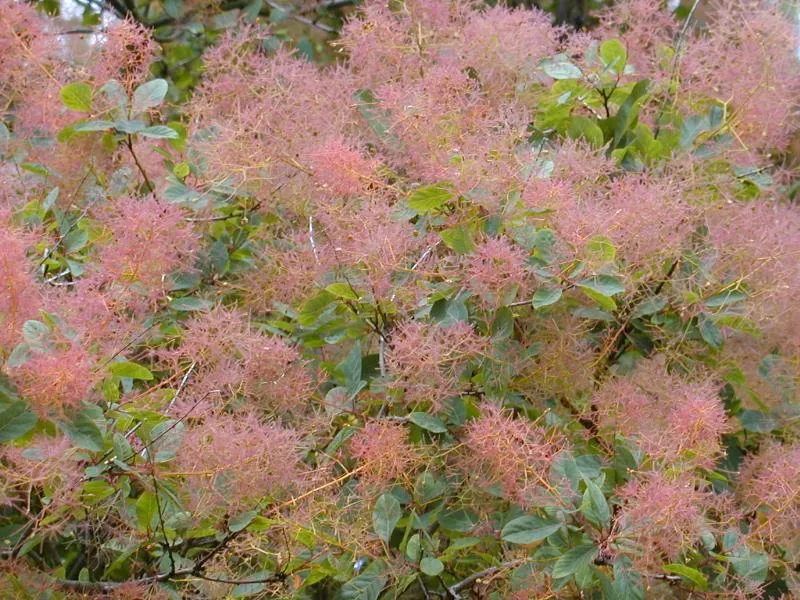
Up close, a smoke bush is all color and soft texture. It is a fast-growing deciduous shrub in the cashew and sumac family, its many stems branching out into a broad, leafy mass that can swell to 10 to 15 feet (3 to 4.5 m) across and tall. The leaves crowd the branches thickly, in tones that run from a plain soft green to a purple so deep it reads nearly black.
The famous haze is not what it seems. The true flowers are tiny and yellowish, barely a speck against the foliage, but once they fade their stalks draw out into long, fine hairs. Massed together, these billowy pink hairs form the plumes that hang over the shrub, shading from smoky pink to a soft purplish pink as summer goes on.
By autumn the whole plant changes coats. The leaves warm into oranges and reds before they fall, leaving the bare, woody stems standing through winter. The spent plumes, meanwhile, dry into fluffy seed heads that cling on well past the last of the leaves.
Care
The short version: set it in full sun with lean, sharply drained soil, and soak it deeply only while it roots in. After that the shrub carries drought on its own, seldom wants feeding, and needs just the pruning that decides between a haze of pink hairs and a flush of colored leaves.
Light
In full sun the leaves reach their deepest color and the hairs their fullest, thickest haze. Partial sun is tolerated, but under real shade the purple cultivars slide back toward green and the plumes grow thin and sparse.
Water
While the roots take hold, the soil should stay evenly moist through the establishing weeks. Once settled the shrub is drought tolerant, happiest with a deep soak every 7 to 14 days rather than constant damp. Standing water in poorly drained ground is what rots its roots.
Soil
This shrub wears lean ground well. Average, well-drained loam suits it, and it holds its color even in poor, rocky soil that would starve a hungrier plant. The pH can range widely, from 5.5 to 8.0, so long as water drains sharply away from the roots.
Temperature
The wood and buds endure a broad span, from -29°F to 95°F (-34°C to 35°C), deep cold at one end and hard summer heat at the other. That toughness lets the shrub color up reliably across temperate gardens.
Humidity
Plain outdoor air suits the foliage, so humidity needs no adjusting. Air moving through the branches counts for more, since still, damp air packed around the leaves is where spots and rust take hold.
Feeding
The shrub grows lush enough on little. A thin spring feeding of balanced fertilizer is the most any plant needs, and most need none, since rich ground pushes soft, leggy stems in place of tight, well-colored growth.
Pruning
The knife sets what the plant will show. A light early-spring trim keeps the hairy summer plumes, which rise only on old wood. To force the darkest leaf color on a purple cultivar, coppice hard in late winter to 6 to 8 inches, giving up the plumes that year for a burst of vivid new shoots.
Repotting
Smoke bush is a large ground shrub and rarely sits in a pot. In a container it shows its limits plainly, sending roots circling the walls or letting water rush straight through once it has filled the space.
Size & spacing
It grows into a wide, dense shrub, filling 10 to 15 feet (3 to 4.5 m) in both height and spread. Set it well back from paths, walls, and smaller plants so its spreading stems have room to reach their full size.
When to plant
Hardy through zones 4 to 8, smoke bush goes into the ground in spring or fall once hard frost has passed. Its tiny flowers open May to July, mere yellowish specks at first, and only afterward do their stalks lengthen into the fine hairs that build the summer haze.
Northern hemisphere
Southern hemisphere
Typical months for a temperate climate: start earlier in warm zones, later where spring frosts linger.
- Plant: Spring or fall, after the last hard frost
- Harvest: Smoke display from late spring through summer (flowers May to July)
Hardiness
USDA hardiness zones: 4–8
Temperature: down to -34°C
Troubleshooting
A vigorous smoke bush shows trouble on its own surfaces first. Wilt darkens and drops the leaves on a branch, spots freckle the foliage, and hard crusts pebble the bark. Look closely at leaves and stems, then match what you see below.
Leaves wilting and browning on one side
Leaves that suddenly wilt, yellow, and brown on a single side signal verticillium wilt, a soil fungus that clogs the water-carrying tissue inside the stems until whole limbs collapse. Cut into a dying stem and dark streaks show in the pale wood beneath the bark. Nothing sprayed on it will help, so the dead wood is cut away, tools are wiped clean between cuts, and a plant too far gone is dug out rather than followed by another in the same soil.
Fix:
- Prune out and destroy affected branches, disinfecting tools between cuts
- Improve drainage and avoid overwatering
- Remove and destroy severely infected plants; do not replant susceptible species in the same spot
Gray crusts pebbling the bark
The tiny gray-to-brown bumps crusting the stems are San Jose scale, sap-feeding insects sealed under a hard round shell that dulls and weakens the wood. Slide a fingernail under one and the shell lifts free. The worst-crusted branches are cut out, and the rest are coated in a dormant horticultural oil in late winter to smother the scale before it stirs.
Fix:
- Prune out and destroy heavily infested branches
- Apply dormant horticultural oil in late winter to smother overwintering scale
Spotted leaves and orange pustules beneath
In damp, crowded growth the leaves pick up leaf spot and rust, marked with defined dark spots on top and small orange-brown pustules on the undersides. The blemishes look worse than they are and rarely weaken a settled shrub. The fallen leaves are raked away, the branches opened for air, and water kept off the foliage.
Fix:
- Rake up and dispose of fallen infected leaves
- Improve air circulation and avoid overhead watering
Toxicity
Beyond its looks, smoke bush is not toxic. It appears on none of the ASPCA's poison lists, and no animal needs to be kept from its leaves or stems. Only the sap carries a small risk for people, raising a mild rash on skin that reacts to poison ivy, so gloves are worth wearing when you cut into it.
Safe for
People · Cats · Dogs · Horses · Rabbits · Livestock · Birds
Cats None
Smoke bush appears on no ASPCA toxic list, so a cat mouthing one of its leaves takes no harm at all.
Dogs None
A dog can push its nose through the branches or chew a leaf freely, since nothing in the foliage is toxic to it.
Horses Safe
No horse poisoning has ever traced back to smoke bush, so a mouthful stripped from a low branch is harmless.
Rabbits Safe
Rabbits gnawing the lowest, tender stems come away unharmed, as the plant holds no compound that hurts them.
Livestock Safe
Cattle, goats, and sheep can crop the shrub or graze beside it with no trace of poisoning.
Birds Safe
Birds threading through the branches to nest or feed are untouched by the leaves, the stems, or the fluffy seed heads.
People Safe
The leaves and stems are safe to handle, but the sap can raise a mild rash on skin that reacts to poison ivy, so gloves belong on your hands at pruning time.
As a member of the Anacardiaceae (cashew and sumac family), contact with the sap may cause mild contact dermatitis in sensitive people, especially those allergic to poison ivy. Wear gloves when pruning if you are sensitive.
Varieties
Almost every smoke bush sold is a named cultivar, picked for the exact color of its leaves or the density of its smoky hairs. These are the ones you will see most, each with its own look.
Royal Purple
A compact form whose leaves emerge a warm maroon-red in spring, then darken to a purple so deep it looks nearly black and stays that rich through summer.
Golden Spirit ('Ancot')
A cultivar clothed in bright golden-yellow leaves that shift to orange and red in fall, glowing far paler than the green and purple forms.
Young Lady
A compact, green-leaved form smothered in dense clouds of fine smoky panicles, thrown even while the plant is still small.
Velvet Cloak
A bigger shrub carrying deep purple leaves and large, soft pink panicles, its stems capable of reaching the top of the size range.
How to propagate
Smoke bush can be raised a few ways, though only cuttings and layers copy a cultivar's leaf color and form exactly. For a plant or two more, layering the shrub's own low, flexible stems is the surest route.
Stem cuttingsModerate
Early to mid summer · Several weeks to root; a full season to establish
Soft new or firmer semi-hardwood shoots from the current season root as cuttings taken in early to mid summer. Roots form over several weeks, and a full growing season passes before the young plant is truly settled.
LayeringEasy
Spring to early summer · One growing season or more to root
Layering works the shrub's own low, bendable stems in spring or early summer. A branch is pinned down against the soil, where it roots along its length over a season or more before it is severed from the parent.
SeedModerate
Fall sowing or after cold stratification · Slow; seedlings of cultivars will not come true to type
Seed suits the plain species rather than the colored cultivars, sown in fall or after a spell of cold. Germination is slow, and seedlings from named forms lose the parent's exact leaf color, so those are grown from cuttings or layers.
Myths
The pink smoke is a mass of open flowers.
The flowers themselves are minute and yellowish, all but invisible among the leaves. The smoke is really their spent stalks, drawn out into long, fine hairs that mass into feathery plumes and color from smoky pink to purplish pink through the summer.
Cutting hard every spring makes the thickest smoke.
The hairy plumes form only on old wood, so a hard yearly cut leaves you with leaves and no haze. A late-winter coppice trades the plumes for the deepest leaf color that season, which is why the darkest purple cultivars are so often grown for foliage alone.