Tree · Malvaceae
American Basswood
Tilia americana
A broad-crowned shade tree hung with small, pale-yellow flowers that scent the summer air.
Full sun
Every 7–14 days
USDA 3–8
60–80 ft · 18.3–24.4 m
Overview
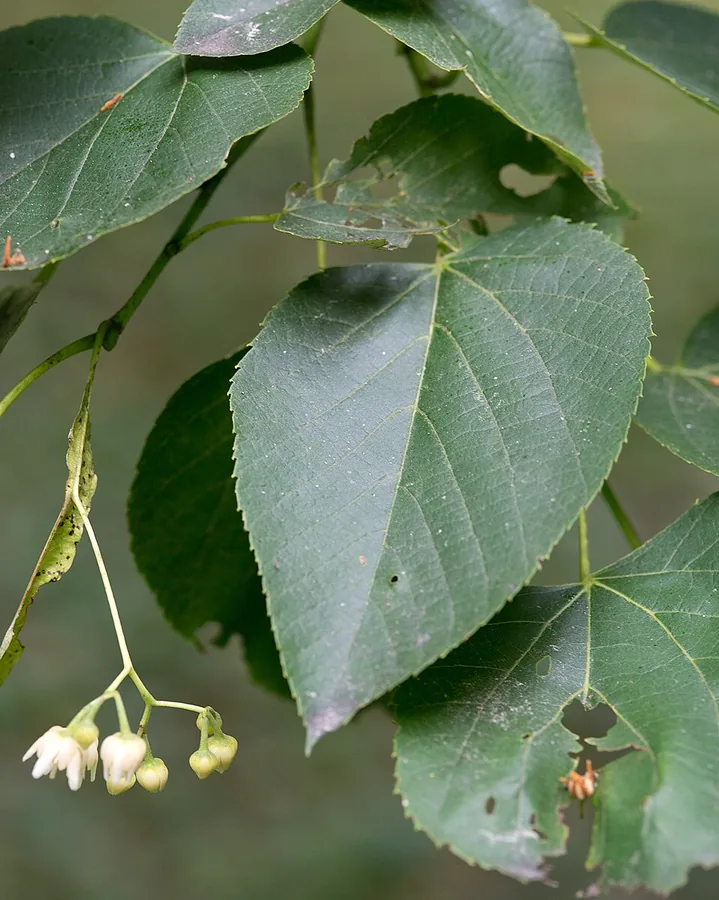
American basswood, the tree most call linden, carries large heart-shaped leaves that overlap into a broad, rounded crown and cast a deep pool of shade. In late spring and early summer the branches hang with clusters of small, pale-yellow flowers whose fragrance drifts on the air, and the humming of pollinators around them is what earned the name bee tree. A mature trunk lifts the whole canopy to a towering 60 to 80 feet (18 to 24 m).
The leaves are the tree's signature, wide and soft with the clean heart shape that names so many lindens. Beneath the bark lies the pale, soft, light basswood wood that gave the tree both its common name and its long history in the hands of carvers. It is a tree for the long haul, hardy through cold winters and easy in full sun or part shade.
Watch the summer canopy and the small flowers give way to the sticky shine of aphid honeydew, a wet-looking film that drips from the leaves onto whatever sits below. It marks nothing wrong with the tree, but it is worth seeing before a patio or a parked car ends up under that wide crown.
Care
The short version: full sun to part shade in moist, well-drained soil, with steady water while the tree is young and little else once it settles in.
Light
Linden grows best in full sun, where the broad crown fills in dense and the pale flowers come thick, and it takes partial shade in stride. A shadier spot leaves the canopy looser and more open, but still healthy.
Water
A young tree stays evenly moist, watered every 7 to 14 days through dry stretches. Once established it stands some drought, but it always leafs out fuller with steady moisture, so long dry spells are best avoided.
Soil
The roots take clay, loam, or sand alike, so long as the ground stays medium-moisture and well-drained. A pH anywhere from 5.5 to 8.0 suits the tree, which covers most garden soils.
Temperature
This is a cold-hardy tree, at home from -40°F to 100°F (-40°C to 38°C). Its bark and buds carry harsh winters and hot summers alike, which is why it grows across so much of the country.
Humidity
Outdoor humidity is no concern for a linden, so there is no figure to meet. Air moving through the canopy matters more, since still, damp air among the leaves is what brings on leaf spots and mites.
Feeding
An established tree in decent soil rarely needs feeding. Where the new growth is thin and weak, a balanced slow-release tree fertilizer goes on in early spring, kept light, since too much nitrogen only feeds the soft growth aphids crave.
Pruning
Pruning comes in late winter to early spring, shaping one strong central leader and clearing dead, damaged, or crossing branches. Around the base the tree pushes up suckers and sprouts, which come off as they appear.
Repotting
Linden is a landscape tree, not a pot plant, so repotting drops away once the roots are in the ground. A nursery tree with roots circling the container or pushing out the drainage holes should be planted out before those roots wind tight.
Size & spacing
The tree needs real room. Its trunk carries the crown to 60 to 80 feet (18 to 24 m) tall while the branches reach 30 to 60 feet (9 to 18 m) wide. A site well clear of buildings, walls, and overhead lines lets that broad, rounded crown fill out.
When to plant
Linden is a tree, so there is no yearly sowing season to watch. Young trees go out in spring or fall, once the hard frosts have passed, and the small fragrant flowers open on their own from late spring into midsummer.
Northern hemisphere
Southern hemisphere
Typical months for a temperate climate: start earlier in warm zones, later where spring frosts linger.
- Plant: Spring or fall, after the threat of hard frost has passed
- Harvest: Fragrant pale-yellow flowers in late spring to early summer (May to July)
Hardiness
USDA hardiness zones: 3–8
Temperature: down to -40°C
Troubleshooting
A healthy linden mostly keeps itself, and most of what marks the leaves is cosmetic. Match the signs on the foliage below before reaching for any treatment, since a large tree carries pest damage that would set back a smaller plant.
Drooping limbs with sawdust and round holes low on the trunk
The linden borer cuts galleries through the wood of the lower trunk and limbs, and it leaves neat round exit holes ringed by pale, sawdust-like frass where it has worked. Any limb it has entered comes out and is destroyed. Borers single out stressed trees, so a well-watered trunk with bark unmarked by mowers and trimmers holds them off, and a trunk that is hit calls for an arborist.
Fix:
- Prune out and destroy borer-infested limbs
- Keep the tree vigorous, as borers preferentially attack stressed trees
- Consult an extension office or arborist for severe trunk infestations
A glossy stickiness on the leaves and a sooty black film after
That wet-looking gloss on the leaf surface is aphid honeydew, and the black that spreads over it is a harmless sooty mold feeding on the sugar. Heavy aphid colonies, at times with scale insects among them, let the sticky film fall over everything beneath. A hard jet of water washes the soft-bodied clusters off, lady beetles and lacewings pick off the rest, and the black lifts once the honeydew dries.
Fix:
- Hose aphids off with a strong jet of water
- Encourage beneficial predators such as lady beetles and lacewings
- Apply insecticidal soap or horticultural oil to accessible foliage for severe infestations
- Sooty mold disappears on its own once the honeydew source is controlled
Leaves eaten to a lacy veinwork through summer
The soft green tissue vanishes and only the fine vein network hangs on, the tell of Japanese beetles feeding from June to August. Look closely and the culprits are metallic green and copper beetles clustered on the upper leaves. On a young tree, they knock into soapy water in the cool early morning. A large established linden fills the gaps with fresh leaves and shrugs it off, and pheromone traps only pull in more.
Fix:
- Hand-pick or knock beetles into soapy water in the early morning on smaller trees
- Tolerate damage on large established trees, which recover
- Avoid Japanese beetle pheromone traps, which attract more beetles
Foliage stippled with fine specks, spots, or brown edges
A close look at a dulled leaf turns up the cause. Lace bugs, basswood thrips, or spider mites pit the surface with pale stippling and dot the underside with dark fecal specks, while fungal leaf spots print discrete brown lesions across the blade in wet seasons. Raked-up leaves cut the spore load, a rinse over the canopy in dry spells strips the mites, and the marks that remain are cosmetic.
Fix:
- Rake and dispose of fallen leaves to reduce fungal spores
- Hose down foliage to dislodge mites in dry spells
- Most leaf spot is cosmetic and needs no treatment
Toxicity
For a home with pets, linden is completely safe. The ASPCA lists it as non-toxic to cats, dogs, and horses, and no part of the tree, leaf, bark, or flower, holds a poisonous compound. The small fragrant flowers are even dried for a calming tea, and the young leaves are tender enough to eat.
Safe for
People · Cats · Dogs · Horses · Rabbits · Livestock · Birds
Cats None
The ASPCA lists linden as non-toxic to cats, so a curious nibble at a low leaf is nothing to fear. A large mouthful of any plant can bring a little passing stomach upset, but the tree holds no poison.
Dogs None
Dogs are safe here as well, with no toxic principles in the leaves, the bark, or the flowers. A dog that gnaws on a fallen twig comes to no harm.
Horses None
Horses can browse the soft foliage without harm, and the species holds its place on the ASPCA non-toxic list for them. The young leaves and the pale flowers are safe forage.
Rabbits Safe
Rabbits can chew the leaves and thin twigs with no toxic risk. Linden is a common browse plant, and the tender spring growth is entirely safe for them.
Livestock Safe
Cattle, goats, and sheep can graze the leaves safely, as the tree holds nothing that would trouble them. Linden has long been cut for fodder without incident.
Birds Safe
Birds nest deep in the leafy crown and forage around the flowers with no danger. The seeds and buds carry no toxic threat.
People Safe
Linden is safe for people, and the small fragrant flowers are dried for a soothing tea while the young leaves are tender enough to eat raw. No part of the tree needs avoiding.
No special handling precautions; honeydew from aphids can make surfaces under the tree sticky but is not toxic.
Varieties
Lindens take a few distinct forms, from compact native selections to a silver-leaved cousin whose foliage flashes pale in the wind. These are the ones you meet most in yards and along streets.
Tilia americana 'Redmond'
A tighter, more pyramidal form of the native tree that reaches about 40 to 60 feet, its neat upright outline suiting it to formal shade and street rows.
Tilia cordata 'Greenspire'
A littleleaf linden carrying small heart-shaped leaves of just 1 to 3 inches packed into a dense oval crown, a tough, city-proof street tree across Europe and beyond.
Tilia tomentosa
The silver linden holds dark green leaves whose undersides are coated in white wool, flashing pale each time a breeze rolls the foliage over so the whole tree seems to shimmer.
How to propagate
Linden starts several ways depending on the aim, from the slow seed to grafting that holds a named form to the suckers the tree throws up around its base.
SeedDemanding
Sow cleaned seed outdoors in fall, or stratify for sowing in spring · 1-2 years or more to germinate
Each linden seed wears a hard, tough coat over a double dormancy, which makes it a slow one to raise. Even after warm-then-cold stratification the seeds may lie one to two years before the first shoots break, and they rise slow and uneven. Cleaned seed goes outdoors in fall, or gets stratified for a spring sowing.
GraftingDemanding
Late winter for bench grafting or summer for budding · 1 growing season to take
Named cultivars such as 'Redmond' and 'Greenspire' will not come true from seed, so a scion of the wanted form is joined to seedling rootstock. Bench grafting is done in late winter and budding in summer, and the graft knits into a firm union across one growing season.
LayeringModerate
Spring · 1-2 years to root
Basswood throws up its own sprouts and suckers from around the base, ready-made clones of the parent. In spring, a low branch is pinned against the soil to layer, or a rooted sucker is lifted, and it spends one to two years growing a root system of its own before it moves.
Myths
Linden trees are poisonous to dogs and cats.
The ASPCA lists linden as non-toxic to dogs, cats, and horses, with no toxic principles in any part of the tree. A pet that swallows a lot of any plant might feel a mild stomachache, but there is nothing poisonous about a linden.
The sticky black coating on basswood leaves is a disease that is killing the tree.
The dark film is aphid honeydew wearing a harmless sooty mold that lives on the sugars. It looks grim on the leaf surface, but it is purely cosmetic, and it clears once the aphids are handled. Wipe it and the leaf beneath is still green and sound.