Shrub · Malvaceae
Rose of Sharon
Hibiscus syriacus
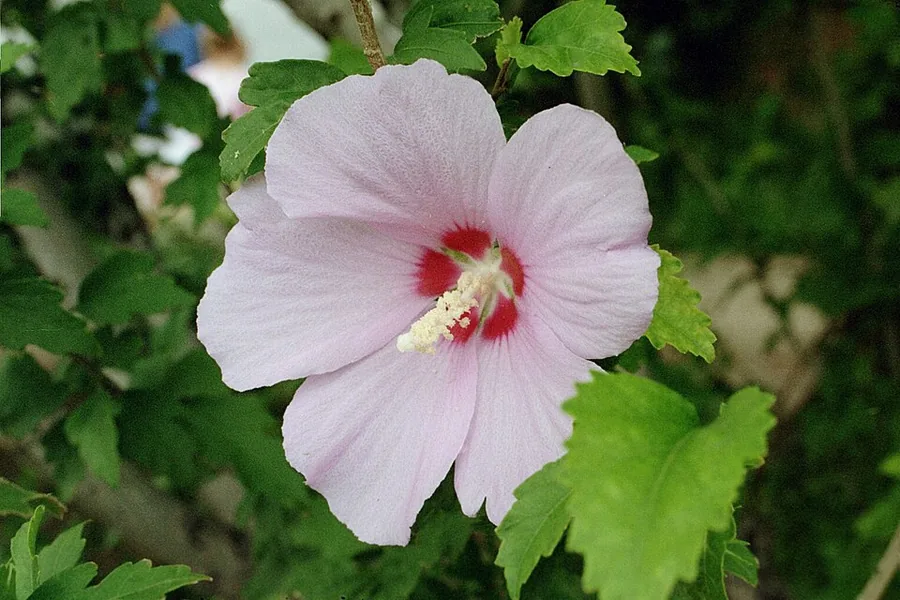
Broad, hibiscus-shaped flowers with a dark eye at the throat, opening fresh from midsummer into fall.
Full sun
Every 7–14 days
USDA 5–9
8–12 ft · 2.4–3.7 m
Overview
Up close, Rose of Sharon reads as a tall, upright deciduous shrub hung with broad, hibiscus-shaped flowers that open one after another from June into October. Each bloom spreads into a wide, open face in white, pink, lavender, or a deep violet-blue, and most are marked at the center by a contrasting eye sunk into the throat. The flowers keep coming in fresh succession, so the shrub carries new color day after day rather than a single flush.
Its frame is upright and fast-filling, climbing to 8 to 12 feet (2.4 to 3.7 m) on woody, branching stems that hold the flowers well above eye level. The plant is built to take punishment, standing through heat, humidity, drought, and poor soil, and it holds firm in cold down to -20°F (-29°C). That sturdy, close-branched form is what lets it read as a solid screen of foliage and bloom.
After the flowers fade, the shrub sets seed in abundance, so freely that it is listed as invasive in a few states and volunteer seedlings crowd in around the base. A sterile triploid like Diana carries the same broad, open flowers but sets almost no seed, so it does not throw those seedlings.
Care
The short version: set it in full sun and well-drained soil, keep the water steady for its first season or two, then cut the bare stems back hard in late winter to bring on the largest, broadest flowers.
Light
In full sun the shrub covers itself with the most of those broad, open flowers. It still blooms in partial sun or light afternoon shade, though more sparingly, with more bare stem showing between the flowers.
Water
While it is young, its roots are still shallow, so regular, deep watering keeps the foliage full and the growth steady. Once established, after a season or two, it turns drought tolerant and holds its leaves and flowers on medium moisture and rainfall through all but the driest weather.
Soil
It takes root in average, well-drained ground of almost any pH, and even in thin, poor soil the stems still fill out. What it cannot stand is soggy ground, one of the few conditions that visibly sets it back, since wet roots undo the rest of the plant.
Temperature
The bare stems and the roots below take a punishing range, from about -20°F to 100°F (-29°C to 38°C). Through the heat and humidity of summer the flowers keep opening, and hard winter cold leaves the woody frame standing to leaf out again.
Humidity
Ordinary outdoor humidity leaves the plant untouched, so there is no level to watch. What shows on the leaves instead is air movement: in still, crowded air the foliage stays damp and picks up the leaf spots and rusts that speckle it.
Feeding
In fair soil the plant fills out on its own and needs little feeding. A single feed of balanced general-purpose fertilizer in spring keeps the growth firm, while heavy nitrogen pushes soft, floppy shoots that curl under aphids.
Pruning
The flowers form on new wood, the fresh stems of the current year, so late winter or early spring, before the buds swell, is the time to cut. Taking the bare stems down to 2 or 3 buds trades a crowd of small flowers for a few large, broad-faced ones.
Repotting
In a pot the roots eventually fill the space and start to show it: roots circling the rootball or pushing out the drainage holes, water running straight through, and growth that stalls in the pot. Those are the cues to shift it to a larger container.
Size & spacing
This is a fast, upright grower, its woody frame reaching 8 to 12 feet (2.4 to 3.7 m) tall and spreading 6 to 10 feet (1.8 to 3 m) across. Set at that spacing, air slips between the plants and the leaves dry quickly after rain.
When to plant
Rose of Sharon leafs out late, its bare winter stems slow to green up in spring, then it packs the second half of the season with flowers from June into October. Set new plants out in spring once frost has passed, or in early fall, and cut back the leafless stems in late winter before the buds swell.
Northern hemisphere
Southern hemisphere
Typical months for a temperate climate: start earlier in warm zones, later where spring frosts linger.
- Sow: late winter to early spring (8-10 weeks before last frost)
- Plant: spring after last frost, or early fall
- Harvest: June to October (mid to late summer)
Hardiness
USDA hardiness zones: 5–9
Temperature: down to -29°C
Troubleshooting
Nearly everything that troubles this shrub shows on its surface, in the leaves and the buds, where you can see it plainly. The pests and spots below announce themselves in chewed, curled, spotted, or yellowing tissue, so a close look over the plant in summer reads the signs early.
Leaves eaten down to a lacy skeleton
The leaves go lacy because Japanese beetles eat the soft green tissue and leave the fine vein network behind, so the foliage turns to a see-through skeleton. The beetles themselves are unmistakable, hard-shelled and metallic green washed with copper, clustered on the leaves in the warmth of the day. Pick them off by hand early in the morning into soapy water, and pass on the pheromone traps, which pull in more beetles than they hold.
Fix:
- Hand-pick beetles in early morning and drop into soapy water
- Avoid pheromone traps that attract more beetles
- Treat heavy infestations with an appropriately labeled insecticide following directions
Curled, glistening tips crawling with insects
The new shoots curl and twist because aphids, and sometimes tiny white flies, cluster on the softest growth and coat it in a clear, sticky honeydew that later blackens into sooty mold. A hard jet of water knocks the crowd loose, and insecticidal soap clears the ones that cling on. Left alone, lady beetles and other predators pick the shoots clean.
Fix:
- Dislodge aphids with a strong spray of water
- Apply insecticidal soap or horticultural oil to affected growth
- Encourage natural predators such as lady beetles
Plump buds yellowing and dropping unopened
The buds swell, then turn a sickly yellow and fall while still closed, a pattern called bud drop that traces to dry spells or uneven watering rather than disease. The rest of the plant looks perfectly green and sound; only the buds let go, and only when the root zone keeps swinging from wet to dry. Even moisture through bud set and the hot weeks, held by a layer of mulch, keeps them plump and holding.
Fix:
- Maintain even soil moisture, especially during bud set and hot weather
- Mulch to conserve moisture and buffer soil temperature
- Avoid letting the root zone dry out completely while flowering
Foliage freckled with spots and a stem or two sunken and dead
The leaves pick up fungal leaf spots, blights, and rusts as discrete spots, dead brown blotches, and rust-colored pustules, and now and then a canker sinks a dark, dead lesion into a stem. Wet foliage and still, crowded air are what let it spread. Strip the marked leaves, cut out the cankered wood, and open the plant up so air moves and the leaves dry fast.
Fix:
- Remove and dispose of affected leaves and prune out cankered stems
- Improve air circulation and avoid overhead watering
- Apply a labeled fungicide only if problems are severe
Toxicity
Every part of this shrub, the broad flowers, the leaves, the stems, is non-toxic across the board. The ASPCA lists it as safe for cats, dogs, and horses, and the flowers are edible for people, raw or steeped. Nothing on the plant needs to be kept out of reach.
Safe for
People · Cats · Dogs · Horses · Rabbits · Livestock · Birds
Cats None
Cats are safe. A bitten leaf or petal might bring a brief upset stomach from the raw roughage, and nothing worse.
Dogs None
The ASPCA marks it non-toxic to dogs, so a mouthful chewed off in curiosity does no harm.
Horses None
Horses are unharmed as well, and cropping a few leaves carries no special risk.
Rabbits Safe
Rabbits can nibble the leaves safely, though any new food is best fed in small amounts at first.
Livestock Safe
The foliage holds no toxins of concern for cattle, goats, or sheep that graze past it.
Birds Safe
Backyard and wild birds come to no harm around it, and many dip into the open flowers for nectar.
People Safe
People are safe too, and the flowers themselves are edible, eaten raw in a salad or steeped into tea.
No special handling precautions for toxicity; as with any plant, ingestion of large amounts of plant material may cause mild, transient stomach upset.
Varieties
The named selections split along flower color and form, from wide-open singles to packed, ruffled doubles. Look closely and each one shows a different face.
Diana
Diana opens broad, pure white single flowers that stay spread wide into the evening, and as a sterile triploid it sets almost no seed.
Blue Bird (Oiseau Bleu)
Blue Bird, also labeled Oiseau Bleu, shows large single flowers in a true violet-blue, each face centered on a sharp red eye.
Minerva
Minerva colors up in soft lavender-pink, with a reddish-purple eye staining the base of the throat.
Aphrodite
Aphrodite carries dark pink single flowers, each broad face anchored by a deep red center.
Red Heart
Red Heart rings a prominent red center with crisp, clean white petals.
Lavender Chiffon
Lavender Chiffon opens lavender semi-double flowers of anemone form, ruffled at the heart by an extra layer of inner petals.
How to propagate
How a new plant looks depends on how it is made. Cuttings and layering carry the parent's exact flower color into the offspring, while seed scatters the traits and often changes the color entirely.
Stem cuttingsEasy
Softwood cuttings in late spring to summer; hardwood cuttings in late fall to winter · Several weeks to root; transplantable the following season
Cuttings grow into an exact copy, right down to the parent's flower color. Softwood cuttings pulled in late spring or summer, or firmer hardwood cuttings taken from late fall into winter, strike roots over several weeks. Grown on, the young plants are ready to lift and move the following season.
SeedEasy
Sow late winter to early spring; the species also self-seeds outdoors · Germinates in a few weeks; flowers in 2-3 years
Seed sprouts easily but slowly, and the seedlings almost never carry the parent's exact flower color, so the blooms come out a surprise. Sown from late winter to early spring, the seed germinates within a few weeks, but a seedling needs 2 to 3 years to reach its first flowers. Outdoors the shrub scatters its own seed freely, seeding itself around more than a gardener may want.
LayeringEasy
Spring to summer · One growing season to root before separating
Layering roots a stem while it is still attached to the plant. A low branch bent down to the soil in spring or summer and pinned in place forms its own roots over a single season, and only then is it severed and lifted as a plant of its own.
Myths
Rose of Sharon is toxic to dogs and cats.
The plant carries no such danger. The ASPCA lists Hibiscus syriacus as non-toxic to dogs, cats, and horses, so a pet that bites into a leaf or one of the broad flowers is unharmed, and the flowers are even edible for people. At most, a mouthful of any plant leaves a brief stomach upset behind.
Cutting Rose of Sharon back in summer or fall brings more flowers.
The cut does the reverse. The flowers form on new wood, the stems the plant grows this season, so a summer or fall cut takes off the very wood the buds would rise from. Cut instead in late winter or early spring before growth begins, and reducing the stems to 2 or 3 buds swaps quantity for a few larger, broader blooms.