Ornamental · Malvaceae
Hardy Hibiscus
Hibiscus moscheutos
Give it full sun and soil that never dries out, and hardy hibiscus unfurls dinner-plate flowers all summer.
Full sun
Every 2–4 days
USDA 4–9
3–7 ft · 0.9–2.1 m
Overview
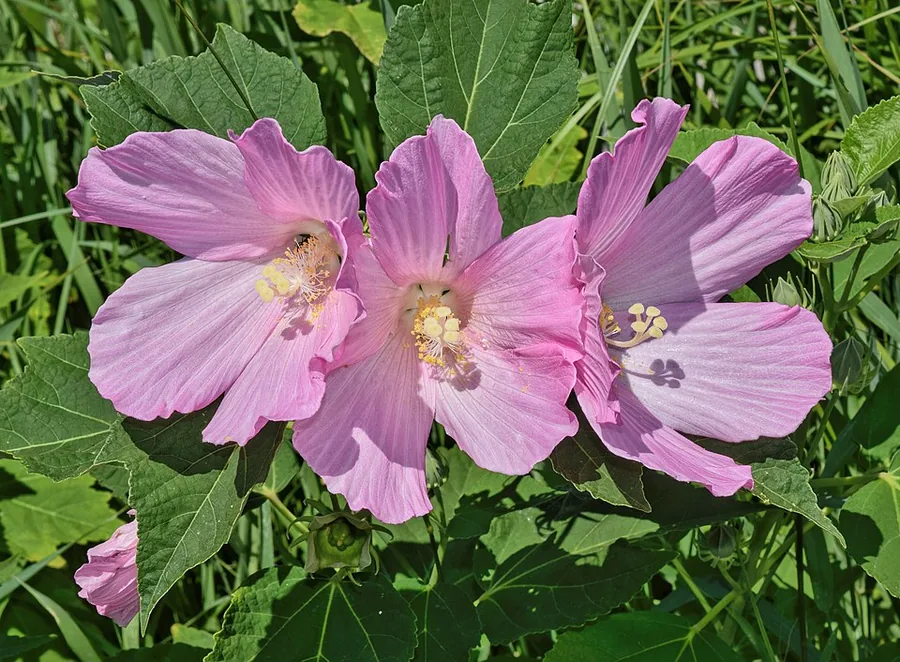
Hardy hibiscus opens flowers so broad they match the face of a dinner plate, five wide petals spreading flat around a central column. For all that soft, tropical bulk in the bloom, the plant beneath is a tough native perennial that holds through cold down to -20°F (-29°C). It belongs to the mallow family and grows wild in marshes and wet meadows, an origin that shapes everything it asks for.
A single open flower lasts only a day or two before it furls and drops, its petals soft and short-lived. Yet a mature clump can unfold 20 or more of these wide blooms in a day through the heat of summer, so fresh flowers keep replacing spent ones from midsummer into early fall. Their color runs from clean white through soft pink to a deep, glowing crimson, set by the variety.
This is an easy plant with one plain demand: keep the roots wet. Under full sun in rich, moist ground it throws up tall, fast-growing stems and heavy flowers. Let the soil dry and the broad leaves crisp brown at the edges and the buds fall away, so water is the one thing it will not go without.
Care
The short version: full sun and soil that stays moist to wet, never dry, a feed through the growing season, the dead stems cut back after frost, and patience in spring, because it pushes up its first shoots late.
Light
Hardy hibiscus opens the most flowers in full sun, and the more light striking those broad leaves, the more buds it sets. It will hold in partial shade, but there the stems grow looser and floppier and carry fewer blooms.
Water
This is the part the plant will not forgive. Hardy hibiscus is a wetland species that wants soil kept moist to wet, and it stands unbothered in standing water and short flooding. Soak it deeply every 2 to 4 days in hot, dry weather, because once the soil dries the leaf edges scorch brown and the buds drop.
Soil
It sinks its roots best into rich, organic loam, silt, or sandy ground that stays damp, though it makes do in average garden soil kept moist. It takes a wide pH span, holding steady anywhere from 5.5 to 7.5.
Temperature
For all the softness of its petals, the plant is genuinely tough, riding out winter cold to -20°F (-29°C) and summer heat up to 95°F (35°C). That deep cold hardiness is why the bare crown pushes up fresh shoots year after year where showier flowers die out.
Humidity
Ordinary outdoor air suits it, so there is no figure to hit. What the plant reads is wet roots, not damp air, which sets it apart from most big-flowered ornamentals.
Feeding
Feed it monthly with a balanced general-purpose fertilizer through the growing season. The stems grow fast and the flowers are broad and heavy, so it eats well and answers a steady supply.
Pruning
After frost blackens the top growth in late autumn, cut the woody stems back to 3 to 4 inches. For a denser, sturdier plant, pinch the soft stem tips at about 8 and 12 inches in early summer, and snap off spent, furled flowers as they fade.
Size & spacing
The stems climb 3 to 7 feet (90 to 210 cm) tall and the clump spreads 2 to 5 feet (60 to 150 cm) wide. Give each plant room for that full spread so air slips between the broad leaves and keeps them dry and healthy.
When to plant
Hardy hibiscus runs on a warm-season clock and breaks the soil late. Start seed indoors in late winter, set plants out once the spring frosts have passed, and the wide flowers open from midsummer into early fall.
Northern hemisphere
Southern hemisphere
Typical months for a temperate climate: start earlier in warm zones, later where spring frosts linger.
- Sow: Late winter to early spring (about 8 to 10 weeks before last frost); seed started very early can flower the first year
- Plant: Spring after the last frost once soil has warmed
- Harvest: Midsummer to early fall (roughly July to September); individual flowers last only 1 to 2 days but a mature plant can open 20 or more per day
Hardiness
USDA hardiness zones: 4–9
Temperature: down to -34°C
Troubleshooting
Most hardy hibiscus trouble writes itself across the leaves, whether a chewing beetle, dry soil, or a fungus is behind it. Learn to read the exact look of that damage and you can act before it spreads. Match what you see below, then step in while it still helps.
Crisp brown leaf margins and buds falling away
When the leaf edges dry to a brittle brown rim and the buds loosen and drop, the plant is under drought stress from soil gone dry several inches down in the heat. Hardy hibiscus grew up with its feet in wet ground, so a deep soaking swells the limp leaves back to firm and full. Lay mulch over the soil to trap moisture, and set the plant in a low, damp hollow where the ground stays cool and wet.
Fix:
- Water deeply and consistently to keep soil moist to wet
- Apply mulch to conserve soil moisture
- Site the plant in a low or naturally moist part of the garden
Leaves eaten to a bare, lacy vein network in midsummer
Japanese beetles carve the foliage down to this, with sawfly caterpillars sometimes adding to the chewing. The beetles gather in glinting clusters, their shells a hard metallic green shading into bronze, over leaves reduced to nothing but a fine lattice of veins. Drop them into soapy water in the cool of early morning, and let light damage stand on a settled plant, since it stays only skin deep.
Fix:
- Hand-pick beetles into soapy water in early morning
- Tolerate minor cosmetic feeding on established plants
- Use a labeled insecticide only for severe infestations
Round spots and raised orange rust dotting the leaves
Circular spots, dark discolored blotches, and small raised orange pustules are the marks of fungal leaf spots and rust, which spread over leaves left crowded and damp. Pick off every marked leaf and gather the fallen ones from the ground, then thin the growth so air slips between the leaves and dries them. A close cleanup of debris at season's end leaves nowhere for the spores to overwinter.
Fix:
- Remove and dispose of affected and fallen leaves
- Improve air circulation and avoid overhead wetting of foliage
- Clean up plant debris at season end
A sticky glaze, black sooty film, and curled new leaves
A glossy sticky glaze on the leaves and curled, warped young growth point to sap-sucking pests, most often aphids, whiteflies, or scale. Turn a leaf and study the stems for soft-bodied specks, faint white fliers, or hard bumpy scale, along with the tacky honeydew that a black film of sooty mold settles over. A hard jet of water knocks a light run loose, and insecticidal soap or horticultural oil clears the rest from the leaf surface.
Fix:
- Rinse off light infestations with a strong stream of water
- Apply insecticidal soap or horticultural oil to affected foliage
- Encourage natural predators
Toxicity
For a home with pets and children, hardy hibiscus is safe from leaf to petal. The ASPCA lists hibiscus as non-toxic to cats, dogs, and horses, and the wide flowers are edible for people. The worst a curious mouthful can do is a mild, passing stomach upset, the same as with any plant.
Safe for
People · Cats · Dogs · Horses · Rabbits · Livestock · Birds
Cats None
Safe for cats to sniff and paw at. The ASPCA lists hibiscus as non-toxic to cats, so a nibbled leaf or petal brings nothing worse than the mild stomach grumble any plant can cause in quantity.
Dogs None
Safe for dogs. Hibiscus is non-toxic to dogs, so a mouthful of leaf or a chewed flower does no harm.
Horses Safe
Horses may crop the leaves and stems without harm, as the plant holds no toxin that affects them.
Rabbits Safe
Safe for rabbits. The soft leaves and petals contain nothing harmful, so a few bites are no cause for concern.
Livestock Safe
Cattle, goats, and sheep may browse the foliage freely, since the plant is not toxic to grazing animals.
Birds Safe
Safe for birds. Backyard hens and wild visitors may peck at the plump buds and open petals with no ill effect.
People Safe
Safe for people, and the wide flowers are edible. The petals drop into teas, salads, and garnishes, so nothing here needs keeping from children.
Varieties
Breeders have shaped hardy hibiscus into a range of named hybrids that differ in flower color, leaf color, and height. These are the ones worth knowing by name.
Lord Baltimore
A tall classic hybrid whose very large flowers open in a deep, saturated crimson red.
Lady Baltimore
Standing about 5 feet, it bears clear pink petals that draw in to a dark red eye at the throat.
Kopper King
Its leaves flush a coppery bronze-red that frames large light-pink blooms threaded with fine red veins.
Disco Belle Series
A group of low, compact dwarf plants that hold to about 3 to 4 feet on short, stout stems.
How to propagate
You can raise more hardy hibiscus by splitting a clump you already have or by starting from seed, and each route suits a different goal.
DivisionModerate
Spring as new growth emerges, or early fall · Establishes over one growing season
Splitting a mature clump is the surest way to copy the same plant, right down to the flower color. In spring as the new shoots break through, or in early fall, lift the clump and slice the thick woody crown into sections, each carrying its own shoots and pale roots. Set the pieces back in the wet ground at once, keep them moist, and they take hold over a single growing season.
SeedEasy
Start indoors in late winter to early spring; seed started very early can bloom the first year · Several weeks to germinate and grow on before transplanting
Seed is easy, though the named hybrids rarely come true, so the seedlings stray from the parent's look. Sow the round, hard-coated seeds indoors in late winter to early spring, nicking or soaking that tough coat first to crack dormancy. The seedlings take several weeks to sprout and grow on before going outside, and seed sown very early can flower in its first year.
Myths
A hardy hibiscus that hasn't leafed out by spring is dead.
Its bare stems in spring are only late, not lost, since it is among the last perennials to stir. Fresh green shoots push up straight from the crown in late spring, well after the rest of the bed has filled in. Give it time before you dig it out, because a slow, bare start is normal for this plant.
Hibiscus flowers are poisonous to dogs and cats.
The broad, showy blooms are harmless, and the ASPCA lists hibiscus as non-toxic to dogs, cats, and horses. The plant is safe around pets, though a bellyful of any leaf or petal can still bring a passing stomach upset.