Tree · Rosaceae
Almond
Prunus dulcis
Give it full sun, deep well-drained soil, and a frost-free bloom, and the almond ripens its kernels year after year.
Full sun
Every 7–14 days
180–240 days
USDA 7–9
Overview
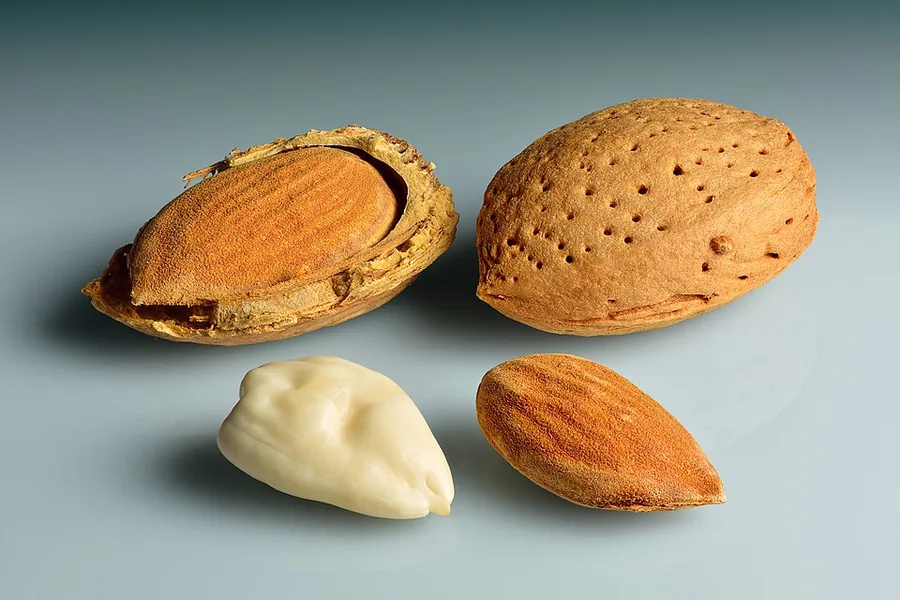
The almond is a deciduous tree in the rose family, a near twin of the peach and apricot, grown not for soft flesh but for the seed locked in its stone. Each fruit is a drupe whose thin outer hull splits to reveal a pitted woody shell, and inside that shell sits the flat, pointed kernel of a drupe, the part you crack out and eat. Its roots reach back to western Asia and the eastern Mediterranean.
In the bare end of winter the almond breaks into bloom ahead of nearly every other orchard tree, its leafless branches crowding with pale five-petaled flowers, often through February or March. That early flush is its weak point, hardy though the tree is across USDA zones 7 to 9, because a late frost can blacken the open blooms and erase the season's crop. A frost-free bloom counts for more than almost any other thing.
The almond grows at a moderate pace into a full, open-headed tree, which is part of why it sits at the demanding end of the scale. Most named kinds cannot set their own nuts and need a second tree flowering nearby so bees can carry pollen between them. Give it deep, well-drained soil, full sun, and steady summer water, and the young tree begins bearing within a few years and keeps on for decades.
Care
The short version: full sun and deep, well-drained sandy loam, with regular deep watering through spring and summer so the kernels fill out. Prune to an open vase in winter, set a pollinizer partner nearby, and shield the early bloom from frost.
Light
An almond reaches for full sun, and it fills out fullest on an open, south-facing site that bathes the whole canopy in light all day. A little partial sun is bearable, but shade thins the green growth and shrinks the kernels the tree can ripen.
Water
Water deeply on a steady rhythm through spring and summer, about every 7 to 14 days, so each kernel plumps out inside its shell. The settled tree shrugs off drought, but it loathes standing wet around its roots, where root and crown rot set in.
Soil
Sink an almond into deep, well-drained sandy loam and the roots run free. Heavy or sodden ground packs around them and stunts the tree, so aim for loose, gritty, fast-draining soil with a pH between 6.0 and 7.5.
Temperature
The almond endures a wide swing of weather on its bare and leafed wood alike, from about 5°F to 104°F (-15°C to 40°C). The danger is never deep winter cold but a frost striking the open, early flowers, which can blacken them on the branch.
Humidity
This is a tree of dry air, somewhere near 30% to 50% humidity, the crisp climate that keeps its blossoms and hulls clean. Damp, heavy air over the open flowers feeds brown rot and other fungal blights.
Feeding
Feed through the growing season, from early spring into summer, with a nitrogen-based orchard fertilizer that carries potassium too. Spread the feedings across the months, and let a leaf or tissue test read the tree's need before you add more.
Pruning
Prune through the bare winter rest, opening the crown into an open-center vase form. Cut out the dead, crossing, and weak wood, and thin the branches so light pours down onto the fruiting wood within.
Repotting
An almond is no pot tree, and field-grown trees are never lifted and repotted. If one starts its life in a container, do not leave it there too long, or the roots coil tight against the wall and the tree stalls and dies back once set out.
Size & spacing
An almond swells into a full-sized tree, climbing 10 to 30 feet (3 to 9 m) tall and throwing its branches nearly as wide. Give it generous open ground so the rounded canopy can spread and air can drift through every limb.
When to plant
The almond keeps an early calendar you can read on the tree itself. Set dormant bare-root trees, bare brown sticks with trimmed roots, into the ground in late winter to early spring, watch for the pale February or March bloom that frost can threaten, and gather the nuts from late summer into fall as the hulls peel open.
Northern hemisphere
Southern hemisphere
Typical months for a temperate climate: start earlier in warm zones, later where spring frosts linger.
- Plant: Late winter to early spring as dormant bare-root, grafted nursery trees
- Harvest: Blooms very early (Feb-Mar) and is frost-prone; nuts harvested Aug-Oct when hulls split
Hardiness
USDA hardiness zones: 7–9
Temperature: down to -18°C
Troubleshooting
Most of an almond's troubles show on the nuts as the hulls split or on the flowers through the early bloom, where you can see the brown petals and tunneled kernels for yourself. Catch the signs at the right stage and a fungicide or a clean-up earns its keep, but miss the window and the crop is spent. Find the match below, then act while the timing still counts.
Kernels bored through with webbing and frass at harvest
Split a damaged nut and the navel orangeworm shows itself, the pest that does almonds more harm than any other. Its larvae tunnel into the kernels as the hulls part, working in from the old shriveled mummy nuts that clung to the branches all through last year. Pick those mummies off over winter, then treat at hull split and once more 2 to 3 weeks later when the pressure runs high.
Fix:
- Treat at the start of hull split and again 2-3 weeks later in moderate-to-high pressure orchards
- Harvest promptly once hulls split to limit exposure
Blossoms browning and falling after a cold snap
An almond unfurls its flowers earlier than nearly any fruit tree, so a late freeze catches the petals wide open and blackens the pistils within, the slender center of each bloom turning brown and dead. Those lost flowers leave a thin crop behind. Wind machines or irrigation guard the riskiest nights, a site where cold air slides downhill helps, and later-blooming varieties hold their petals back where frost lingers.
Fix:
- Use frost protection (wind machines or irrigation) during high-risk nights
- Avoid the earliest-blooming cultivars in frost-prone sites
Shoots and leaves wilting brown as the hulls open
When a green shoot suddenly browns and droops at hull split, the cause is hull rot, a pair of fungi that take hold as the hulls crack and seep toxins into the spur or shoot right beside the nut. A fungicide at hull split holds the line, and cutting back on late-season nitrogen and water lets the hulls leather over and dry fast, leaving the fungus nothing damp to grow on.
Fix:
- Apply an effective fungicide (DMI or QoI) at hull split
- Reduce late-season nitrogen and water to speed hull drying
Brown-collapsed blossoms and gummy twig cankers at bloom
A wet spell over the open flowers lets brown rot blossom blight in, and the pale petals brown, shrivel, and hang limp on the spur while small cankers weep clear gum along the twigs. Time a fungicide to the flowers themselves, around pink bud and full bloom, and snip away the blighted spurs and clinging mummies you find.
Fix:
- Apply a bloom fungicide at the appropriate flower stage (e.g., pink bud and full bloom)
- Remove blighted spurs and mummies
Toxicity
Look closely and this is a tree to keep apart from animals. The slim leaves, the bark, the green outer hulls, and the kernels of bitter almond all hold amygdalin, which releases cyanide, while the rich-fatted whole nuts add choking and pancreatitis risk for pets. The sweet almonds people eat are safe, but livestock, horses, and pets should stay clear of the foliage and prunings.
Toxic to
Cats · Dogs · Horses · Rabbits · Livestock · Birds · People
Cats Mild
A cat that swipes a few of the smooth sweet kernels tends to bring on vomiting, loose stool, and a churning stomach. The sharper hazard is the bitter kernels and the slim green leaves, which can set off cyanide signs such as drooling, blown-wide pupils, and labored breathing.
Dogs Mild
A dog bolts the whole oval kernel down at once, so look for vomiting and diarrhea, a fatty bout of pancreatitis, or a choke or a blockage from the hard nut. The bitter kernels and any green parts of the tree carry it further into cyanide territory.
Horses Toxic
In a horse, the cyanide held in the wilting leaves and the bark moves fast, bringing quick breathing, an unsteady stagger, gums flushed bright red, and collapse. Keep horses well away from the cut prunings and any fallen branches.
Rabbits Toxic
A rabbit is small enough that the amygdalin packed in the almond's leaves and slim twigs leaves no margin at all, and a single nibble can turn dangerous. The foliage belongs entirely out of reach.
Livestock Toxic
Cattle, goats, and sheep that crop the leaves or strip the bark can take in cyanide enough for a sudden, severe poisoning. Fence the trees off and rake any dropped prunings clear of the pasture.
Birds Toxic
Cyanide is acutely toxic to birds, so the green hulls, the foliage, and the bitter kernels stay far from backyard poultry and pet birds alike.
People Caution
The plump sweet kernels from the store hold only a trace of cyanide and are safe to eat. Bitter almonds are a different seed entirely, carrying amygdalin enough to be genuinely poisonous raw, which is why they never reach the shelf for raw eating.
Sweet (culinary) almonds sold in the U.S. are low in cyanide and edible; bitter almonds and the tree's foliage, bark, and green hulls are the cyanogenic hazard. Keep pets from chewing foliage, twigs, or fallen green hulls.
Helpline numbers

United States
ASPCA Animal Poison Control: (888) 426-4435 (fee applies)
Poison Control: (800) 222-1222



Canada
Poison Centres: 1-844-764-7669
Varieties
Almond varieties are told apart by the timing of their blossoms and the thickness of their shells as much as by flavor, since most lean on a partner to set nuts. These are the ones worth knowing by name.
Nonpareil
California's leading cultivar, prized for thin, smooth shells that split open under the lightest pressure, though it sets no nuts unless a cross-pollinizer stands nearby.
Carmel
A soft-shell variety whose blossoms open in step with Nonpareil, which is why the two are so often planted side by side for pollination.
Monterey
A late-blooming, hard-shell cultivar planted to stretch the bloom window and keep an orchard's pollination running.
All-in-One
A self-fertile semi-dwarf with a compact frame, the obvious pick for a garden with room for only one almond tree.
Mission (Texas)
A hard-shelled, late-blooming variety that holds its flowers past much of the spring frost, so it earns a place where the cold lingers.
Companions
Plant near
Pollinizer almond varieties (e.g., Nonpareil with Carmel/Monterey): Most cultivars are self-incompatible and need a different, overlapping-bloom variety nearby for bee cross-pollination and nut set.
Flowering bee-forage cover crops (clover, mustard): Support honey bee and native pollinator activity during the critical early bloom window.
Keep apart
Peach and other Prunus stone fruits planted close by: Share pests and diseases such as brown rot, peach twig borer, and navel orangeworm, increasing pressure on the almonds.
How to propagate
A named almond will not grow true from its own seed, so each tree is built by joining a bud or scion onto chosen rootstock, with raw seed kept back to raise those rootstocks.
GraftingModerate
T-budding in late summer or bench/whip grafting onto rootstock in late winter · 3-4 years to first meaningful nut crop
A named almond never comes true from its own seed, so a single bud or scion is set onto a peach, almond, or hybrid rootstock chosen to match the soil and the vigor wanted. A T-shaped cut takes the bud in late summer, or a bench graft joins scion to rootstock through the late winter dormancy. From that union the young tree needs 3 to 4 years before it carries a real crop.
SeedModerate
Stratify seed over winter and sow in spring · 1 season to seedling, several years to bear
A seed chilled through winter and sown in spring sends up a leafy seedling within a single season, though several years pass before it bears. The catch is that seedlings don't match the parent, so they mostly grow on as rootstock rather than as a copy of a named variety.
Myths
An almond is a true nut.
The almond on your plate is the flat, teardrop seed resting inside the woody stone of a drupe, the very same fruit form a peach or apricot carries. It is a seed, not a true nut at all.
Every almond is equally safe to eat.
Sweet almonds grown for food hold no more than a trace of cyanide and are safe in the hand. Bitter almonds, near-identical to look at, are packed with amygdalin that releases cyanide, which is why they are never sold for raw eating in the U.S.