Tree · Ulmaceae
American Elm
Ulmus americana
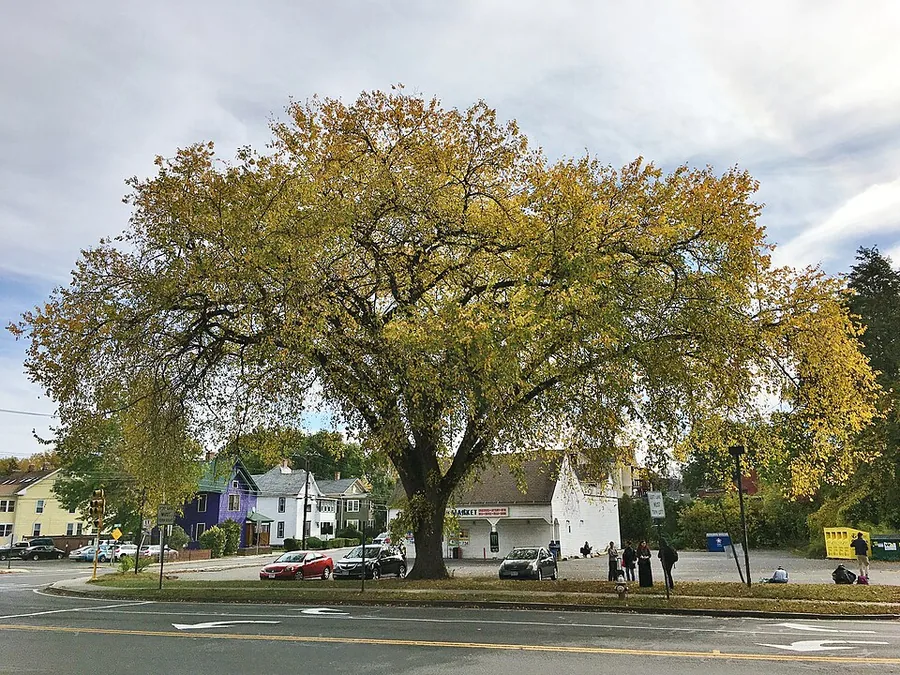
A fast-growing tree whose tall, arching, vase-shaped form spreads wide on branches that reach out and curve gently downward at the tips.
Full sun
Every 7–14 days
USDA 2–9
60–80 ft · 18.3–24.4 m
Overview
Stand beneath a mature American elm and the first thing that strikes you is the shape: the trunk rises and then branches spread outward and upward before arching back down at the tips, forming the wide, vase-shaped, arching crown the species is defined by. The tree climbs to 60 to 80 feet (18 to 24 m) with a spread that can match or exceed that, casting deep shade across a broad footprint.
Look more closely and the details fill in. The bark on older trunks is gray-brown and deeply furrowed into interlocking flat ridges. The leaves are coarsely toothed and slightly rough on the upper surface. In late winter to early spring the tree produces tiny reddish-green flowers before the leaves break, clustered in small bunches along the twigs. By April and May those give way to flat, papery, winged samaras, each seed encircled by a thin, oval wing, which fall and scatter in quantity.
The wood is notably brittle, prone to splitting under ice or wind load, and the roots run wide and shallow, eventually pushing up as large surface roots that ridge the soil and can buckle nearby pavement. Hardy from zone 2 to zone 9, it tolerates a wide range of soil and pH. Dutch elm disease remains the defining threat to the species, but resistant cultivars now make the tree plantable again with realistic expectations.
Care
The short version: plant in full sun to partial shade in nearly any well-drained soil, water young trees through dry spells on a schedule of roughly every 7 to 14 days until the roots reach out, prune in late winter to build strong branch structure before the brittle wood becomes a liability, and give this wide, arching tree open ground well clear of pavement and structures.
Light
The American elm performs best in full sun, where the crown fills out densest and the branch structure develops most strongly. It accepts partial shade without visible distress, though the canopy tends to be less full than in open exposure.
Water
Young trees need consistent moisture while their root systems are still establishing, roughly every 7 to 14 days through dry periods. Once the shallow, wide-spreading root network has taken hold, the tree adjusts to both dry and wet conditions with little help needed from you.
Soil
The American elm is genuinely unfussy about ground conditions. It grows best in average, medium-moisture, well-drained loam but tolerates clay, sand, and both wet and dry sites. The pH range it accepts runs from 5.5 to 8.0, covering acid to alkaline soils.
Temperature
The range this tree endures is wide. It holds its own across zone 2 to zone 9 and withstands temperatures from -51°F to 100°F (-46°C to 38°C), which explains why it once covered such a large portion of the continent.
Humidity
Ordinary outdoor humidity at whatever level the climate provides is all this tree needs. No specific humidity range needs managing for a tree grown in the ground.
Feeding
In spring, apply a balanced slow-release tree fertilizer to young trees to support their fast early growth. Fully established, mature specimens rarely need supplemental feeding and generally do fine without it.
Pruning
Prune in late winter while the tree is dormant, focusing on crossing branches and weak attachment points. Because the wood is prone to breakage, developing a strong branch scaffold early matters. There is also an urgent pruning task: cut out any limb showing wilting the instant you see it, to slow the progress of Dutch elm disease.
Repotting
The American elm is not suited to long-term container growing. Move a nursery-grown sapling into the ground before the roots begin to circle inside the container. Roots emerging from drainage holes are the signal that planting out is overdue.
Size & spacing
The American elm needs real room. At maturity it stands 60 to 80 feet (18 to 24 m) tall with a spread of 40 to 70 feet (12 to 21 m), and its shallow roots push outward even farther, forming large surface roots that lift pavement. Site it well away from buildings, paths, and any hard surface.
When to plant
The American elm follows a temperate seasonal pattern. Plant it in spring or fall while dormant, watch for tiny reddish-green flowers emerging along the bare twigs in March and April, then look for the papery, flat-winged samaras as they ripen and fall through April and May.
Northern hemisphere
Southern hemisphere
Typical months for a temperate climate: start earlier in warm zones, later where spring frosts linger.
- Plant: Spring or fall
- Harvest: Tiny reddish-green flowers in late winter to early spring (March-April), followed by flat winged samaras maturing April-May
Hardiness
USDA hardiness zones: 2–9
Temperature: down to -46°C
Troubleshooting
The two most significant problems on American elm both show up in the canopy, where you can see them if you look. One branch that wilts suddenly and browns while the rest of the crown stays full is the sign to act on immediately. Leaves eaten down to a skeleton of veins call for a closer look at who is doing the chewing. Match what you find below and respond quickly.
One branch collapses and browns while the rest of the canopy stays full and green
A single limb that wilts, yellows, and dies back while the surrounding branches hold their color is the telling early signal of Dutch elm disease, a lethal fungal wilt that elm bark beetles carry into the sapwood and that passes between neighboring trees through fused root systems. Peel back the bark on a flagging stem and look for distinct brown streaks running through the pale outer wood. Elm yellows can produce the same canopy collapse, though, so send a sample to a lab before assuming which one you are dealing with. Cut out flagging limbs well below any visible streaking the moment you spot them, interrupt root connections shared with adjacent elms, and clear dead wood promptly so beetles cannot breed in it.
Fix:
- Prune out and destroy infected limbs well below visible streaking as soon as flagging appears
- Remove and destroy severely affected or dead trees promptly to eliminate beetle breeding sites
- Sever root grafts between adjacent elms to stop underground spread
- Consult an arborist about fungicide injection for high-value trees
Leaves eaten to bare veins with beetles visible on the surface
Leaves reduced to a brown lattice of veins point straight to the elm leaf beetle: pale, soft larvae graze the leaf undersides, scraping away the green tissue, while the striped adults chew through the tops. Japanese beetles can leave a similar pattern of damage, so inspect the insects directly before deciding on a response. A mature elm with a full, dense crown can absorb moderate feeding without lasting harm, so hold back where the tree looks otherwise sound, welcome whatever predators arrive naturally, and bring in a labeled insecticide only when a heavy outbreak descends on a smaller or younger tree.
Fix:
- Tolerate light feeding on otherwise healthy trees
- Apply an appropriately labeled insecticide for heavy infestations on smaller trees
- Encourage natural predators
Toxicity
The American elm carries no toxin in its bark, wood, leaves, or samaras, and it does not appear on ASPCA toxic-plant lists. Pets, livestock, and people can all be around this tree without chemical risk. The physical character of the tree, specifically its brittle limbs and the thick surface roots that ridge the ground around a mature trunk, is what actually warrants attention.
Safe for
People · Cats · Dogs · Horses · Rabbits · Livestock · Birds
Cats None
A cat that bites into a fallen leaf or mouths one of the flat, papery samaras is not in any danger, as the tree carries no toxin in its tissues. The only thing worth noticing would be mild stomach upset from eating plant matter, which any animal can get from unusual greenery.
Dogs None
A dog gnawing on a twig or licking at the rough, furrowed bark will come away unharmed. Neither the wood nor the foliage contains anything poisonous, so sniffing around under the wide-spreading canopy carries no chemical risk.
Horses Safe
Horses grazing near an elm and pulling at the coarsely toothed leaves or strips of bark face no toxic hazard. The tree holds nothing harmful, and pasture animals can browse it freely.
Rabbits Safe
Rabbits that nibble on the ridged outer bark or chew the papery buds in winter take no harm from it at all. The plant is safe to grow near a hutch or a warren.
Livestock Safe
Cattle, goats, and sheep can eat the serrated, slightly rough-textured leaves without ill effect, and the foliage has long been fed as fodder. No part of the tree poisons grazing animals.
Birds Safe
Birds that feed on the papery, round-winged samaras in spring and shelter in the high, arching branches are in no danger. The elm is a harmless and genuinely useful part of their environment.
People Safe
The American elm presents no poisoning risk to people. Any hazard from this tree is structural, not chemical: the brittle wood, the large surface roots that ridge the ground, and the reach of the outstretched limbs are the things that warrant attention.
No special handling is required for toxicity, though the tree's large size, surface roots, and falling samaras and limbs are landscape considerations.
Varieties
Named cultivars bred for resistance to Dutch elm disease are the practical choice for any new planting. These four are the ones most consistently available and documented.
'Princeton'
Selected as far back as 1922, this cultivar holds the classic arching, vase-shaped silhouette of the species and has demonstrated solid resistance to Dutch elm disease across many decades.
'Valley Forge'
A U.S. National Arboretum release with notably high tolerance to Dutch elm disease, though its thick-canopied form is not fully immune to the fungus.
'New Harmony'
Another disease-resistant Arboretum selection whose sturdy growth holds up through the cold reliably to about zone 4.
'Jefferson'
A resistant selection chosen specifically to preserve the wide, sweeping, vase-shaped crown the American elm has always been recognized by.
How to propagate
Seed is the straightforward route to a new American elm, but it will not produce a tree with disease resistance. To get that, you need to propagate a named cultivar by grafting or by cutting.
SeedModerate
Sow fresh samaras in late spring soon after they mature · A few weeks to germinate; several years to establish as a tree
The flat, winged samaras need to go into the ground fresh in late spring, right as they ripen and drop, and they typically sprout within a few weeks. Those seedlings will slowly build into full trees over several years. Keep in mind that seed-grown elms do not carry the disease resistance that has been selected and bred into named cultivars.
GraftingDemanding
Dormant season · One or more seasons
Grafting in the dormant season is the method nurseries rely on to reproduce named, disease-resistant elms with their traits intact. The union takes a season or more to bind properly and demands a skilled hand, placing it firmly in the propagator's domain rather than the casual gardener's.
Stem cuttingsDemanding
Softwood in late spring to early summer · Weeks to root, then years to establish
Softwood cuttings taken in late spring or early summer reproduce the physical character of a resistant cultivar exactly, from the texture of the bark to the angle of the branching. The cut stems put down roots within a few weeks, then require years to grow on into a tree, and getting them to strike reliably takes genuine experience.
Myths
The American elm is extinct or no longer worth planting because of Dutch elm disease.
Dutch elm disease tore through the species during the 20th century and removed millions of trees, but the American elm never disappeared entirely. Resistant cultivars are available today, including 'Princeton', 'Valley Forge', 'New Harmony', and 'Jefferson', which means planting one and watching it develop its tall, arching form is a reasonable and supported choice.