Ornamental · Liliaceae
Toad Lily
Tricyrtis hirta
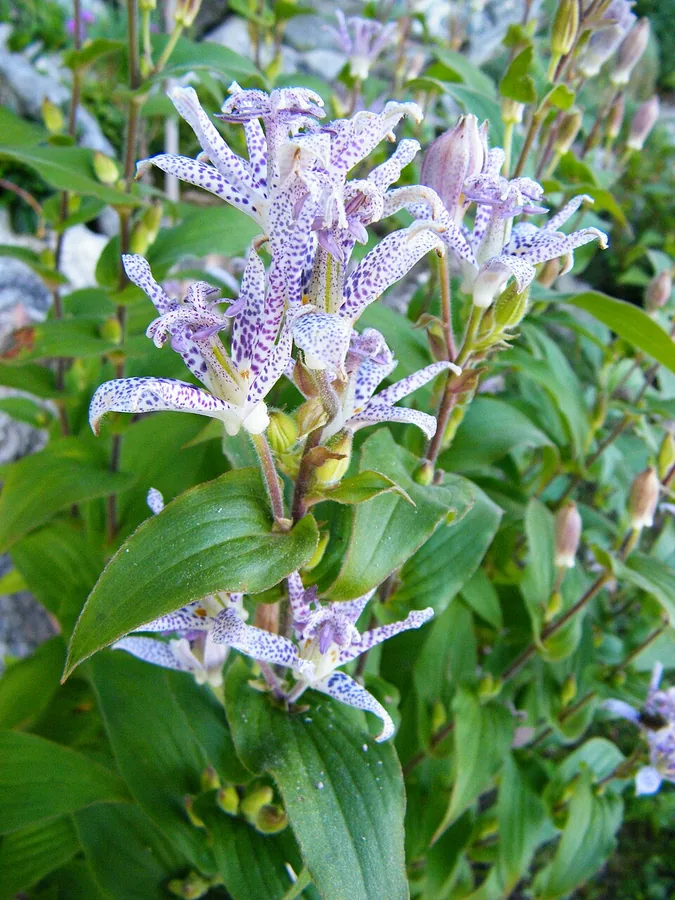
Along the upper stems, the toad lily sets out small, waxy flowers freckled in purple, held on leafy stems that arch through the shade.
Partial shade
Every 3–7 days
USDA 4–8
2–3 ft · 0.6–0.9 m
Overview
The toad lily carries its flowers along the upper reaches of arching, leafy stems, each bloom small, waxy, and freckled and speckled in purple like an orchid in miniature. It comes from the woodlands of Japan and grows as a hardy perennial across USDA zones 4 to 8. The flowers open late and low in the light, close to eye level only when you lean in for a look.
The plant forms a slow, clumping mound of leafy stems that lengthen and arch as the season goes on. It roots in rich, humusy soil kept damp, and dry ground marks the foliage before long. A young clump takes a few years to thicken into a full stand, then breaks the same ground each spring.
Well grown, the leaves stay clean and green along stems tipped with those freckled flowers. Kept cool, shaded, and moist, the plant needs only occasional division and a watch for slug-chewed holes. Let the ground dry or the sun beat down, and the leaves spot and brown into an early dieback before the buds ever open.
Care
The short version: part to full shade and rich soil kept evenly moist, out of hot afternoon sun, keep the leaves clean and the flowers coming. Feed once in spring, cut the browned stems to the ground at season's end, and divide the clump every few years.
Light
Set it in part to full shade, where the leaves hold their green and the soil stays cool and damp. A little morning sun does no harm, but hot afternoon light burns brown patches into the foliage and pushes the whole plant into an early summer dieback.
Water
Keep the soil consistently moist so the leaves never draw tight and dry, since drought freckles them with spots and drops the plant into early dormancy. Water every 3 to 7 days as the weather runs, poured at the base so the leaf surfaces stay dry.
Soil
Root it in moist, humusy, well-drained soil dark with organic matter, the loose, crumbly ground of a woodland floor. A slightly acidic to neutral pH of 5.5 to 7.0 suits it, and a yearly top-dressing of compost keeps that soft, moisture-holding texture around the crown.
Temperature
The plant is fully hardy, its crown and roots holding firm through winter lows of -29°F (-34°C) and summer heat to about 86°F (30°C). Because the underground parts come through hard frost intact, the clump needs no lifting or covering.
Humidity
Ordinary outdoor humidity is enough, so no figure applies. Moving air is what counts, since still, damp air pooled among the crowded leaves settles as anthracnose across their surfaces.
Feeding
A single feed in spring, a balanced fertilizer or a dark top-dressing of compost worked in as the shoots rise, carries the plant through. Its slow growth asks for little, and one feed a season keeps the foliage full and green.
Pruning
Little cutting is needed. Once the stems and leaves brown and slump at the end of the season, cut them down to the ground, clearing the crown until fresh shoots push up in spring.
Repotting
The toad lily grows from a clumping crown in open ground rather than a pot. Lift and divide the clump every few years in early spring when the center packs tight, the flowers thin, and the new leaves come up noticeably smaller.
Size & spacing
Mature stems stand 2 to 3 feet (58 to 91 cm) tall and the clump spreads to about 18 to 23 inches (46 to 58 cm) across. Leave each one room to arch and let air slip between the leafy stems to keep spotting off the foliage.
When to plant
The toad lily builds slowly and flowers late. Set out in spring after frost, its leafy stems lengthen and arch through summer, and only from August into September do the freckled buds open along their tips.
Northern hemisphere
Southern hemisphere
Typical months for a temperate climate: start earlier in warm zones, later where spring frosts linger.
- Sow: Late winter to early spring (seed; may require cold stratification)
- Plant: Spring after frost danger has passed
- Harvest: August to September (late summer to early fall)
Hardiness
USDA hardiness zones: 4–8
Temperature: down to -34°C
Troubleshooting
Read the plant's surfaces closely and it tells you what is wrong: dry-stressed leaves freckle with spots, wet foliage picks up orange flecks, and virus streaks the flowers before they purple over. Match the marks you see below to the cause behind them.
Mottled leaves and flowers streaking to purple
When the flowers break into irregular streaks and the leaves mottle before the whole bloom flushes purple, the plant carries Tricyrtis floral virus, moved plant to plant by aphids and past any spray. Dig up and destroy the marked plant, hold the aphids down, and wipe the tools between plants so the infected sap goes no further.
Fix:
- Remove and destroy infected plants to limit spread
- Control aphid vectors
Small orange spots on the leaves and stems
Small orange flecks scattered over the leaves and stems are anthracnose, a fungus that settles onto surfaces left wet in close, still air. Drying the plant out clears it. Pull off the spotted leaves, open the stems to moving air, and water at the base so the foliage never stays damp.
Fix:
- Remove and discard symptomatic leaves
- Improve air circulation
- Water at the base to keep foliage dry
Spotted leaves and an early summer dieback
Leaves that freckle with spots and then brown into early dormancy show drought stress, the plant folding in on itself under too much sun or soil baked dry between waterings. Soak the ground deeply on a steady schedule and lay mulch over it to hold the damp. Move the clump to shadier, moister ground if the spotting returns.
Fix:
- Water deeply and consistently
- Add organic mulch to retain moisture
- Site in shadier, moister conditions
Ragged holes in the leaves with slime trails nearby
Ragged holes torn through the soft new leaves, with silver slime trails crossing them, are the mark of slugs and snails working the shady, damp bed. Find them by torchlight in the evening or early morning and lift them off by hand. Rake away the mulch and debris they shelter in, and lay iron-phosphate bait where the chewing keeps up.
Fix:
- Hand-pick slugs and snails in the evening
- Remove garden debris and mulch harboring them
- Use iron-phosphate slug bait if needed
Toxicity
Behind the freckled, lily-like flowers, the toad lily is not toxic. The bloom mimics a true lily, but this is not one, and it carries none of the kidney danger real lilies pose to cats. It is safe to grow around pets, livestock, and children.
Safe for
People · Cats · Dogs · Horses · Rabbits · Livestock · Birds
Cats None
Safe around cats. For all that the flower mimics a true lily, this is not one, so it carries none of the kidney danger that Easter and Asiatic lilies pose. A curious nibble at a leaf brings no real worry.
Dogs None
No toxicity is reported for dogs, so a dog that chews a leaf or stem should be fine. A big mouthful of any plant can still upset a sensitive stomach for a short while.
Horses Safe
Safe for horses, with nothing on record to suggest the plant does them harm.
Rabbits Safe
Rabbits browse toad lily without harm, and they often crop the leafy stems right down, so a wire guard helps if the clump is to flower.
Livestock Safe
No poisoning is reported in cattle, sheep, or goats. As a small shade perennial, it rarely grows where stock graze anyway.
Birds Safe
Safe for birds, with no toxic compounds noted in the foliage, flowers, or seed.
People Safe
Not known to be toxic to people. It is grown for its freckled flowers rather than the table, so treat it as ornamental and wash your hands after handling, as with any garden plant.
Generally considered safe; no toxicity reported. Wash hands after handling as a routine precaution.
Varieties
The named toad lilies part ways in their stems and in the color and freckling of their flowers. Two forms show the range clearly.
Miyazaki
Miyazaki is the shorter form, its arching stems reaching only about 2 feet and hung with white to pale lilac flowers packed with purple freckles.
Hairy toad lily (species form)
The upright species form stands taller at 2 to 3 feet, and every stem is furred with hairs from base to tip, the very texture that names the hairy toad lily.
Companions
Toad lilies pair best with the other plants of the moist woodland floor, which share their love of shade and damp, rich soil.
How to propagate
The toad lily grows from a clumping crown of rooted stems that pulls apart with ease, which makes division the surest way to multiply it. Cuttings and seed add more plants for anyone willing to wait.
DivisionEasy
Early spring while dormant · One growing season
Division is the easiest and most reliable way to increase the plant, and the only one that keeps a named cultivar true to its flowers. Lift the dormant crown in early spring and tease it apart into rooted pieces. Each piece takes hold and fills out over a single growing season.
Stem cuttingsModerate
Late spring to early summer · Several weeks to root
Stem cuttings root readily, even standing in a plain glass of water. Take them from late spring into early summer and give them several weeks to root before potting them on.
SeedModerate
Late winter to spring · Multiple seasons to flowering size
Seed raises the species rather than the freckled cultivars, and in ground it likes the plant self-sows where it stands. Sow from late winter into spring, and wait, since seedlings take several seasons to reach flowering size.
Myths
The toad lily is a true lily, so its lily-like flowers make it as deadly to a cat's kidneys as an Easter or Asiatic lily.
The bloom looks the part, but the plant is not a true lily. It sits in the lily family under the genus Tricyrtis, not Lilium, so the resemblance ends at the flower. No source reports it as toxic, and it never appears on the ASPCA toxic plant list. It carries none of the severe kidney danger that true lilies pose to cats.