Bulb · Liliaceae
Tulip
Tulipa spp.
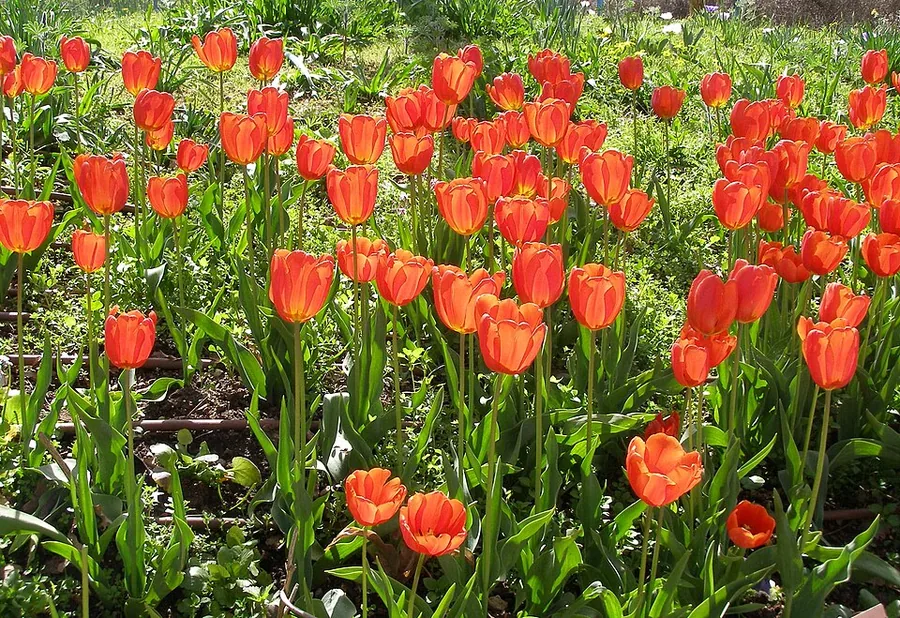
A cup of petals on a firm green stem, the tulip carries the boldest color of the early spring garden.
Full sun
USDA 3–8
9–24 in · 23–61 cm
Overview
The tulip belongs to the lily family and grew wild first in the mountains of central Asia. Above the soil it reads as a single cupped flower on a firm, upright stem, and below it sits a rounded bulb with a pointed tip and an outer husk. That bulb banks a full season of energy, enough to raise stem, green leaves, and a colored cup within a few weeks of spring.
Before any of that color appears, the bulb needs a real winter. It takes 12 to 16 weeks of cold to trigger flowering, so bulbs in mild zones get chilled first or grown for a single season. Most modern hybrids weaken after a year or two, their cups coming up smaller each spring, which is why many are replanted fresh each fall.
The plant ranges from a low 6 inch species tulip to a tall Darwin hybrid, standing 9 to 24 inches (23 to 61 cm) in all, and the flower can be nearly any color. Some classes open as plain rounded cups, others as fringed and twisted forms, each carried on a stem firm enough to hold the bloom upright. Full sun and quick-draining soil bring out the fullest color.
Care
The short version: a tulip is a firm-stemmed cup of color that wants full sun and fertile, well-drained soil, its rounded bulb set 6 to 8 inches (15 to 20 cm) deep in fall. Watered in at planting and kept from soggy ground, it holds its green leaves until they yellow and brown after bloom.
Light
Full sun, 6 or more hours a day, draws out the deepest color and the firmest cup and recharges the bulb for next spring. A little partial sun is tolerated. In deep shade the flowers come up weak and few, or fail to form at all.
Water
A drink at planting is enough; after that the bulb wants little. In soggy soil the bulb turns soft, mushy, and discolored, so the ground stays on the dry side once the leaves fade and the bulb rests.
Soil
The bulb sits best in rich, fertile, well-drained soil. Drainage counts above all, since a bulb left in wet ground rots to a soft, discolored mass long before it can flower.
Humidity
Air moisture makes little difference to a tulip, so there is no figure to track. Good drainage and airflow matter far more, since still, damp, crowded air is where the gray mold of tulip fire and the soft rot of the bulb take hold.
Feeding
A balanced slow-release fertilizer such as a 5-10-5 feeds the bulb at planting and again after the cups fade. Bone meal adds little and draws digging animals to the bed, so the plain balanced feed serves better.
Pruning
The spent cups come off so the bulb stops pouring itself into seed. The green leaves stay put until they slacken, yellow, and finally brown, usually by late June into July, since cutting them green leaves the bulb underfed.
Repotting
Every few years, once the leaves have browned and died back, a crowded clump is lifted and split, then the bulbs go back at proper depth. Overcrowding shows in the flowers, which come up smaller and fewer, and in bulbs that shoulder their way toward the surface.
Overwintering
Tulips are hardy in zones 3 through 8, where the bulb rides out winter in the ground and takes the cold it needs. In zone 9 and warmer, the bulb gets a pre-chill of 12 to 16 weeks or a fresh replanting each year.
Size & spacing
By class, tulips stand 9 to 24 inches (23 to 61 cm) tall. The rounded bulbs go 3 to 6 inches (8 to 15 cm) apart and 6 to 8 inches (15 to 20 cm) deep, pointed tip up.
When to plant
The tulip keeps its own calendar. The bulb, a rounded knob with a pointed tip, goes into the ground in fall before it freezes, waits out a long cold winter, and pushes up leaves and a colored cup from April into late May.
Northern hemisphere
Southern hemisphere
Typical months for a temperate climate: start earlier in warm zones, later where spring frosts linger.
- Plant: September–November (fall before ground freezes; October ideal)March–May
- Bloom: April–May (early April to late May by division)October–November
Hardiness
USDA hardiness zones: 3–8
Temperature: down to -40°C
Troubleshooting
Trouble usually shows on the plant itself: a bulb gone soft, a leaf gone gray, a petal streaked out of pattern. A rotted bulb, a grazed stem, or a hybrid fading year by year covers most of it. The look of each problem below points to its cause.
Scorched, twisted leaves under a gray fuzzy mold
The scorched, twisted leaves and gray fuzz are tulip fire, the fungus Botrytis tulipae, which races through damp, cool, overcast weather. Any plant that shows it gets pulled and destroyed, and a bulb dotted with tiny black pinhead specks on its husk never goes in the ground. Moved to fresh soil, the disease finds nothing to carry over.
Fix:
- Remove and destroy infected plants
- Apply fungicide as leaves emerge
- Discard damaged or spotted bulbs
Bulbs gone soft, discolored, and foul
A bulb that has turned soft, mushy, and discolored is bulb rot, almost always from wet, poorly drained soil. A dug bulb in that state is finished and gets thrown out. Until the drainage improves, the next bulb rots the same way.
Fix:
- Discard rotted bulbs
- Improve drainage before replanting
Fresh holes and gnawed bulbs after planting
Holes and chewed bulb fragments point to squirrels, chipmunks, voles, and mice, and bone meal in the hole only pulls them in faster. A sheet of hardware cloth or chicken wire laid over the bed shuts them out. The barrier does what no repellent can.
Fix:
- Cover beds with hardware cloth/chicken wire
- Skip bone meal
Petals streaked and feathered, leaves mottled
Streaks and feathering that break the flower's own pattern signal tulip breaking virus, moved plant to plant by aphids. Nothing cures it, so the streaked plant and its bulb are dug out and destroyed. Holding aphids down keeps the virus from the rest of the bed.
Fix:
- Dig and destroy infected plants and bulbs
- Control aphids
Full green leaves but few cups or none
Leaves without flowers are blind tulips, the usual fade of modern cultivars after 3 to 5 years. Leaves cut before they brown, and too little sun, both leave the bulb too weak to form a cup. Fresh bulbs in full sun, their leaves left to yellow on their own, bring the color back.
Fix:
- Replace exhausted bulbs with fresh ones
- Let foliage die naturally
- Site in full sun
Shoots, buds, and cups bitten off in spring
Stems bitten down to stubs mean deer, which prize tulips in spring, with rabbits close behind. Repellents slow a hungry deer little. Only a real fence keeps the cups intact, and an open bed loses its stems.
Fix:
- Fence or exclude with wire
- Apply repellents (less effective)
Twisted shoots with aphids at bulbs and leaf bases
Clusters of pale-green tulip aphids collect under the leaf sheaths, at the base of the plant, and on stored bulbs, leaving shoots twisted and stunted. Because they spread the breaking virus, they come off early. Infested bulbs go into insecticidal soap, and growing plants take soap or a stronger spray.
Fix:
- Immerse infested bulbs in insecticidal soap
- Treat plants with insecticidal soap, pyrethroid or systemic
Cups fewer and smaller with each year
Cups that shrink and thin out each spring mark the decline of modern hybrids after their first year, worsened by a warm climate too mild to chill them. Grown as annuals and replanted fresh, or swapped for species and Darwin hybrid types, they hold up better. Mild zones need a pre-chill first.
Fix:
- Replant fresh bulbs annually
- Choose species or Darwin hybrid types
- Pre-chill bulbs in warm zones
Toxicity
Every part of the tulip carries poison, and the rounded bulb holds the most. Inside sit irritant compounds called tulipalin A and B, which upset the stomach in pets and people. The bulbs belong out of reach of animals and children, and gloves guard the hands that handle them.
Toxic to
Cats · Dogs · Horses · Rabbits · Livestock · Birds · People
Cats Moderate
A cat that bites into a tulip drools, vomits, and passes diarrhea, and often turns quiet and dull. The bulb holds the worst of it and stays well out of a cat's reach.
Dogs Moderate
A dog that digs up and chews a bulb drools, vomits, and gets diarrhea. A whole bulb swallowed by a small dog can also lodge in and block the gut.
Horses Moderate
In a horse the bulb brings an upset stomach and a flat, dull mood. Tulip beds and stored bulbs stay clear of where horses graze.
Rabbits Toxic
The irritant compounds in a tulip are ones a rabbit must never eat, with the bulb the most dangerous part of all. Fenced plants and bulbs kept far from the hutch keep a rabbit safe.
Livestock Moderate
Cattle, goats, and sheep that eat the bulbs or foliage drool, vomit, and pass diarrhea, and a larger dose can strain the heart and breathing.
Birds Toxic
Both bulb and foliage are toxic to birds. Poultry and pet birds are kept away from tulip beds and stored bulbs.
People Caution
No part of the tulip is safe to eat, and a bulb is now and then taken for an onion or shallot. Swallowed, it brings vomiting and diarrhea, and handled bare-handed it can raise a rash, so gloves go on first.
Bulb is most toxic; handling bulbs can cause 'tulip fingers' contact dermatitis
Helpline numbers

United States
ASPCA Animal Poison Control: (888) 426-4435 (fee applies)
Poison Control: (800) 222-1222



Canada
Poison Centres: 1-844-764-7669
Varieties
Tulips split into 15 official divisions, set apart by the shape, size, and color of the flower. A few classes turn up again and again, and their looks are worth knowing.
Darwin hybrid
This class bears large, sturdy cups in mid-spring, holds them the longest, and returns more reliably than other hybrids.
Triumph
Triumph, the biggest class of all, opens classic cup-shaped single flowers across a wide color range in mid-spring.
Parrot
Parrot tulips are the ruffled ones, their petals fringed, twisted, and feathered.
Species/botanical (e.g. Tulipa tarda)
These low-growing tulips outlast the rest, spread on their own, and open white flowers with a yellow eye.
Tulipa batalinii
In April this species tulip lifts soft-yellow single flowers on stems of 6 to 10 inches.
How to propagate
Underground, the bulb makes small offsets that pull away as new plants, and dividing them multiplies the clump. Seed is the other route, slow and best left to the species types.
Bulbs & cormsModerate
Lift and separate offsets when dormant in summer · 1-3 years to flowering size
A crowded clump, lifted while dormant in summer, breaks into a parent bulb ringed with small daughter bulbs. Most of these offsets are too small to flower at first, so they go back in the ground to grow on. They fill out to blooming size in 1 to 3 years.
SeedDemanding
Sow ripe seed; mainly for species tulips · 4-7 years to first bloom
From seed the tulip is slow, a route that suits only the species types. Sown ripe, a seed becomes a seedling that takes 4 to 7 years to raise its first cup. Hybrid seed does not come true, so the plant it makes looks nothing like its parent.
Myths
Tulips return larger and brighter every year.
In fact the cups of most modern hybrids shrink after 1 to 3 years, which is why many are grown as annuals and started over. The species tulips are the ones that truly perennialize.
Set the bulb as deep as it will go.
The right depth runs about 2 to 3 times the bulb's own height, near 6 to 8 inches. Buried too deep, the bulb spends its store just driving the stem to the surface.
Tie, braid, or cut the leaves as soon as the flowers drop.
The green leaves stay until they slacken, yellow, and brown on their own. Cut green, they starve the bulb and leave blind, cupless plants next spring.
Bone meal has to go in with every bulb.
Most soil already carries enough phosphorus, so bone meal rarely helps and leads squirrels and other diggers to the bulb. A balanced slow-release feed does the job better.
A late snow finishes off tulips that have broken ground.
The green foliage takes frost and light snow in stride, and the snow even lies over it like a blanket. Only a hard, bare freeze below the mid-20s°F (about minus 4°C) does real harm.
Sources
- ASPCA Animal Poison Control
- Iowa State University Extension
- Iowa State University Extension
- University of Illinois IPM (Report on Plant Disease 609)
- NIH/NCBI PubMed Central
- Missouri Botanical Garden Plant Finder
- Royal Horticultural Society
- NC State Extension
- Iowa State University Extension
- University of New Hampshire Extension
- University of Georgia Extension
- Iowa State University Extension