Bulb · Liliaceae
Oriental Lily
Lilium
Tall stems topped with large, richly scented blooms that perfume a whole garden, under one hard rule: keep them away from cats.
Full sun
Every 3–7 days
USDA 3–9
1–6 ft · 0.3–1.8 m
Overview
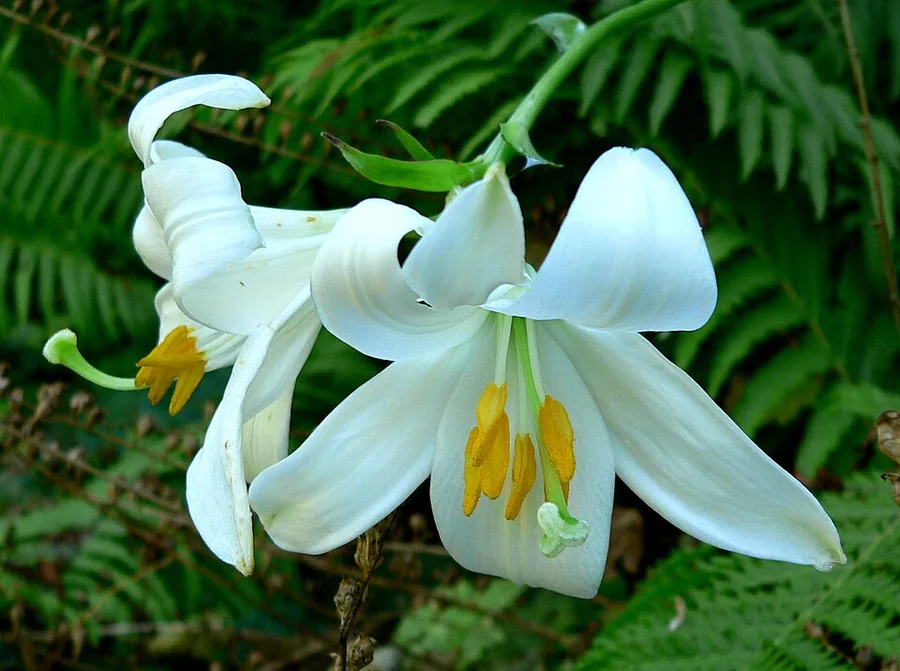
Oriental lilies carry the big, fragrant flowers of high summer on tall, upright stems, and the heavy scent drifts out well before the blooms come into view. They rise from bulbs in the genus Lilium, built up from Japanese species that breeders crossed into today's showy hybrids. Stargazer is the face most people picture, its wide petals in crimson-pink, and across the group the flowers stay large, thick-petaled, and heavily perfumed.
These hardy perennials return from the same bulb each year, the clump thickening slowly as the stems multiply. In a good spot a single stem climbs to 6 feet (183 cm), lifting a cluster of broad, outward-facing blooms high above the surrounding foliage through mid to late summer. It takes a couple of seasons for the bulb to bulk up, and then a settled clump throws its fullest, tallest flush.
One hard fact sits behind every one of those flowers where a cat is near. Oriental lilies are deadly to cats, far beyond the risk to any other animal, right down to the loose orange pollen on the anthers, and that danger alone keeps them out of some homes. Away from cats, the plant is easy and generous, asking little more than sun and soil that drains.
Care
The short version: full sun with a little afternoon shade, deep planting in rich soil that drains freely, even moisture with the roots mulched and cool, and a light feed in early spring.
Light
Oriental lilies open their fullest, deepest-colored blooms in full sun, though they hold up under a little partial shade through the hottest part of the day. The old rule is sun on the flowers and shade on the roots, and a layer of mulch over the soil is what keeps the root zone cool and dark.
Water
The soil is held evenly moist but never waterlogged, since a bulb sitting in standing water turns soft and rots. Water goes on every 3 to 7 days as the weather dictates, with mulch laid over the surface to hold that moisture and keep the roots cool through summer.
Soil
They root into fertile, humus-rich soil that drains freely, on the acidic to neutral side at a pH of 5.5 to 7.0. Alkaline ground they will not take, so a pH test settles any doubt, and plenty of dark organic matter is dug in first.
Temperature
The plant holds up across a wide range, from about 30°F to 84°F (-1°C to 29°C), and the fleshy bulbs are hardy enough to sit out the winter in the ground across their zones. Summer heat is no trouble as long as the roots stay cool and moist.
Humidity
Average outdoor air suits them, so there is no figure to chase. Moving air counts for more than moisture around the leaves, since a crowded, damp stand of foliage is what lets the gray botrytis mold take hold.
Feeding
They ask for little at the root. A balanced fertilizer in early spring, worked in as the new shoots break the soil, is all they need for the season, and heavier feeding adds nothing.
Pruning
The faded flowers are snapped off, and on cut stems the pollen-loaded anthers are clipped away before the rusty grains stain what they touch. The leaves are left to yellow and die back on their own, feeding the bulb for next year, and the bare stems are cut down in fall.
Repotting
A clump is divided every 3 to 4 years in fall once the tops die down, which keeps the blooms full-sized rather than shrinking. Bulbs in pots take a refresh every few years, and thin flowering, tight-packed clumps, or pale bulbs heaving up to the surface show the moment has come.
Size & spacing
The stems stand from 1 to 6 feet (30 to 183 cm) tall depending on the cultivar, each one spreading 1 to 3 feet (30 to 91 cm) across. Room between them lets air move through the leaves, and the tallest, top-heavy stems take a stake when the flower heads weigh them down.
When to plant
The plant keeps the bulb's own calendar. The bulbs are set in fall or early spring, about 6 inches deep, rooting and pushing up their leafy stems through spring, and the broad flowers open from mid to late summer, with some cultivars still in bloom into fall.
Northern hemisphere
Southern hemisphere
Typical months for a temperate climate: start earlier in warm zones, later where spring frosts linger.
- Plant: Plant bulbs in fall or early spring, about 6 inches deep
- Harvest: Mid to late summer, some cultivars into fall
Hardiness
USDA hardiness zones: 3–9
Temperature: down to -40°C
Troubleshooting
Most lily trouble begins down at the bulb or shows first on the lower leaves, so that is where a close look pays off. Rot and disease mark the tissue there before anything reaches the flowers up top. The sign below is matched to what the plant is showing, and the response comes before it climbs the stem.
Soft, collapsing bulbs and stems that never surface
A bulb gone to bulb rot feels mushy under the fingers, its once-firm scales discolored and foul-smelling, and no green tip pushes up through the soil. Wet ground is nearly always behind it, keeping the bulb sodden until a fungus breaks the tissue down. The soft, blackened bulbs are lifted and discarded, coarse compost is worked through the bed to loosen it, and the firm, pale bulbs go back where water drains clean away.
Fix:
- Improve drainage by amending soil with organic matter
- Remove and discard rotted bulbs
- Replant healthy bulbs in raised or better-drained sites
Brown and gray spots and a woolly gray film after rain
Through a wet stretch, botrytis stipples the green leaves with brown blotches and lays a soft gray, almost woolly film along the stems where the tissue turns to mush. Every spotted leaf and streaked stem is cut away and destroyed. More space between the plants lets air dry the foliage, and water aimed low at the soil keeps the leaf surfaces dry so the gray spores find nowhere to settle.
Fix:
- Remove and destroy affected foliage
- Improve air circulation and spacing
- Avoid overhead watering
Ragged, chewed leaves and buds with bright red beetles clinging on
The lily leaf beetle shows as a hard, glossy scarlet body clinging to the leaves, and its larvae leave the foliage and buds ragged and holed as they feed. The bright adults and the soft grubs beneath the leaves are picked off by hand. Aphids cluster in soft green knots on the buds, washed off with a jet of water or cleared with insecticidal soap, and a close look through spring and early summer spots both while the numbers are still small.
Fix:
- Handpick beetles and larvae
- Spray aphids off with water or treat with insecticidal soap
- Monitor regularly through the growing season
Toxicity
This plant carries a serious warning. Oriental lilies are catastrophically toxic to cats, and even a trace of the orange pollen or a sip of the vase water can cause fatal kidney failure, so they have no place in a home with cats. The effect on dogs and horses is far milder and people face no real danger, but the cat risk is the one that decides everything.
Toxic to
Cats · Dogs · Horses · Rabbits · Livestock · Birds
Safe for
People
Cats Severe
This is the one that kills a cat. A single lick of the orange pollen from the fur, a bite of any part, or a sip of vase water can shut a cat's kidneys down, and the first signs slip by quietly: vomiting, a flat refusal of food, and a limp, droopy cat. Within a day or two it becomes acute kidney failure, which turns fatal fast without emergency treatment, so a vet visit cannot wait.
Dogs Caution
A dog fares far better than a cat. Chewing the plant tends to bring on drooling and vomiting, but the kidneys are not at risk, and most dogs settle once it passes through.
Horses Caution
A horse that nibbles the strap-shaped leaves may end up with a mild stomachache and some drooling. The upset is uncomfortable rather than dangerous, though grazing on the plant is still worth stopping.
Rabbits Caution
Extension sources flag lilies as unsafe for rabbits, so the leaves, stems, and flowers are kept away from them. Potted plants and cut stems stay well clear of any rabbit that roams the house or garden.
Livestock Caution
Cattle, goats, and sheep are best kept away from lily plantings, since grazing the foliage can leave them with digestive trouble. Any bed where the bulbs are growing is fenced off.
Birds Caution
Pet birds are kept from picking at the leaves or the petals. The whole plant, pollen and all, stays off limits around a cage.
People Safe
Oriental lilies are no poisoning risk to people, and no part needs to be eaten or avoided for safety. The rusty-orange pollen does stain skin and cloth on contact, so the anthers are brushed off cut stems, and hands get washed after handling where a cat shares the home.
Keep all parts of the plant and any cut stems, fallen pollen, and vase water completely out of reach of cats; even brushing against pollen and grooming it off the fur can poison a cat. Wash hands after handling.
Helpline numbers

United States
ASPCA Animal Poison Control: (888) 426-4435 (fee applies)

United Kingdom
Animal PoisonLine: 01202 509000 (fee applies)

Australia
Animal Poisons Helpline: 1300 869 738
Varieties
Oriental lilies run to many named hybrids, but a few keep their looks fixed in the mind. These are the ones worth knowing by name.
Stargazer
The best-known face of the group tips its crimson-pink blooms up to the sky, each petal rimmed in white and dusted with orange pollen, and it unfurls earlier than most other Oriental lilies.
Rubrum (Lilium speciosum var. rubrum)
A fragrant Japanese show lily whose white petals, freckled and flushed with pink, roll back hard on themselves into a tight curve.
Casa Blanca
A large-flowered lily of pure, unmarked white, its broad petals facing outward and giving off a heavy scent that carries across a garden.
How to propagate
The bulb itself is built for increase, its scales and offsets multiplying so readily that seed is rarely worth the wait. Each route below trades a little speed for how soon the flowers come.
Bulbs & cormsEasy
Fall when dormant · 1-2 growing seasons to flowering size
In fall a dormant bulb is lifted and a few of its fleshy, overlapping outer scales are peeled loose and potted up. Each thick scale swells its own small bulblet at the base, and those grow to flowering size in one to two seasons.
Offsets & pupsEasy
Fall · 1-2 seasons
An established bulb rings itself with small offset bulblets of its own making. In fall these are eased off the parent and set back about three times their own height deep, plumping to size over one to two seasons.
DivisionEasy
Fall when dormant · 1 season to reestablish
A crowded clump of bulbs is lifted in fall while dormant and teased apart into smaller pieces by hand. The separated pieces root back in and lift fresh blooms again the following season.
SeedDemanding
Fall or spring · Several years to flowering
Fine seed is sown in fall or spring for a grower with patience. The slender seedlings take several years to build a bulb large enough to flower, so most keep to the scales and offsets instead.
Myths
A cat has to eat the leaves to be poisoned, so pollen and vase water are harmless.
Every part of a true lily is toxic to a cat, not just the green leaves. A few grains of the orange pollen groomed off a coat, or a sip from the vase, is enough to poison one, and even a tiny, indirect exposure can trigger fatal kidney failure.
Lilies are equally dangerous to cats and dogs.
The two are worlds apart. True lilies cause severe, often fatal kidney failure in cats specifically, while a dog that eats one usually has nothing worse than a brief upset stomach and no kidney harm at all.