Bulb · Iridaceae
Bearded Iris
Iris germanica
The fat rhizome lies shallow in full sun, kept lean and dry, and pushes up ruffled blooms again each spring for years.
Full sun
Every 7–14 days
USDA 3–10
1–3 ft · 0.2–1 m
Overview
The bearded iris grows from a fat, fleshy rhizome that lies along the soil surface rather than a buried bulb, its rounded top exposed to the light. From that thick root rise flat, sword-shaped leaves that stand stiff and upright in overlapping fans, and among them push up tall, smooth stalks that open ruffled flowers in late spring.
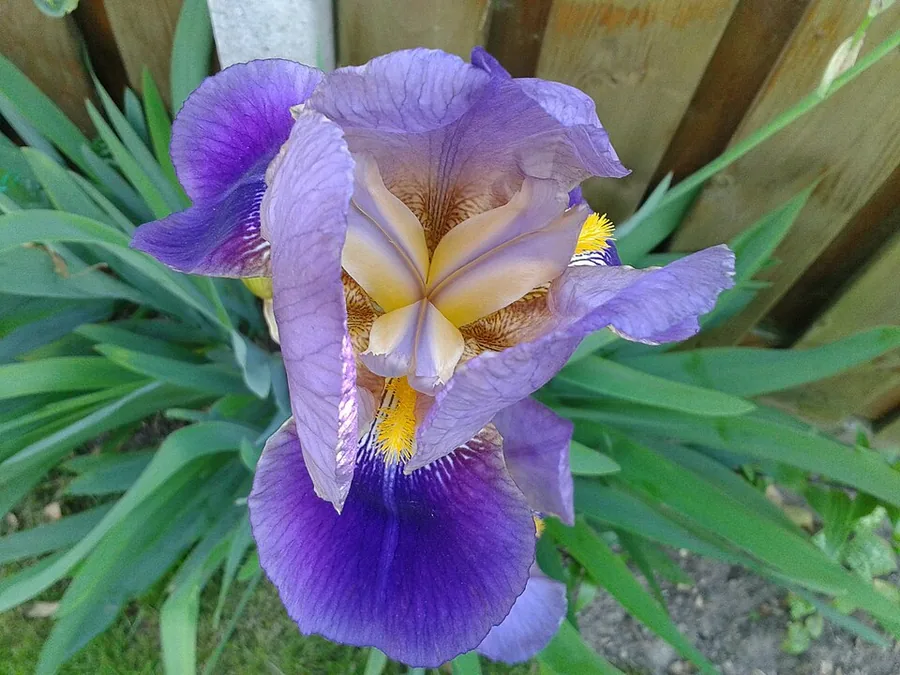
The flower is where the plant earns its name. Three lower petals fall outward and downward, and along the center of each runs a dense, fuzzy strip of fine hairs, the beard that gives the bearded iris its name. The petals themselves are heavily ruffled and crimped at their edges, soft to the touch and held above the foliage on the stalk.
The whole plant is built to endure, taking cold to -40°F (-40°C) and heat past 100°F (38°C) in its stride and shrugging off drought once rooted. The thick rhizome is the weak point: left wet or buried too deep, the firm flesh turns soft and rots. Every few years the clump is lifted and the rhizomes pulled apart, which keeps the flowers coming and yields firm new pieces to replant.
Care
The short version: the fat rhizome lies shallow in full sun with its rounded top near the surface on free-draining soil, watered sparingly once established and fed lean. The clump is divided every few years, splitting the rhizomes to keep the ruffled blooms coming.
Light
Bearded iris wants full sun, ideally six or more hours a day, to set the ruffled flowers well. It takes a little afternoon shade, but deeper shade leaves the sword-shaped leaves lax and floppy and the stalks bare of bloom.
Water
Once rooted in, this is a drought-tolerant plant happiest on the dry side, its thick rhizome storing what it needs. The top half of the soil dries between waterings, roughly every 7 to 14 days, and overhead watering is skipped because water sitting on the rhizome rots the flesh.
Soil
Drainage is everything to the fleshy rhizome. A well-drained loam with some organic matter is ideal, loose sand is fine, and heavy, dense clay needs sand or compost worked through it. The pH sits between 6.0 and 7.0.
Temperature
This is a remarkably hardy perennial, the rhizome and fans coming through cold and heat alike from -40°F to 100°F (-40°C to 38°C), the span of USDA zones 3 through 10. Hard winters and most summers leave it unharmed.
Humidity
Ordinary outdoor humidity suits it, so there is no number to chase. Air moving between the fans matters far more, since still, damp air trapped around crowded blades is what lets leaf spot mark the green.
Feeding
A low-nitrogen fertilizer such as 5-10-10 is fed lightly, once after bloom and again in early spring. It is scattered around the clump, never over the exposed rhizomes, because too much nitrogen softens the flesh into soft rot rather than flowers.
Pruning
The spent flower stalks are cut away after bloom so no seed forms. In late fall the sword-shaped leaves are trimmed back to 3 to 6 inches (8 to 15 cm), clearing the leaf spot and the borer eggs that shelter down in the blades.
Repotting
Iris is no houseplant, but the fattening clumps need lifting every 3 to 5 years in late summer once they crowd. Fewer flowers, packed fans, and dead old center rhizomes that no longer bloom show the flesh is ready to be split.
Size & spacing
The stalks stand from about 9 to 39 inches (23 to 100 cm) tall over the fans, depending on the class. The clumps go 12 to 24 inches (30 to 61 cm) apart so air moves between the sword-shaped leaves and leaf spot stays off the green.
When to plant
The fleshy rhizome is set into the ground in late summer to early fall, its rounded back near the surface, giving the roots time to grip before winter. The stalks and ruffled flowers follow the next spring to early summer, opening around May, and some cultivars send up a second set of blooms later on.
Northern hemisphere
Southern hemisphere
Typical months for a temperate climate: start earlier in warm zones, later where spring frosts linger.
- Plant: Plant rhizomes in late summer to early fall
- Harvest: Spring to early summer (May), some cultivars rebloom
Hardiness
USDA hardiness zones: 3–10
Temperature: down to -40°C
Troubleshooting
Most of what ails a bearded iris shows first in the thick rhizome below the soil or low among the leaf bases, hidden until the blades themselves brown or spot. Read the foliage and the rhizome together, since the borer and the rot both leave clear marks on the flesh and the green. Match the look below before the damage runs through the clump.
Browning leaf tips with sawdust-like grains gathered low
Tips that brown and shrivel while gritty, sawdust-like grains gather where the leaves meet the rhizome are the mark of the iris borer, a caterpillar that hatches in spring, feeds down inside the blade, and bores into the rhizome below. The grains are the dry, pale crumbs of chewed tissue it pushes out behind it, easy to feel between finger and thumb. Squeezing the leaf crushes the small larva still hidden in the green, but a rhizome left soft, hollowed, and threaded with tunnels has to be dug out and destroyed.
Fix:
- Crush infected leaves early in the season
- Dig up and destroy affected rhizomes
Mushy, collapsing rhizomes with a sour smell
A rhizome gone soft to the squeeze, slumping in on itself and giving off a sour, foul reek, is in the grip of bacterial soft rot, which takes hold where the ground stays wet, the rhizome sits too deep, or mulch and rich feeding pack down over it. The firm, pale flesh turns to a slick, mushy pulp that no longer holds its shape and cannot be saved. The rotted piece is cut away and discarded, the drainage corrected, and the remaining firm, solid sections replanted shallow with their tops riding at or just above the soil.
Fix:
- Remove and destroy infected plants entirely
- Improve drainage and replant healthy rhizomes shallowly
Spotted, fading sword-shaped leaves
Discrete spots scattered across the flat, sword-shaped blades signal fungal leaf spot, which races through a clump grown so dense the air sits trapped between the fans. The marked leaves are stripped off and destroyed as the spots appear on the green. Where the fans have packed in tight and tangled together, the clump is lifted and divided so each blade stands free with light reaching it and air moving past.
Fix:
- Remove and destroy affected foliage
- Divide overcrowded clumps to improve air circulation
Toxicity
No part of the bearded iris is for eating. The whole plant is mildly toxic and the fat rhizome holds the most irritant, packed with terpenoids that upset the stomach if swallowed and can leave skin red and itchy where the cut flesh touches it. The rhizomes are kept away from pets and children, and gloves go on before the flesh is cut for digging or dividing.
Toxic to
Cats · Dogs · Horses · Rabbits · Livestock · Birds · People
Cats Mild
A cat that bites into a blade or scratches the rhizome open usually drools, vomits, and falls quiet and off its food for a while, with loose stools sometimes following. The thick rhizome holds the strongest irritant and is the part to keep beyond a cat's reach.
Dogs Mild
Dogs go for the fat rhizome, the most irritating part of the plant, and a chew brings drooling, an upset stomach, and a listless dog with no appetite. Loose stools are common alongside, though the upset stays mild.
Horses Moderate
The same irritant compounds inflame a horse's gut and bring on drooling and diarrhea. Horses rarely seek iris out, but clumps are kept away from paddock edges where a bored animal might browse the leaves.
Rabbits Moderate
Iris is not rabbit food. The terpenoids running through the rhizome and the blades irritate a rabbit's digestive tract, so the plants stay fenced off and trimmings are never offered as a treat.
Livestock Moderate
Cattle, sheep, and goats can get a sore mouth and a churning stomach if they crop the leaves or turn up a rhizome. Most leave it untouched unless the pasture runs short.
Birds Caution
Little is settled either way for birds, and since the rhizome is an irritant, iris is treated as off-limits. Poultry and pet birds are kept from pecking at the roots or the foliage.
People Caution
No part of a bearded iris is meant for eating, and the rhizome is the most irritating piece if swallowed. Handling the cut flesh can leave skin red or itchy, so gloves go on for digging and dividing, and children are kept from chewing the leaves.
Wear gloves when handling rhizomes, as the sap can cause minor skin irritation or contact dermatitis.
Helpline numbers

United States
ASPCA Animal Poison Control: (888) 426-4435 (fee applies)
Poison Control: (800) 222-1222



Canada
Poison Centres: 1-844-764-7669
Varieties
Bearded iris is sorted into classes by the height of the flowering stalk, from short dwarfs that hold their blooms low to tall stalks that lift them well above the fans. The class sets how high the ruffled flowers stand over the sword-shaped leaves.
Tall Bearded
The tallest and most widely grown class, rising on stalks of 2.5 to 3 feet (71 to 97 cm) and opening the big, heavily ruffled flowers that come to mind first at the name bearded iris.
Intermediate Bearded
A mid-height group at 16 to 27 inches (41 to 69 cm), its stalks standing between the low dwarfs and the tall types and lifting their flowers a touch earlier in the season.
Standard Dwarf Bearded
A short, compact class at 8 to 15 inches (20 to 38 cm), low enough to hold its flowers near the front edge of a border or down among the stones of a rock garden.
Miniature Dwarf Bearded
The smallest class, its flowers carried on stalks of only about 8 inches (20 cm), and the first of all to open each spring.
How to propagate
Bearded iris multiplies through its own spreading rhizomes, a healthy clump fattening and crowding until the flesh begs to be split. Division is the easy, reliable way to part the rhizomes, while seed is a slow route best left to breeders.
DivisionEasy
Mid to late summer, after flowering · Blooms typically resume the following season
Division is how bearded iris is multiplied, done in mid to late summer once the flowers have faded. The clump is lifted whole and the rhizomes snapped apart by hand, the young, firm pieces along the outside kept and the tired, spent centers that no longer bloom thrown away. Each fan of sword-shaped leaves is cut down short, and the pieces go back in shallow with the top bared, settling in to flower again the following season.
SeedModerate
Sow after seed ripens; named cultivars do not come true from seed · Several years to flowering
Seed is a breeder's route, since a named cultivar will not come true from its own seed. The ripe seed is sown as it matures, and the seedling is slow, taking several years to send up its first flower. Where breeding is not the point, the spent flower stalks are cut away so the plant never sets seed at all.
Myths
Bearded iris should be planted deep like a tulip or daffodil bulb.
Bearded iris grows from a thick, fleshy rhizome rather than a true bulb, and that rhizome wants to lie shallow with its rounded back resting at or just below the surface. Sunk deep like a tulip, the buried flesh turns soft and rots instead of pushing up flowers. It belongs shallow, its top bared to the sun.