Bulb · Iridaceae
Siberian Iris
Iris sibirica
Narrow, grassy blades and airy flowers on slim stems give Siberian iris its fine-textured, upright look.
Full sun
Every 3–7 days
USDA 3–8
2–4 ft · 0.6–1.2 m
Overview
Up close, Siberian iris reads as a fountain of narrow, blade-like leaves, each one slim and grassy and standing nearly straight up. The fans cluster into a dense, clump-forming tuft, and in late spring slender stems rise clear of the foliage to carry the flowers. Unlike bearded iris, there is no fat, fleshy rhizome bulging at the soil surface.
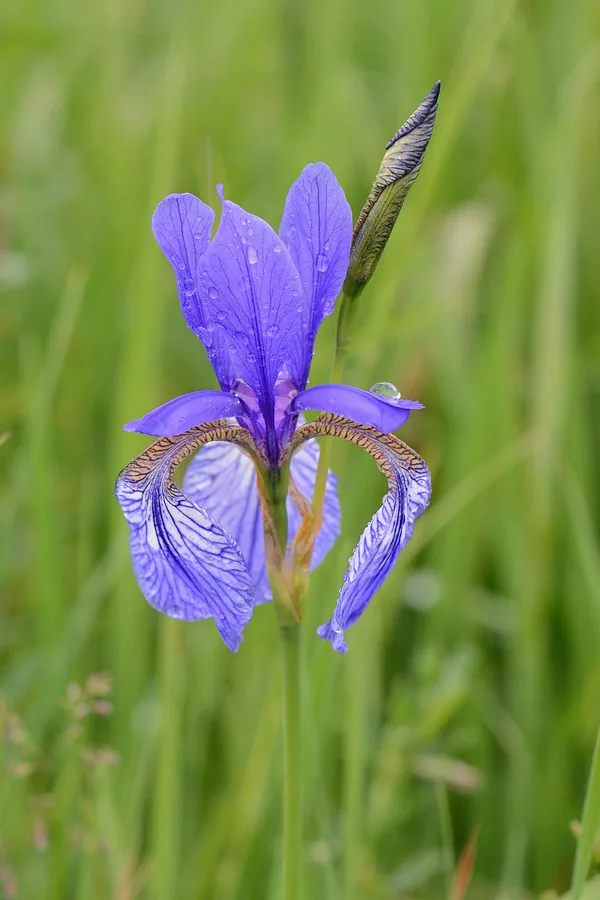
The blooms themselves show the classic iris shape, with downward-arching falls below a set of more upright standards. Across the different cultivars the color shifts from deep purple to soft yellow, and on to a clean, pure white. Each flower sits light and open at the top of its stem rather than crowded against the leaves.
When the flowers finish, the fine, grassy foliage carries on, holding its narrow, upright form and staying green through the summer. The clump fills out to a substantial size, and the leaves keep their slim, blade-shaped profile the whole way. For most of the year it is a plant of leaf more than flower.
Care
The short version: set it in full sun to part shade, keep the soil evenly moist through the season, and give it rich, free-draining ground that shrugs off a boggy patch. Lift and split the dense clump about every 3 years, and it mostly tends to itself.
Light
The clump flowers hardest in full sun, though it holds up in partial shade. It needs 6 hours or more of direct sun daily, or the tall leaf blades bend and flop and only a few flowers open.
Water
Keep the soil evenly damp from the first green shoots of spring until a few weeks past the flowers, when growth is fastest. The roots take wet, boggy ground without complaint, and a settled clump shrugs off a short dry spell after a season or two.
Soil
Plant it in dark, rich, humusy soil that drains freely, though the roots also take ground far soggier than most perennials could stand. It sits happiest at a pH between 6.0 and 7.0.
Temperature
The plant is built to take cold, holding from -40°F to 86°F (-40°C to 30°C). Those grassy blades push up again after the hardest freezes and stand through summer heat.
Humidity
There is no humidity figure to hit; open outdoor air is plenty. What counts is air moving through the fans, since blades packed tight and left damp are where rot can take hold.
Feeding
A single feed in early spring, as the new blades push up, sets the clump for the year. A balanced general-purpose fertilizer or a layer of compost around the base is all it takes.
Pruning
After the flowers brown and drop, cut the bare bloom stems away close to the base. At dividing time, or in late fall once the blades yellow and collapse, shear the whole tuft back to 6 to 8 inches.
Repotting
Lift and split the crowded clump about every 3 years, or sooner once the center dies out. A hollow, leafless middle ringed by living fans, along with fewer blooms, is the plain sign it has packed itself too tight.
Size & spacing
A full-grown clump stands 2 to 4 feet (60 to 120 cm) tall and spreads 2.5 to 3 feet (76 to 91 cm) wide, a broad fountain of upright blades. Set at that spacing, air slips between the fans and the leaves dry quickly.
When to plant
Its year has a clear shape. In colder regions the planting and dividing fall in spring, while the southeast turns to fall. The blooms open in May and June, standing well above the leaf blades, and once they fade the fans of foliage hold the clump through the rest of the year.
Northern hemisphere
Southern hemisphere
Typical months for a temperate climate: start earlier in warm zones, later where spring frosts linger.
- Plant: Spring in cooler-winter regions; fall in the southeast
- Harvest: May to June
Hardiness
USDA hardiness zones: 3–8
Temperature: down to -40°C
Troubleshooting
Siberian iris runs into little trouble, well below what bearded iris suffers. What does show up tends to leave visible marks: pale, sparse flowers, a soft patch at the base, or nibbled leaf edges. Match the look of the damage below to find the cause.
Soft, slimy rot at the base of the fans
A soft, wet, foul-smelling patch where the blades meet the roots is bacterial soft rot, uncommon on Siberian iris beside bearded iris. Cut back to firm, clean tissue and throw the slimy part away, then open up the drainage and keep the crown near the surface. Dry, sound footing under the clump is what holds it off.
Fix:
- Remove and destroy affected tissue
- Improve drainage and avoid burying the crown too deeply
Pale, scarce flowers over flopping blades
Few flowers held over blades that splay and flop usually trace to too little sun or a clump grown dense and crowded. A site with 6 hours of direct sun firms the leaves back up, and a woody, hollow center means it is time to lift and split. Splitting every 3 years keeps the fans tight and upright.
Fix:
- Relocate or thin surroundings to provide full sun
- Divide the clump and replant healthy fans with at least two fans each
Notched, ragged bites along the leaf edges
Torn, notched edges and a dried silver smear across the blades give away slugs and snails grazing at night. The bites are shallow and cosmetic, so lift the pests off by hand in the dark and rake out the wet cover they shelter in. Drier soil around the fans moves them along.
Fix:
- Hand-pick slugs and snails
- Reduce moist hiding spots near plants
Toxicity
For all the softness of its flowers, this is a plant to look at and not to eat. Every part carries irisin and terpenoids, packed most densely into the underground rhizome, and a pet that chews it can end up drooling and sick. The cut roots leak a sap that can leave skin red and irritated, so gloves belong on your hands at dividing time.
Toxic to
Cats · Dogs · Horses · Rabbits · Livestock · Birds · People
Cats Mild
A cat that chews the leaves or roots drools, brings its food back up, then goes limp and quiet. The rhizome carries the strongest dose, so a cat that digs and gnaws below ground suffers most.
Dogs Mild
Heavy, ropey drool and a churning stomach follow a bite, often with loose stools and a flat, tired look. Dogs that dig out and chew the pale roots take the hardest hit.
Horses Mild
A horse that grazes the fans drools, sours in the stomach, and passes loose droppings. Most horses turn away from it, but the plant is safest kept out of their reach.
Rabbits Toxic
The same irisin and terpenoids at work in cats and dogs run right through the plant, leaving it unsafe for rabbits near any hutch or run.
Livestock Toxic
Cattle, goats, and sheep drool and turn sick in the gut after eating the blades or roots, so the plant is best fenced clear of any pasture.
Birds Toxic
The toxins put birds at the same risk, so poultry and pet birds should be kept off the blades and rhizomes alike.
People Caution
No part of this plant is food, and with the rhizome the most toxic piece, curious children are best kept well back. The cut roots weep a sap that reddens and irritates skin, which is why gloves go on before you split a clump.
Wear gloves when dividing or handling, as the sap can cause skin irritation.
Helpline numbers

United States
ASPCA Animal Poison Control: (888) 426-4435 (fee applies)
Poison Control: (800) 222-1222



Canada
Poison Centres: 1-844-764-7669
Varieties
The color range shows most clearly in the named cultivars, which run from the darkest purples through soft yellows to clean white. A few stand out for their form and coloring.
Caesar's Brother
This vigorous old cultivar lifts deep, saturated purple on stiff, upright stems to roughly 3 feet, and it is a named Plant of Merit.
Butter and Sugar
A two-tone flower, its lower falls a soft butter yellow beneath standards of clean white.
White Swirl
Pure, clean white flowers with no other color, bright enough to stand out where the light is low.
Baby Sister
A miniature at just 1 to 1.5 feet, its short fans and small flowers sitting low and neat near the ground.
How to propagate
More plants come from either splitting the clump or sowing seed. Division is quicker and reproduces the parent's exact flower, while seed scrambles the coloring of a hybrid. Most growers split a clump.
DivisionEasy
Late summer or early spring (after bloom) · 6 to 8 weeks to root; may take more than one season to bloom
Division is the quick, sure way to make more, and the tough fans take firmer handling than a bearded iris would. Work in late summer or early spring after the flowers pass: cut the blades down to 6 to 8 inches, drive a sharp blade through the clump so each split holds two fans or more, then bury the pieces under 1 to 2 inches of soil and keep them damp. Pale new roots grip within about 6 to 8 weeks, though a fresh split often holds back its bloom for a whole season.
SeedModerate
Sow when ripe · Several seasons to reach blooming size
Seed is the slow way, and it fits the wild species better than the named kinds, since a hybrid's seedlings come up mixed, not true. Sow the fresh seed the moment it ripens, then wait, because a seedling spends several seasons growing before it is large enough to flower.
Myths
Siberian iris carries the same fat rhizome and borer trouble as bearded iris.
It does not. Its roots knot into a dense, clumping mass with no fat surface rhizome that borers can bore into, and it resists the soft rot that eats away at bearded types. A split about every 3 years is all it asks, and it stays nearly untouched by pests otherwise.
Iris is harmless to have around pets.
Not so. Iris is toxic to cats, dogs, and horses, and the underground rhizome holds the heaviest dose. A pet that bites into the plant can be left drooling and vomiting, with a dull, flat mood and diarrhea in the hours that follow.