Bulb · Iridaceae
Freesia
Freesia refracta
Arching sprays of intensely fragrant winter blooms, each flower opening in turn along one side of a slim wiry stem.
Full sun
Every 3–7 days
61–70°F · 16–21°C
70–84 days
Overview
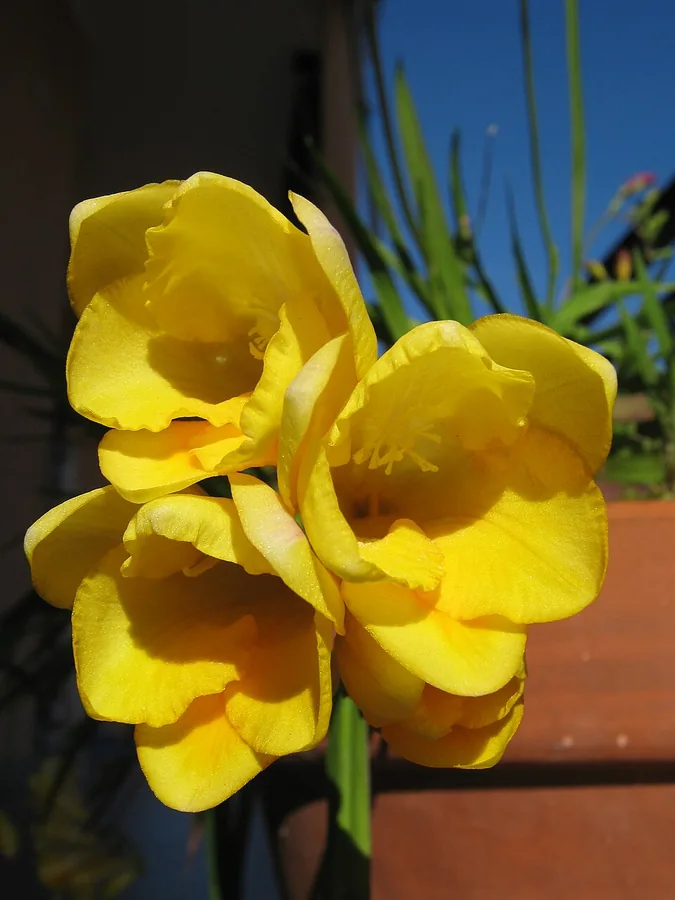
Look closely at a freesia in bloom and the first thing you notice is the stem: thin, wiry, and arching over into a gentle curve. The flowers do not scatter around it. They line up along one side of that single stem, ranked in a row that follows the arc, so the whole spray leans and nods in one direction.
The blooms do not all open at once. They open in sequence, the lowest first and the rest following up the stem, which is why a single spray keeps showing fresh flowers for days. The color runs across white, gold and yellow, blue, and red, and every open flower carries a strong sweet fragrance, with the white forms smelling sweetest of all.
Below the surface, the whole plant grows from a corm, a firm underground store that should feel solid and dry to the touch. When it goes wrong that corm turns soft, brown, and mushy. Above ground the plant stays trim, standing 12 to 24 inches (30 to 60 cm) tall on a slim spread of 6 to 12 inches (15 to 30 cm).
Care
The short version: give freesia full sun and a fast-draining mix, water steadily but lightly through active growth, then ease off as the foliage yellows and the corms slip into dormancy.
Light
Give freesia full sun for the straightest stems and the fullest count of flowers along each arching spray. It will take partial shade, but too much shade shows up plainly in the plant itself: weak floppy stems that cannot hold their arc, and fewer blooms lined up along them.
Water
Keep the mix evenly moist during active growth, watering roughly every 3 to 7 days, but never let the corm sit wet. Standing water below the surface is the one thing freesia will not forgive, and overwatering rots the corms from within. As the foliage yellows, cut back sharply on water and let the plant slide into dormancy.
Soil
Plant into an organic-rich, well-drained potting mix cut with coarse sand or crushed rock so water runs straight through. Aim for a pH of 6.0 to 8.0. Freesia is fussy about drainage above almost everything else, and standing water kills the corms.
Temperature
This is a cool-season plant, happiest between 61°F and 70°F (16°C to 21°C). Heat works against it: hot weather cuts the bloom short, so the fragrant flowering season ends sooner than it should.
Humidity
Average household or garden humidity suits freesia, with no target figure to hit. Good airflow matters more than moisture in the air, since stagnant air around those slim stems and leaves invites pests and rot.
Feeding
Feed monthly through active growth and flowering with a balanced or low-nitrogen liquid fertilizer. Go easy on nitrogen, because heavy nitrogen pushes leaves over flowers, leaving you with foliage instead of the fragrant sprays you planted for.
Pruning
Freesia gets no true pruning. Deadhead the spent flowers as each one finishes along the stem, then let the foliage die back naturally before you lift and store the corms. Those fading leaves are still working, feeding next year's bloom.
Repotting
Freesia is replanted, not repotted. Start each season with fresh or stored corms rather than shifting an established rootball. Lift and divide when crowded corms give fewer, smaller blooms or outgrow their pot.
Size & spacing
Expect a trim plant, 12 to 24 inches (30 to 60 cm) tall with a slim spread of 6 to 12 inches (15 to 30 cm). Set the corms about 1 to 2 inches apart so each has room to send up its own arching spray.
When to plant
Freesia runs on a cool-season clock. Set the corms late summer through early winter, let them grow through the cool months, and the fragrant flowers arrive winter into early spring, about 10 to 12 weeks after planting.
Northern hemisphere
Southern hemisphere
Typical months for a temperate climate: start earlier in warm zones, later where spring frosts linger.
- Sow: Plant corms in pots in late summer through early winter (succession planting extends bloom)
- Plant: In zones 9-10, plant corms in fall; elsewhere grow in containers and overwinter corms indoors
- Harvest: Winter to early spring, about 10-12 weeks after planting
Hardiness
USDA hardiness zones: 9–10
Temperature: down to -7°C
Troubleshooting
Most freesia trouble traces back to water and a handful of common pests. Catch the early signs on the corms and leaves and you can step in before the damage spreads.
Corms turn soft and the plant collapses
The clearest sign of corm rot is a corm gone soft, brown, and mushy, with the plant above it collapsing. The leading cause is overwatering or poorly drained soil; less often it is fusarium wilt or root rot pathogens. Confirm by lifting a corm and looking for soft brown mushy tissue in waterlogged soil. Stop overwatering, improve drainage, discard the rotted corms, and replant healthy ones in a fresh, well-drained, organic-rich mix. Prevent it with a fast-draining mix cut with coarse sand or crushed rock, and never overwater. Severity: severe.
Fix:
- Stop overwatering and improve drainage
- Discard rotted corms
- Replant healthy corms in fresh, well-drained organic-rich mix
New growth twists and leaves turn sticky
Distorted, twisted new growth and sticky, shiny leaves, sometimes with small insects visible, point to aphids or thrips. Confirm by inspecting the new growth and the undersides of leaves for clusters of aphids or the slim bodies of thrips. Rinse them off with a jet of water, and step up to insecticidal soap if the problem persists. Prevent it by inspecting regularly and keeping air moving around the plant. Severity: setback.
Fix:
- Rinse off insects with water
- Treat with insecticidal soap if infestation persists
Chewed leaves and silvery trails
Chewed leaves and flowers with irregular holes, plus silvery slime trails that show up after watering or rain, are the mark of slugs and snails. Confirm it by pairing those irregular holes with the silvery trails, most often seen after watering. Hand-pick them in the evening, and set out bait or barriers. Prevent it by avoiding overly wet conditions and clearing away the debris where slugs hide. Severity: cosmetic.
Fix:
- Hand-pick slugs and snails
- Use bait or barriers around plants
Toxicity
Freesia is a safe choice for a home with animals. The ASPCA lists it among non-toxic bouquet flowers, with no report of real poisoning in pets or livestock. A pet chewing on a stem might get nothing worse than a brief mild stomach upset.
Safe for
People · Cats · Dogs · Horses · Rabbits · Livestock · Birds
Cats None
Safe for cats, with nothing toxic in the leaves, flowers, or corms. A curious nibble might bring a brief mild stomach upset, the kind any off-diet plant can cause.
Dogs None
No poisoning risk for dogs. The worst you might see is a little drooling or a loose stool after a dog eats something it should have left alone.
Horses Safe
No known toxins for horses. A mouthful of foliage passes through with at most a passing digestive grumble.
Rabbits Safe
Rabbits are not at risk, since nothing in the plant is poisonous. A sudden large helping of any new green could loosen the gut, so introduce it slowly.
Livestock Safe
Cattle, goats, and sheep face no poisoning from grazing the foliage. As with any animal, unfamiliar plant material can cause a mild, short-lived upset.
Birds Safe
No toxic threat to pet or backyard birds. Nothing about freesia warrants keeping a bird away from it.
People Safe
Not poisonous to people, which is why it is so common in cut bouquets. It is not grown to be eaten and there is no reason to taste it, but a stray bit does no harm.
Non-toxic, but ingestion of plant material that is not part of a pet's normal diet may cause mild stomach upset.
Varieties
Freesia flowers span a wide color range, from white through gold, blue, and red. A few named cultivars turn up more often than the rest.
Royal Blue
Royal Blue is a blue-flowered cultivar, an uncommon color among the warmer freesia shades.
Golden Passion
Golden Passion is a gold to yellow form grown above all for its strong sweet fragrance.
White River
White River is a white-flowered cultivar, and white forms are reported to carry the richest scent of all.
Red Lion
Red Lion is a red-flowered cultivar that brings the boldest color to a freesia planting.
How to propagate
Freesia is easy to multiply. Split the corms you already have, or simply start fresh from a new bag.
Offsets & pupsEasy
Lift and separate offset cormels when foliage yellows and the plant goes dormant · Replant and bloom the following season (about 10-12 weeks after replanting)
Dividing corms and offsets is the easiest and most reliable route. Wait until the foliage yellows and the plant goes dormant, then lift the clump and pull apart the small cormels ringed around the parent corm. Replanted the next cycle, they bloom about 10 to 12 weeks later.
Bulbs & cormsEasy
Plant corms in late summer through early winter for winter to early spring bloom · Flowers normally appear 10-12 weeks after planting
Starting from bought corms is just as simple. Plant them 1 to 2 inches deep and 1 to 2 inches apart, pointed end up, in a well-drained mix, any time from late summer through early winter. Flowers follow about 10 to 12 weeks later, from winter into early spring.
SeedModerate
Sow seed in the growing season · Seed-grown plants take 1-2 years to reach flowering size
Growing from seed works but is slow. Sow during the growing season, and expect the plants to need 1 to 2 years to reach flowering size. It is slower than division, so few home gardeners bother with it.
Myths
Freesia corms can be left in the ground all year in any climate.
Freesia is frost-tender and hardy only in USDA zones 9 to 10, where the corms can stay outdoors and return yearly. In colder areas the corms must be lifted and stored, or the plants grown in containers and overwintered indoors. A hard freeze finishes them, so leaving corms in cold ground is a loss waiting to happen.
Freesia is poisonous to cats and dogs.
The ASPCA lists freesia among its non-toxic bouquet flowers, and it is not reported harmful to pets. A nibble may bring a little mild stomach upset, the same as most plants outside an animal's usual diet. That is ordinary tummy grumbling, not real poisoning.