Tree · Altingiaceae
Sweetgum
Liquidambar styraciflua
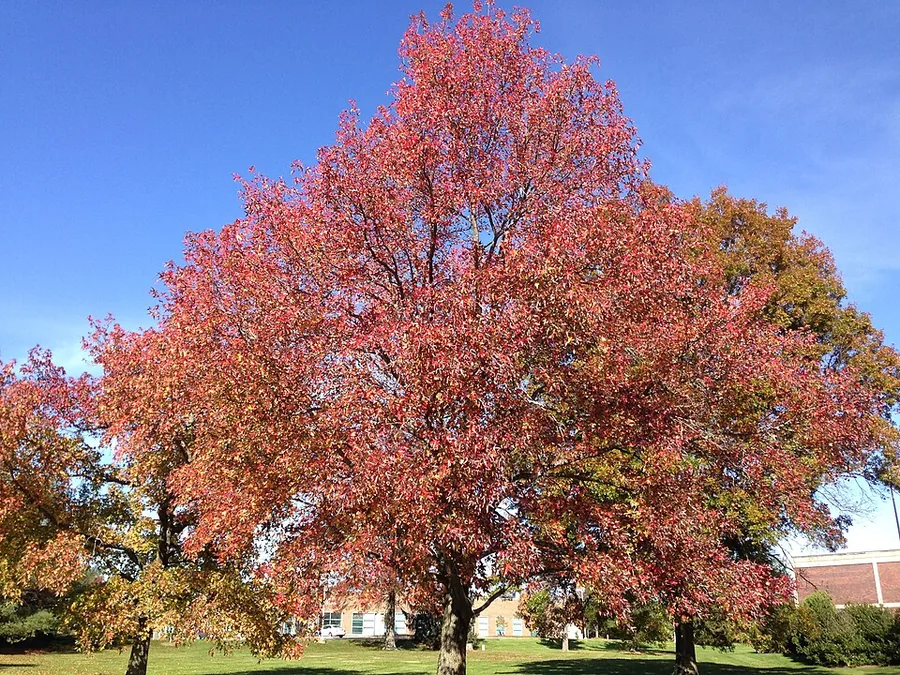
In deep, acidic soil and full sun, the sweetgum unfurls star-shaped leaves that ignite yellow, orange, red, and deep purple by fall.
Full sun
Every 7–14 days
USDA 5–9
60–100 ft · 18.3–30.5 m
Overview
Up close, the sweetgum shows its hand in two features: the star-shaped leaves, each spread into pointed lobes like an open palm, and the corky, ridged bark that furrows and roughens the trunk. It is a fast grower, and a mature tree lifts a broad pyramidal crown to 60 to 100 feet (18 to 30 m), the star-cut foliage layered thick from the low branches to the high.
The autumn turn is the tree's loudest moment. The star leaves flood from green into yellow, then orange, red, and a deep purple, and a single branch can hold several of those colors at once. Then come the gumballs, hard brown spheres bristling with stiff points, each roughly 1 to 1.5 inches wide, that ripen and drop across the ground from December into spring.
In spring the tree flowers without fanfare, hanging small, yellow-green blooms that are easy to miss against the new leaves in April and May. The bark stays corky and deeply ridged the year round, and the wide, shallow roots trace along at the surface. The whole tree reads as texture, from star-cut leaf to spiny fruit to furrowed trunk.
Care
The short version: sweetgum wants full sun and deep, moist, acidic soil at pH 7 or less, water for young trees through their first seasons, and wide, open ground away from paving, where the surface roots run shallow and the spiny gumballs fall.
Light
Sweetgum colors deepest and grows densest in full sun, which fills out its form and sharpens the fall reds and purples. It will hold in partial sun or partial shade, though the star leaves thin and the color fades as the light drops.
Water
A young tree drinks steadily through its first seasons and again in drought, taking a deep soak every 7 to 14 days as it roots. It leans toward deep, moist bottomland ground, yet a grown tree turns fairly drought tolerant once its roots stretch out.
Soil
The roots want deep, moist, fertile, slightly acidic loam that drains clean, though they will grip clay and sand as well. Held at 7.0 or less, from 5.5 to 7.0, the soil keeps iron within reach; let it turn alkaline and the leaves pale to yellow.
Temperature
The wood is tough through cold and heat alike, riding out roughly -20°F to 95°F (-29°C to 35°C). That hardiness carries the tree across USDA zones 5 to 9.
Humidity
The tree asks nothing of humidity, taking the open air as it comes. As a large landscape tree, it lives on whatever moisture the sky and soil provide.
Feeding
A settled sweetgum feeds itself and asks for little. A balanced complete fertilizer goes down in early spring only when growth looks thin, and chelated iron or sulfur clears the yellow of iron chlorosis where the soil runs high in pH.
Pruning
The tree needs little pruning to keep its shape. In late winter, cut away dead, damaged, or crossing wood, and coax one strong central leader up the middle while the tree is young.
Repotting
Sweetgum is built for open ground, not a pot, so no repotting follows once it is planted. Roots winding the inside of a nursery container, threading out the drainage holes, or a stalled crown all mark a tree that has outgrown its pot.
Size & spacing
Full grown, the tree stands 60 to 100 feet (18 to 30 m) tall under a crown 40 to 60 feet (12 to 18 m) across. Set it at least 8 to 10 feet from curbs and paving, where the thick surface roots would buckle the stone in time.
When to plant
The sweetgum wakes slowly, setting roots before it reaches for height. Its seed takes a winter chill and sows in late winter to spring, while a nursery tree goes in during spring, when the shallow roots have the whole season to spread. The tree stays hardy across USDA zones 5 to 9.
Northern hemisphere
Southern hemisphere
Typical months for a temperate climate: start earlier in warm zones, later where spring frosts linger.
- Sow: Late winter after 1-3 months cold stratification
- Plant: Spring (preferred) due to shallow, slow-to-establish root system
- Harvest: Inconspicuous yellow-green flowers April to May; spiny gumball fruits ripen in fall and drop December to April
Hardiness
USDA hardiness zones: 5–9
Temperature: down to -29°C
Troubleshooting
Most of what troubles a sweetgum shows on the surface, in a leaf or a patch of bark, rather than deep in a failing tree. The two worth close attention are the yellow cast that alkaline soil brings and the litter of spiny fruit. Match what your eyes find below.
Sunken bark weeping dark sap
A sunken, discolored patch on the trunk that seeps dark sap, with branches dying back above it, is bleeding canker disease. It works into wood already worn by stress or a wound, so a drought-strained or freshly moved tree shows it first. Cut the sick branches away well below the sunken bark and burn them, keep the tree watered and rightly placed, and spare the trunk from mower and trimmer scars.
Fix:
- Prune out and destroy affected branches well below cankered tissue
- Maintain vigor with adequate water and proper siting
- Avoid mechanical trunk wounds from mowers and trimmers
Yellow leaves veined in green
When the newest leaves fade to pale yellow while their veins stay a sharp green, the tree is showing iron chlorosis. Alkaline soil has locked the iron away from the roots, and a soil test above 7.0 makes it plain. Elemental sulfur pulls the pH down, chelated iron reaches the leaves by soil or spray, and clearing the drainage lets the iron move again.
Fix:
- Test and lower soil pH toward acidic with elemental sulfur
- Apply chelated iron to soil or as foliar spray
- Improve drainage and avoid planting in alkaline sites
Chewed leaves and silken webbing
Ragged, chewed leaves and pale silken nests strung in the branches point to fall webworm first, then tent caterpillars, bagworms, and leaf miners, with scale and borers moving in on a tree already weakened. Cut out and burn the nests, coat scale with horticultural oil, and keep the tree strong so borers find no soft wood. A healthy tree wears a little chewing without harm.
Fix:
- Prune out and destroy webworm and bagworm nests
- Control scale with horticultural oil; keep trees vigorous to limit borers
- Tolerate minor caterpillar feeding on healthy established trees
Spiny brown balls underfoot
The hard brown spheres scattered under the canopy are the tree's gumballs, the spent seed capsules a mature female sheds in heaps from December to April. Each is a bristling knot of stiff points, 1 to 1.5 inches across, that rolls and jabs underfoot. Rake them as they drop, or plant a fruitless Rotundiloba and keep the tree back from paths and play areas to be rid of them.
Fix:
- Rake and remove gumballs regularly
- Plant fruitless or low-fruit cultivars such as Rotundiloba where litter is a concern
- Site the tree away from walkways, patios, and play areas
Spotted leaves falling early
Dark flecks and blotches across the foliage, followed by an early fall of leaves, are fungal leaf spot, worst after a wet spring or summer. The marks are skin-deep and cosmetic, so no fungicide is needed. Rake and clear the fallen leaves to take the spores with them, and keep the tree in good health.
Fix:
- Rake and remove fallen leaves to reduce inoculum
- Maintain good air circulation and tree vigor
Toxicity
Nothing on the sweetgum carries poison, so it is not poisonous to a household. The ASPCA lists it nowhere among its toxic plants for cats, dogs, or horses, and the leaves and bark hold no toxin. The only real threat is the fruit itself, those hard, spiny gumballs, stiff enough to prick a paw or choke a pet or child that mouths one.
Safe for
People · Cats · Dogs · Horses · Rabbits · Livestock · Birds
Cats None
No poison to fear. A cat can rub along the leaves and rough bark unharmed, though a spiny gumball on the ground can still bite into a paw.
Dogs None
Safe for a dog. The leaves hide no toxin, and the only worry is a dog closing its jaws on a hard, spiny ball, a choking or blockage risk rather than a poison.
Horses Safe
No threat to horses. The tree holds no compound that could sicken an animal at graze.
Rabbits Safe
Harmless to rabbits, with nothing poisonous anywhere in the plant.
Livestock Safe
Cattle, goats, and sheep may graze beside a sweetgum with no chance of poisoning.
Birds Safe
No harm to birds, which pry the seeds from the split, dried gumballs.
People Safe
No poison to people. The one hazard is that spiny ball, easy to roll an ankle on or for a small child to slip into the mouth.
No poisoning risk from foliage. Watch pets and children around fallen spiny gumballs, which can injure paws and feet or cause obstruction if swallowed.
Varieties
The named sweetgums differ most in the shape of their leaves and the color they strike in fall. These are the selections worth telling apart.
Rotundiloba
An essentially fruitless cultivar whose leaf lobes curve round instead of tapering to points, leaving the branches clear of the spiny gumballs.
Slender Silhouette
A narrow, columnar form barely 5 to 6 feet wide, a tall green pillar that sets only a scattering of fruit.
Worplesdon
A broadly pyramidal to oval tree with deeply cut, finger-like lobes that flush purple, orange, and yellow in fall.
Moraine
Reputed the most cold-hardy of the lot, its leaves turning a clean, dependable red each fall.
Burgundy
The cultivar that deepens to a rich burgundy-red in fall, though it bears cold a little less readily than the rest.
How to propagate
Sweetgum grows chiefly from its seed, shaken from the dried gumballs, while named cultivars are grafted to hold their form. Cuttings root only reluctantly, so seed and grafting do the work.
SeedModerate
Sow stratified seed in late winter to spring · Seedlings establish over 1 to 2 growing seasons; some seed may take up to 2 years to germinate
Seed is the common way in, shaken from the dried gumballs gathered in fall. Give it a cold rest of 1 to 3 months before sowing in late winter to spring. The sprouting comes slow and ragged, some seed sitting up to two years, and the seedlings need one to two growing seasons to take firm hold.
Stem cuttingsDemanding
Summer, from half-ripe (semi-hardwood) wood · Several months to root, often with low success
Cuttings fight the grower. Half-ripe semi-hardwood, taken in summer over bottom heat with rooting hormone, needs several months to root and often fails outright, which leaves seed the surer path.
GraftingDemanding
Late winter to spring onto seedling rootstock · One to two seasons to establish a grafted plant
A named cultivar will not repeat itself from seed, so it is grafted or budded onto seedling sweetgum rootstock in late winter to spring. That union is how a fruitless Rotundiloba keeps its bare, rounded character, and the joined tree settles over one to two seasons.
Myths
Sweetgum gumballs are poisonous and can harm a dog or cat that touches or chews them.
For all their menacing spines, the gumballs carry no poison, and the ASPCA lists sweetgum as non-toxic to cats and dogs. The danger is the shape, not any toxin, since a stiff, spiny ball can gouge a paw or lodge in a throat if swallowed, yet nothing in it will poison a pet.
Planting a Rotundiloba sweetgum guarantees a completely fruitless tree forever.
Rotundiloba alone is called essentially fruitless without a caveat, its rounded leaves matched by all but bare branches. Low-fruit cultivars like Slender Silhouette can still hang a few spiny balls in time, so fruitless is the aim rather than a promise cast in stone.