Shrub · Clethraceae
Summersweet
Clethra alnifolia
Give it steady moisture and a little shade, and summersweet raises fragrant, upright spikes long after other shrubs have finished for the year.
Partial shade
Every 3–7 days
USDA 3–9
3–8 ft · 0.9–2.4 m
Overview
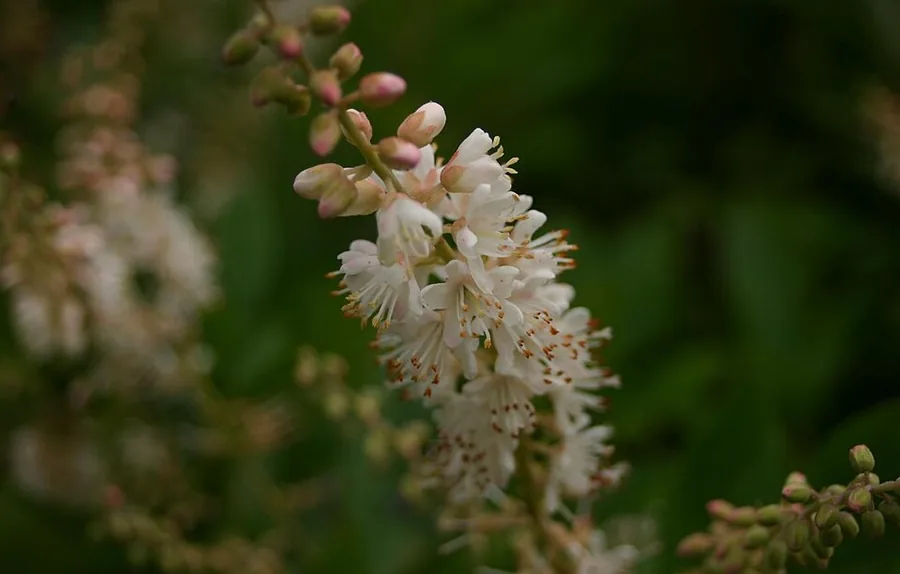
Summersweet earns its name in July and August, when slender bottlebrush spikes of fragrant white or pink flowers stand upright above the leaves as the rest of the garden fades. Each spike is a narrow, cylindrical column packed tight with small blooms along its length. The shrub belongs to the Clethraceae family and grows wild along the eastern seaboard in damp woods and beside streams, and that wetland origin is the heart of it, since this is a plant that thrives with wet roots.
The green summer foliage clothes a rounded, moderate-growing shrub, and in fall those leaves turn a clean golden yellow before they drop. Hardy from zone 3 to zone 9, it holds up through hard winters and takes clay, salt, and standing water that would sink most shrubs. Through the warm months the flower spikes stay busy with the bees and butterflies drawn to their scent.
Give it the moist, acidic ground it wants and it grows into a full, leafy mass with little fuss. Its one weak point is a hot, dry site, where the leaf surface bronzes and spider mites gather. Set it somewhere damp with a bit of afternoon shade and it thickens, sucker by sucker, into a fragrant, spreading colony.
Care
The short version: partial shade to full sun, in moist to wet, acidic soil that never dries out, watered through the heat, pruned in late winter, and fed once in spring.
Light
Summersweet shows its fullest spikes in partial shade but grows on from full sun to deeper shade. A little direct light lifts the flower count, yet it still raises spikes where many shrubs stand bare, which makes it a rare sight in a shadier corner.
Water
Keep the soil evenly moist to wet so the leaves never wilt and bronze. Water every 3 to 7 days, and more often while a young plant roots in or through a dry spell. This is a streamside shrub at heart, so damp roots keep it firm and green where thirst would not.
Soil
Sink its roots into moist to wet, acidic ground dark with organic matter. A pH from 4.5 to 7.0 keeps the foliage healthy, and unlike fussier shrubs it drives its roots through heavy clay and soggy, low-lying ground.
Temperature
Cold leaves no mark on it. The wood is hardy from roughly -29°F to 100°F (-34°C to 38°C), holding firm through zone 3 winters and the heat of southern summers alike.
Humidity
Plain outdoor air suits the leaves, so there is no number to track. Moisture at the roots is what shows on the foliage, since dry air over dry soil is what leaves the surface stippled and bronze under mites.
Feeding
One spring feeding keeps the leaves deep green. A balanced or acidifying fertilizer for acid-loving plants holds the soil on the sour side those roots want.
Pruning
Because the spikes rise on new wood, cut in late winter or early spring, while the shrub is bare, to shape it and check its size with no loss of bloom. The pale root suckers come off too, unless a spreading clump is the aim.
Repotting
In open ground the roots rarely need touching. In a pot, repot only once roots coil against the wall, poke from the drainage holes, or water runs straight through the packed mass without soaking in.
Size & spacing
A mature shrub builds to 3 to 8 feet (91 to 244 cm) tall and fills 4 to 6 feet (122 to 183 cm) across in a rounded mound. Leave room for that full width, and expect fresh shoots to sucker out past the original crown.
When to plant
Summersweet is set in the ground in spring or fall, while the air stays mild and the roots take hold before the next stretch of heat or cold. The upright, fragrant spikes come on their own in July and August, borne on green growth the plant pushes out that same year.
Northern hemisphere
Southern hemisphere
Typical months for a temperate climate: start earlier in warm zones, later where spring frosts linger.
- Plant: Spring or fall
- Harvest: July to August
Hardiness
USDA hardiness zones: 3–9
Temperature: down to -40°C
Troubleshooting
Nearly every fault you will read on a summersweet leaf traces to one thing: a spot that runs too hot and too dry. The foliage tells the story early, in stippling and bronze and droop, and most of it reverses once the moisture is right. Match what you see below, then act before the damage deepens.
Fine stippling and bronze cast under thin webbing
When the green leaf surface breaks into fine pale speckles and takes on a dull bronze cast under a thin veil of webbing, the cause is spider mites, which move in on a plant left too hot and too dry. A hard jet of water strips the mites and their webs from the leaves, and keeping the soil moist ends the stress that let them settle. A heavier film clears under insecticidal soap or horticultural oil.
Fix:
- Spray foliage with a strong stream of water to dislodge mites
- Improve soil moisture and avoid hot, dry sites
- Apply insecticidal soap or horticultural oil to affected foliage if needed
Limp, yellowing leaves on a parched shrub
Leaves that hang limp and turn yellow, on a shrub with little life left in it, point to drought stress rooted in the planting spot rather than in your care. Summersweet holds its green best on steady moisture and slackens quickly in dry heat. More frequent watering firms the leaves back up, a blanket of mulch keeps the moisture at the roots, and a shrub that stays limp recovers in a cooler, damper, partly shaded spot.
Fix:
- Increase watering frequency to keep soil evenly moist
- Mulch to conserve moisture and keep roots cool
- Relocate to a moister, partly shaded site if chronically stressed
Toxicity
Reassuring news for homes with animals or small children. Summersweet is not on the ASPCA toxic-plant lists and is treated as non-toxic and pet-safe. The worst a stray bite of leaf is likely to bring is a brief, mild stomach upset, the same as with almost any garden plant.
Safe for
People · Cats · Dogs · Horses · Rabbits · Livestock · Birds
Cats None
A cat can bat at the leaves and even bite one without harm, since summersweet is not on the ASPCA toxic list. The worst a chewed leaf brings is a short bout of stomach upset, no different from any other plant.
Dogs None
A dog nosing through the green stems finds nothing dangerous, as the shrub holds no known toxin. Should one swallow a whole mouthful of leaves, the most that follows is a little drooling or a soft stool.
Horses Safe
Horses can crop the leafy growth in passing with no ill effect, since the plant carries no harmful compounds. A few leaves taken from the branch tips leave them untroubled.
Rabbits Safe
A rabbit can nibble the low leaves and shoots safely. Nothing in the green tissue is poisonous, so a stray bite does no damage.
Livestock Safe
Cattle, goats, and sheep can browse the foliage beside them without risk. The leaves and stems hold none of the toxins that harm grazing animals.
Birds Safe
Birds moving among the branches are perfectly safe, and the fragrant flower spikes hum with the bees and butterflies they draw. Nothing on the plant is a hazard to them.
People Safe
The leaves and flowers are not toxic to people. Summersweet is not a plant to eat, yet a curious child who tastes a leaf meets nothing worse than a possible mild stomach ache.
As with any plant, ingestion of large amounts of plant material may cause mild, transient stomach upset.
Varieties
Several named summersweet selections reach nurseries, told apart mostly by size and by the color and set of their flower spikes. These are the ones worth knowing.
Hummingbird
A compact dwarf that holds around 2 to 4 feet tall and crowds its frame with thick, densely packed white flower spikes.
Ruby Spice
Its spikes carry deep pink flowers that keep their saturated color from first open to last instead of bleaching pale.
Pink Spire
Pink buds unfurl into slender spikes of soft pink, fragrant flowers.
Sixteen Candles
Stiff, upright white spikes rise like tapers well clear of the leaves on a tight, compact frame.
Companions
Summersweet pairs best with other natives that share its love of wet, acidic ground, the kind of partners that thrive in a rain garden or a damp, shaded border.
Plant near
Itea virginica (Virginia sweetspire): Shares the same moist, acidic soil and sun-to-part-shade conditions for wet-site and rain-garden plantings.
Ilex verticillata (winterberry): Native shrub that thrives in the same wet to moist soils and pairs well in naturalized and pollinator plantings.
How to propagate
Summersweet is easy to increase, and the suckering habit that some gardeners fight, those new shoots rising at the clump's edge, is exactly what makes free plants so easy to come by.
DivisionEasy
Late winter to early spring · 1 to 2 growing seasons
The simplest route lifts the small rooted suckers that push up around the edge of a clump. Prised out in late winter or early spring and reset in the ground, each thickens into a full shrub over 1 to 2 growing seasons.
Stem cuttingsModerate
Early summer (softwood) · Several weeks to root, then 1 season to establish
Soft, bendable stem tips cut in early summer root under mist or a humidity cover. Fine white roots break from the stem base within a few weeks, and the young plant then takes about a season to establish.
SeedModerate
Sow collected seed in fall or after cold stratification · 1 to 2 seasons
The seed is dust-fine and sits on the soil surface, sown in fall or after cold stratification because it wakes only with light and a chill. It takes 1 to 2 seasons to build into a plant, and seedlings of named cultivars will not match the parent.
Myths
Summersweet only blooms well in full sun.
It is one of the few flowering shrubs that sets full spikes in part shade. The fragrant, late-summer flower spikes still form in the shaded spots where most shrubs give only bare stems.
Prune summersweet right after it flowers to get more blooms.
The spikes form on new, current-season wood, so the cut belongs in late winter or early spring while the shrub is bare. A trim then strips away none of the coming season's flowers, since that flowering growth has yet to appear.