Shrub · Iteaceae
Virginia Sweetspire
Itea virginica
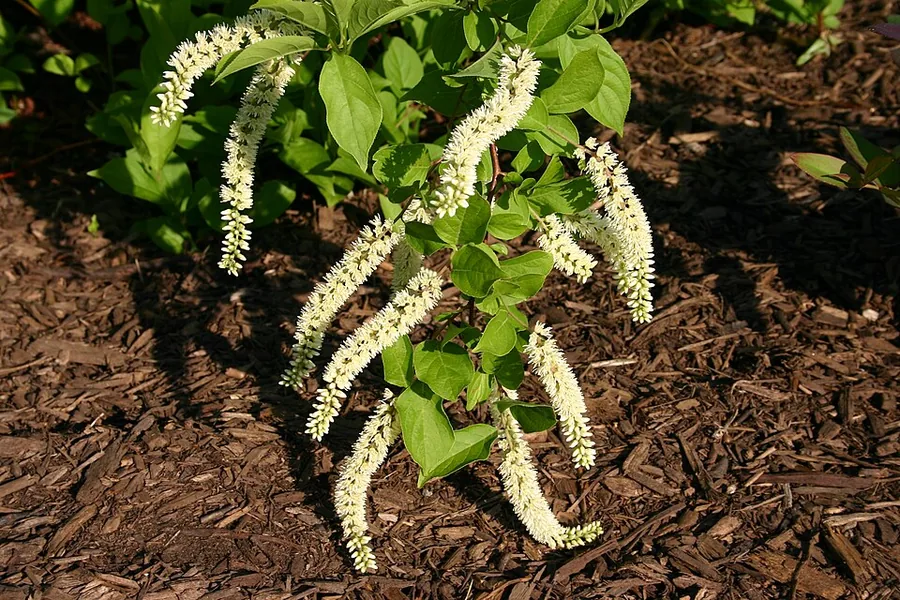
Arching stems hung with slender white spires, then leaves that turn deep red and burgundy.
Full sun
Every 3–7 days
USDA 5–9
3–8 ft · 0.9–2.4 m
Overview
Virginia sweetspire is a native shrub whose character shows in its silhouette: slender, arching stems that lean out and down rather than standing stiff. It grows wild along the wet woods and stream banks of the eastern United States. Give it room and moisture, and those arching canes fill in on their own.
Twice a year the plant changes its look completely. In late spring, the arching stems line up with narrow white flower spires, each one a slim, tapering plume of fragrant bloom. Then in autumn the foliage shifts to deep red and burgundy, a saturated color that clings to the branches long after nearby leaves have browned and dropped.
Below ground the shrub is just as active. Sweetspire sends up suckers that break the soil as fresh shoots and thicken into a colony of stems. In a wet, open spot those new canes weave into a dense, low stand. In a tidy bed the stray shoots stand out and want cutting back each year, so the plant's spreading roots shape where it looks best.
Care
The short version: set it in moist to wet, slightly acidic soil under full sun to part shade, keep the water steady while it roots, and prune only right after the white spires fade.
Light
Sweetspire takes light across the whole range, from full sun to full shade. Some direct sun brings out the best of it, though: in deep shade the white spires come in thin and the red autumn color washes toward a dull, muddy tone.
Water
This shrub reads as a lover of wet ground, and it wants soil kept moist to soggy. It stands through flooding, heavy clay, and slow-draining pockets, the reason it settles so well along streams and in rain gardens. An established plant endures a dry stretch, but its stems and leaves look fullest with steady moisture.
Soil
Root it in moist, fertile soil thick with organic matter, held slightly acidic at a pH of 5.0 to 7.0. It takes to clay and wet ground, but in alkaline soil the leaves pale and yellow with chlorosis, the green draining out between the veins.
Temperature
The bare canes are tougher than they look. Sweetspire withstands winter lows near -20°F (-29°C) and summer heat to 100°F (38°C), a span that carries it through zones 5 to 9.
Humidity
Air moisture leaves no mark on this shrub outdoors, and there is no level to watch. Shaped by damp woodland, its stems and foliage take the day's weather as it comes.
Feeding
It draws little from the soil and feeds lightly. A single spring dose of balanced fertilizer, or a scattering of compost over the roots, keeps the canes and foliage growing full.
Pruning
The flower buds ride on old wood, so timing shapes the next display. Cut the arching stems back right after the spires fade and before new buds set in late summer, thinning out suckers and worn old canes so the fresh growth stands clear.
Repotting
Grown in the ground, sweetspire seldom needs repotting. In a pot, its roots signal a move when they circle the rootball, when water slides straight through, or when the stems stall despite steady watering.
Size & spacing
The stems climb to 3 to 8 feet (91 to 244 cm) and the clump widens to 3 to 6 feet (91 to 183 cm), with suckers pushing the edge out further. Leave space for that spread, or plant compact forms close for a low, dense sheet of arching growth.
When to plant
Hardy through zones 5 to 9, sweetspire holds up to winter lows near -20°F (-29°C) on its bare, arching canes. Plant it in spring or fall, look for the white flower spires from late spring into early summer, and watch the leaves flush red and burgundy once the nights turn cold.
Northern hemisphere
Southern hemisphere
Typical months for a temperate climate: start earlier in warm zones, later where spring frosts linger.
- Plant: Spring or fall
- Harvest: Late spring to early summer (May to June)
Hardiness
USDA hardiness zones: 5–9
Temperature: down to -29°C
Troubleshooting
For all its show, sweetspire is an untroubled plant with no serious pests or diseases. When its looks slip, the cause usually traces to where it sits or when it was cut. The symptoms below describe what you will see and how to set it right.
Fresh canes breaking ground beyond the clump
The new stems are the visible sign that sweetspire suckers from the roots, thickening year by year into a dense colony of canes. Cut or dig the stray shoots at ground level while they are young, or sink a barrier below the soil and keep a clean edge to pen the clump in. Where a broad thicket of stems looks right, let it run; where it does not, start with a compact cultivar.
Fix:
- Dig out or cut unwanted suckers at ground level as they appear
- Install a root barrier or site the plant where colony spread is acceptable
- Mow or edge the perimeter regularly to limit lateral expansion
Leaves paling yellow between green veins
The washed-out yellow with a lace of green veins is chlorosis, the look of iron the roots cannot reach because the soil sits too alkaline. A soil test names the cause, and lowering the pH with elemental sulfur or acidic organic matter cures it at the source. Chelated iron and a blanket of pine-bark mulch restore the green while the pH eases down.
Fix:
- Test soil pH and amend with elemental sulfur or acidifying organic matter to lower pH
- Apply chelated iron as a temporary corrective measure
- Mulch with acidic organic matter such as pine bark
Thin spires and a dull, faded autumn
Sparse flowers and a flat, brownish fall are the marks of too much shade and badly timed pruning. In heavy shade the spires come in few and the red color never deepens, so move the plant where direct sun reaches it each day. Because the buds form on old wood, cut only once the spires have faded, never in late winter or spring.
Fix:
- Site or transplant to a location receiving at least some direct sun each day
- Prune only immediately after flowering, not in late winter or early spring
Toxicity
Beyond its looks, sweetspire is safe from top to bottom. It does not appear on the ASPCA toxic-plant list and holds no real danger for cats, dogs, horses, livestock, birds, or people. The most a large mouthful of its leaves could bring on is a brief, passing stomach upset.
Safe for
People · Cats · Dogs · Horses · Rabbits · Livestock · Birds
Cats None
Sweetspire is missing from the ASPCA toxic list, so a cat that bites into a leaf is safe. A large mouthful, at most, passes with a little mild stomach upset.
Dogs None
Dogs are safe with it as well. Chewed foliage does no real harm, and only a large helping might bring on a short spell of loose stool, as any plant can.
Horses Safe
No toxicity to horses is known, and a grazing horse can strip and eat the leaves without harm.
Rabbits Safe
Rabbits can crop the foliage freely, since the plant carries no toxin that reaches them.
Livestock Safe
Cattle, goats, and sheep take no harm from this native shrub, which holds no compound that troubles grazing stock.
Birds Safe
Birds are safe among its stems. Songbirds work through the plant, and its seeds and the insects it draws are part of why it belongs in a wildlife garden.
People Safe
The shrub is harmless to people. It is not grown to be eaten, but a child who tastes a leaf comes to no harm.
No special handling precautions are required for toxicity; as with any plant, ingestion of large amounts of foliage could cause mild, transient gastrointestinal upset.
Varieties
The named selections differ most in their size and their color, from the length of the spires to the tone of the fall foliage. Three stand out.
Henry's Garnet
A Missouri Botanical Garden Plant of Merit reaching 3 to 5 feet tall and 4 to 6 feet wide, hung with longer flower spires and lit in a deeper red-burgundy come fall than the wild species.
Little Henry (Sprich)
A dwarf holding to about 2 to 3 feet on every side, its stems tipped with creamy-white spires that give way to yellow, orange, and red foliage in autumn.
Scentlandia (SMNIVDFC)
A compact form with a stronger-scented flower and firmer buds that hold up through cold better than most.
Companions
Sweetspire pairs naturally with other natives that share its taste for moist, acidic ground, which makes it a mainstay of rain gardens and wet borders.
Plant near
Inkberry holly (Ilex glabra): Another native shrub tolerant of moist, acidic soils, pairing well in rain gardens and naturalized wet borders.
Summersweet (Clethra alnifolia): Shares preference for moist to wet acidic soils and part shade, complementing sweetspire in pollinator and rain-garden plantings.
How to propagate
Sweetspire lends itself to propagation, and its habit of suckering and rooting along low, arching stems opens up several easy methods.
Stem cuttingsEasy
Spring to early summer using softwood cuttings · Several weeks to root; transplantable the following season
Softwood cuttings snipped from the new growth between spring and early summer strike roots without much coaxing. Over several weeks they build a root system, and the young plants shift to their permanent ground the following season.
DivisionEasy
Dormant season or early spring · One season
The mass of suckers makes division easy: lift a clump in the dormant season or early spring and pull the rooted shoots away from the parent crown. Each piece knits in over a single season.
LayeringEasy
Spring to summer · One growing season to root
The low, arching stems root themselves wherever a branch presses into damp soil. Pin one down in spring or summer, let roots form across a single growing season, then sever the new plant from the parent.
SeedModerate
Sow collected seed; slower than vegetative methods · Multiple seasons to reach landscape size
Collected seed will grow, but slowly. The seedlings come up more varied than cuttings or divisions and take several seasons to build into a plant of any real size.
Myths
Virginia sweetspire is a poisonous shrub around pets.
It is not. Itea virginica has never appeared on the ASPCA toxic-plant list, and it stands as safe around cats and dogs. A leaf pulled off and chewed does nothing worse than the mild stomach upset any plant can cause when a lot goes down.
The arching stems can be cut back at any time.
Shear the stems in late winter or spring and the buds come off with them, before a single spire can open. Sweetspire carries its flowers on the previous season's wood, so the one moment to cut is right after the spires brown and fade. Timed that way, the plant stays shapely and the next crop of white spires is safe.