Houseplant · Asteraceae
String of Pearls
Curio rowleyanus
Round green beads the size of peas thread down every trailing stem of this succulent.
Bright indirect
50–81°F · 10–27°C
USDA 9–12
1–3 ft · 0.3–0.9 m
Overview
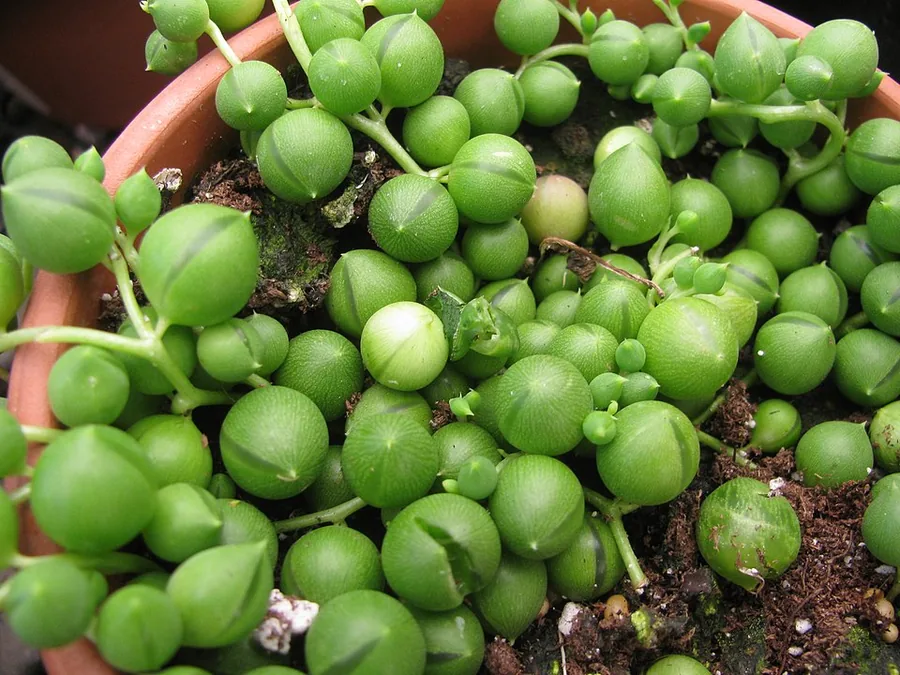
Up close, string of pearls resolves into dozens of small green spheres, each about a quarter inch across and shaped like a garden pea, strung along slender trailing stems. The beads feel firm and smooth, and a single clear stripe runs down one side of every one, a narrow translucent window that channels light into the green interior while the bead loses barely any water. The plant is a succulent from the dry parts of South Africa, and those round leaves are where it banks its moisture.
The stems are wiry and green, and left to grow they lengthen into long beaded ropes that hang straight down. In summer a mature plant can open small white daisy-like flowers, each around half an inch wide with a faint cinnamon smell, a nod to its place in the aster family, though the flowers are an uncommon sight indoors. Sold for years as Senecio rowleyanus and now placed in the genus Curio, the plant looks identical under either name.
Watch the beads and they tell the plant's condition. Well watered, they swell round, taut, and glossy; short of water, they soften and pucker, the smooth skin drawing into fine wrinkles. Left in wet soil too long the stems blacken and go soft instead, and the beads turn glassy and drop. Healthy strands stay a clean, even green from the crown all the way to the trailing tips.
Care
The short version: those green beads keep their plump, glossy look under bright indirect light in a shallow pot of gritty, quick-draining mix, watered only after the soil dries out completely, with less in winter and a light spring feed.
Light
Give it bright indirect light, roughly what falls near a window without the sun striking the beads directly. After it hardens off, the beads take a little direct sun, but raw midday light bleaches and browns them. In weak light the stems stretch and the beads sit far apart on bare runs of stem.
Water
Water is what the beads respond to most visibly. Flood the mix until it drains, then wait until the soil is bone dry before the next soak, more in summer and less in winter. Thirsty beads wrinkle and go soft; roots left in wet soil rot, and rot kills more of these plants than anything else.
Soil
Set the roots in a gritty, fast-draining cactus or succulent mix so water drains through fast and never pools. The plant accepts any pH from 6.0 to 8.0. A shallow clay pot suits it, since the porous walls let the mix breathe and dry out between waterings.
Temperature
It holds up in ordinary room warmth, about 50°F to 81°F (10°C to 27°C). A cooler spell near the low end over winter suits it, and frost is fatal, so it comes indoors before the cold sets in.
Humidity
Dry indoor air is what this succulent wants, so misting and pebble trays only work against it. The low humidity keeps the stems and beads drier and less prone to rot.
Feeding
It asks for very little food. A dilute balanced or cactus fertilizer, applied lightly in spring while it is growing, is plenty, and it takes nothing at all through the winter rest.
Pruning
Cut back any thin, bare strands to bring the beads in closer and fill the plant out, and pinch the longest runners to keep it even. The cut pieces root readily into new plants, so the trimmings need not be wasted.
Repotting
It only needs repotting every one to two years, into a shallow container rather than a deep pot. Roots pressing against the sides of the pot, or soil that dries almost the moment it is watered, mean it has outgrown its home.
Size & spacing
The beaded strands grow to about 1 to 3 feet (30 to 91 cm) long, and the plant spreads roughly as wide as it hangs. From a raised pot the ropes of green beads fall well past the base.
Troubleshooting
The beads and stems show trouble before anything else does. Soft, wrinkled pearls mean the plant is dry; soft, darkening stems mean it is too wet. The problems below are sorted by what the plant physically looks like, so match the beads in front of you and act before a soft patch spreads.
Blackening, mushy stems with beads dropping or turning glassy
Stems that darken and go soft, with beads that fall away or turn see-through and glassy, mark root and stem rot, the leading killer of this plant, caused by mix that never dries. Stop watering, cut off every soft, discolored section, and set a few firm, healthy tips into fresh gritty mix to start over. The mushy tissue does not recover.
Fix:
- Stop watering and remove affected mushy sections
- Take healthy unaffected stem cuttings and restart in fresh gritty mix
- Repot into fast-draining cactus mix in a shallow, well-drained container
Wrinkled, softened beads losing their round shape
When the round beads lose their firmness and draw into soft wrinkles, the plant is dry: this is underwatering, and it shows once the mix has gone dry well beneath the surface. A slow, thorough soak until water runs from the base, followed by a complete dry-down before the next, plumps them back to their smooth, glossy shape.
Fix:
- Water thoroughly until it drains, then let the mix dry completely before watering again
- Resume a regular dry-down cycle, watering more in summer than winter
Bleached or browned beads on the sunward side
Beads on the side facing the glass that fade to pale or scorch brown and crisp have taken sun scorch from harsh, direct light. The plant likes it bright but cannot take fierce midday sun on beads that have not toughened to it, so return it to bright indirect light. Move it toward stronger sun only across a week or two so the beads can harden gradually.
Fix:
- Move to bright indirect light
- Acclimate gradually before increasing sun exposure
Toxicity
For all its delicate looks, this is a toxic plant. Pyrrolizidine alkaloids sit in the leaves and the milky sap, so a cat or dog that bites the beads can vomit and turn listless, and the sap can redden skin and unsettle the gut. Keep the strands out of reach of pets and children, and wear gloves whenever you cut them.
Toxic to
Cats · Dogs · Horses · Rabbits · Livestock · Birds · People
Cats Toxic
A cat that chews the beads usually vomits and then settles into a quiet, lethargic slump. Drooling and loose stools can follow, and the sap may leave its mouth sore and raw.
Dogs Toxic
Dogs respond much the same way, with vomiting and sunken energy the clearest signs. A few also pass loose stools after chewing on the trailing beads.
Horses Caution
The pyrrolizidine alkaloids running through this genus are hard on a horse's liver, so the beaded stems belong nowhere near one. Eating the leaves can bring a sour, upset gut and a dull, off-feed mood.
Rabbits Caution
Count the plant as unsafe for rabbits. The alkaloids that trouble other animals make the beads a poor, risky nibble, so keep any rabbit from reaching the strands as they hang.
Livestock Caution
Cattle, sheep, and goats all react to Senecio-type alkaloids, which build up and wear on the liver over time. A houseplant rarely meets a barn, but it belongs well away from any grazing animal.
Birds Caution
Firm evidence on birds is scarce, so the careful choice is to keep a pet bird clear of the strands and let it feed only on greens known to be safe.
People Caution
None of this plant is meant to be eaten, and swallowing the beads or leaves can upset the stomach. The milky sap stings any broken skin, so gloves make sense for pruning and small children should be kept from mouthing the beads.
Wear gloves when handling or pruning, as the sap can irritate skin and cause a rash in sensitive individuals.
Helpline numbers

United States
ASPCA Animal Poison Control: (888) 426-4435 (fee applies)
Poison Control: (800) 222-1222



Canada
Poison Centres: 1-844-764-7669
Varieties
The everyday plant is solid green, but one named form shifts the color of the beads.
'Variegata' (variegated string of pearls)
On this form the round beads are streaked and marbled with green and creamy white, so the whole strand looks noticeably paler and softer in color than the solid green plant.
How to propagate
New plants come easily from the strands themselves, and a trim usually leaves several beaded tips ready to root.
Stem cuttingsEasy
Active growth, spring through summer · Roots typically develop at the nodes within a couple of weeks
The strands root so readily that cuttings are the standard way to multiply the plant, taken in the spring-through-summer growing season. Cut 3 to 4 inch tips, pull the beads off the lower end to bare the nodes, and lay that stretch of stem on damp gritty mix or just under it. Fresh white roots push out from each buried node within a couple of weeks.
SeedModerate
Not commonly used in cultivation · Slow and uncommon in cultivation; less reliable than cuttings
Seed is possible but seldom worth the effort indoors. The seeds are wind-borne, each tipped with a small cottony tuft, and they are hard to source in the trade. They sprout slowly and far less dependably than cuttings, so most growers leave them alone.
Myths
The right botanical name for this plant is Senecio rowleyanus.
That name still covers most tags and shop listings, but the species has been reclassified since. Kew's Plants of the World Online now treats Curio rowleyanus as the accepted name and keeps Senecio rowleyanus as a synonym, so the two names describe the very same beaded plant.
Because it is a succulent, it thrives on neglect and rarely needs a drink.
It is more particular than that. The beads collapse into wrinkles when the plant runs dry, and the stems rot away in soil that stays wet, so it wants a full dry-down between deep waterings, neither bone dry for long nor constantly damp.