Houseplant · Asteraceae
String of Dolphins
Curio × peregrinus
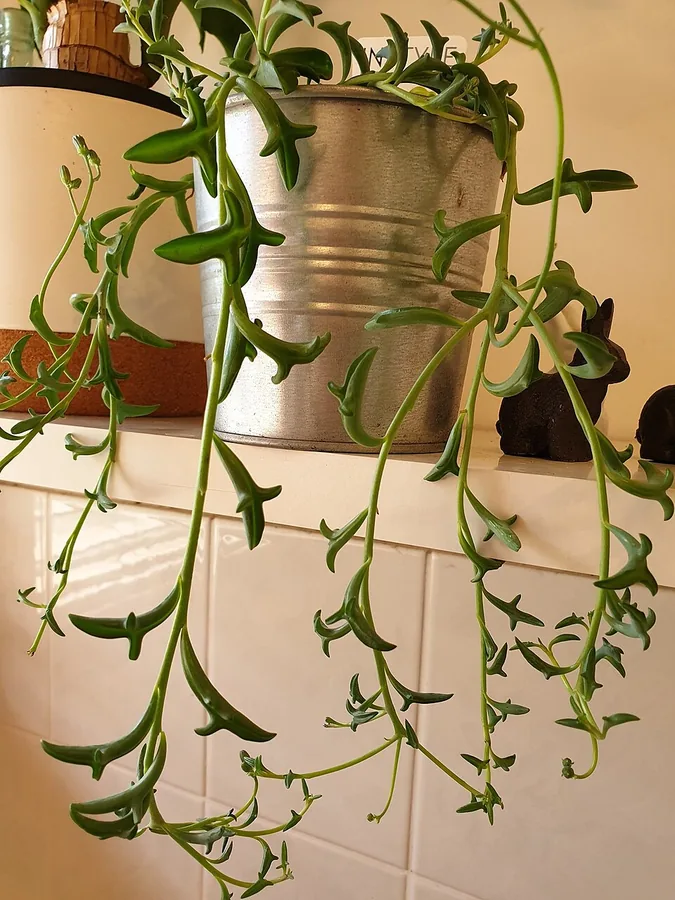
Fleshy little leaves, each curved into the arch of a leaping dolphin, strung down long trailing stems.
Bright indirect
50–77°F · 10–25°C
USDA 9–12
12–35 in · 30–90 cm
Overview
Look closely and every leaf on string of dolphins reads as a tiny leaping dolphin, its fleshy body curved with an arched back and a pair of small side points that stand in for fins. The plump leaves are strung at intervals along slender, trailing stems, a succulent in the daisy family and a cultivated hybrid of string of pearls and candle plant rather than a wild plant. Those stems run 12 to 35 inches (30 to 90 cm) as they spill from the pot.
The leaves hold their own water, so they sit firm and plump when the plant is content and pucker inward when it runs dry. Each one keeps that forked, dolphin-like outline that sets the plant apart from a plain string of beads. Give it the wrong conditions and the look shifts fast: a soggy pot turns the stems soft and mushy at the base.
New stems trail and lengthen rather than climb, so the plant grows as a curtain of dangling strands rather than an upright shape. Left in dim light, those stems stretch thin and pale and the crisp dolphin shape blurs, while in good light they stay short-jointed and packed with well-formed leaves. Handled or cut, the stems weep a milky, irritant sap.
Care
The short version: bright, indirect light, a gritty cactus mix in a pot that drains, and water only when the plump leaves begin to look slightly shriveled.
Light
The plant wants bright, indirect light for most of the day, close to a window but back from the harsh midday sun that can scorch and mark the leaves. A little soft morning sun sits well on it. In a dim spot the stems draw out thin and pale and the fleshy dolphin shape flattens and blurs.
Water
Water lightly while it grows, then let the gritty mix dry out completely before the next drink. The leaves show their thirst plainly, softening and puckering inward as their stored water is spent. In winter they need barely any water, since a cold, wet base is what turns the stems soft and rotten.
Soil
Root it in a gritty, fast-draining cactus or succulent mix so water slips past rather than clinging to the roots. The plant is unbothered by pH across 6.0 to 8.0, so the coarse, open texture of the mix counts for more than any reading.
Temperature
It sits comfortably in warmth of 50°F to 77°F (10°C to 25°C), the range of a typical room. The plant has no tolerance for frost, so bring it well indoors before the cold sets in.
Humidity
The fleshy leaves carry their own moisture, so dry room air suits the plant and it leans to the low end of humidity. There is no reading to reach for and no call to mist, which would only wet the foliage and invite rot.
Feeding
Feed it once a month across the growing season, from spring into early autumn, with a half-strength general-purpose liquid fertilizer. Growth eases off in winter, and feeding pauses with it.
Pruning
Cut the trailing stems with scissors to shape the plant or thicken it up, and fresh growth follows quickly. Each cut releases the milky sap, which can irritate skin, so keep gloves on while you work.
Repotting
Repot every 1 to 2 years, or sooner once the roots crowd the surface or push through the drainage holes. Move up a single pot size to one that drains, since a large volume of mix stays damp around the fine roots and turns them soft.
Size & spacing
The stems hang 12 to 35 inches (30 to 90 cm) and spread about as wide, a full curtain of dolphin-strung strands. A single plant in its own hanging pot lets each strand fall clear without knotting into the next.
Troubleshooting
Two problems change how the plant looks, and they pull in opposite directions. Too little water leaves the dolphins shriveled and puckered, while too much turns the stems soft and dark at the base. Read the physical signs below to tell which one is in front of you.
Soft, blackened stems slumping at the base
This is rot, and it shows on the plant as stems gone soft and mushy where they meet the soil, a base darkening to black, and often a sour smell. It takes hold when the mix stays wetter than a succulent can hold. Stop watering, cut back to firm tissue, discarding every soft stem and root, then reroot clean cuttings in gritty mix inside a clay pot that dries out fast.
Fix:
- Stop watering and let the mix dry out
- Remove and discard rotted stems and roots
- Take healthy stem cuttings to propagate and start fresh in a gritty, fast-draining mix
- Repot into a clay pot with drainage to improve evaporation
Puckered, stretched leaves that lose the dolphin outline
One appearance covers two problems. When the mix runs bone-dry, the leaves lose their stored water and pucker soft, and when light is too weak, the stems draw out thin and pale until the crisp dolphin shape smears. A deep watering plumps the shriveled leaves again, brighter light firms the stretched stems, and cutting back the leggy runners brings tight, well-shaped growth.
Fix:
- Water thoroughly when leaves begin to shrivel, then let the mix dry completely again
- Move to a brighter spot with bright, indirect light
- Trim leggy, distorted stems to encourage compact new growth
Toxicity
Inside every stem and leaf sits an irritant, milky sap and a load of pyrrolizidine alkaloids, which makes the plant toxic to cats and dogs and a poor choice around other pets, livestock, and small children. No part of it is edible, and the sap can redden and sting bare skin, so wear gloves whenever a stem is cut.
Toxic to
Cats · Dogs · Horses · Rabbits · Livestock · Birds · People
Cats Toxic
A cat that bites through the fleshy strands usually vomits, gets loose stools, drools, and turns sluggish. The leaves are charged with pyrrolizidine alkaloids, so keep the trailing tips well above any jump.
Dogs Toxic
A dog that chews the plump leaves tends to vomit, pass loose stools, and go tired and low. The same alkaloids are the cause, and the bitter, milky sap can leave the mouth sore, so keep the strands out of reach.
Horses Toxic
The parent plant is listed as toxic to horses, and this hybrid carries the same. Past the immediate stomach upset, the pyrrolizidine alkaloids in these Curio succulents can build up and harm the liver over repeated grazing.
Rabbits Toxic
A rabbit should not get at the leaves. The alkaloids that trouble cats and dogs act the same way on a rabbit's gut, so keep the strands out of the hutch and up off the floor.
Livestock Toxic
Grazing animals fare badly on it, as the pyrrolizidine alkaloids collect in the liver with repeated feeding. Fence the plant away and clear off every dropped trimming.
Birds Caution
Treat the foliage as off limits around birds. The toxic compounds packed in the leaves make it a poor choice near pet birds, so hang it where no beak can reach the tips.
People Caution
None of this plant is food, and a bite of the fleshy leaves can upset the stomach. The cut sap stings skin as well, so wear gloves to prune and keep small children from pulling at the strands.
Wear gloves when pruning or handling cut stems, as the milky/irritant sap can irritate skin.
Helpline numbers

United States
ASPCA Animal Poison Control: (888) 426-4435 (fee applies)
Poison Control: (800) 222-1222



Canada
Poison Centres: 1-844-764-7669
Varieties
There is a single form to look at. String of dolphins is grown as one hybrid rather than a range of named cultivars, so the leaf shape below describes what every plant looks like.
Curio × peregrinus (typical String of dolphins)
This is the type plant, its curved, branched leaves arching like a pod of leaping dolphins, built like string of pearls except for the forked outline that gives each leaf its fins.
How to propagate
The same trailing stems that make the plant are what you use to multiply it. Two easy methods work, and each needs only scissors and a gritty mix.
Stem cuttingsEasy
Spring to summer during active growth · Roots in about a month
In spring or summer while the plant is growing, cut lengths of stem 3 to 4 inches (8 to 10 cm) long, pull the lower leaves off to bare the nodes, and press or lay those nodes against a moist, gritty mix. Fresh roots push out from the exposed nodes, and a cutting takes hold within about a month.
LayeringEasy
Spring to summer · About a month to root
Layering leaves the strand on the plant. Pin a trailing stem down so its nodes meet the compost, let roots grow from those buried points over roughly a month while the parent still feeds it, then cut the new plant loose once it holds.
Myths
String of dolphins is a wild species you might find growing in nature.
No wild plant like it exists. It is a cultivated hybrid, Curio x peregrinus, bred by crossing string of pearls (Curio rowleyanus) with candle plant (Curio articulatus), and that pairing is what shaped the leaping-dolphin curve of its leaves.