Houseplant · Asteraceae
String of Bananas
Curio radicans
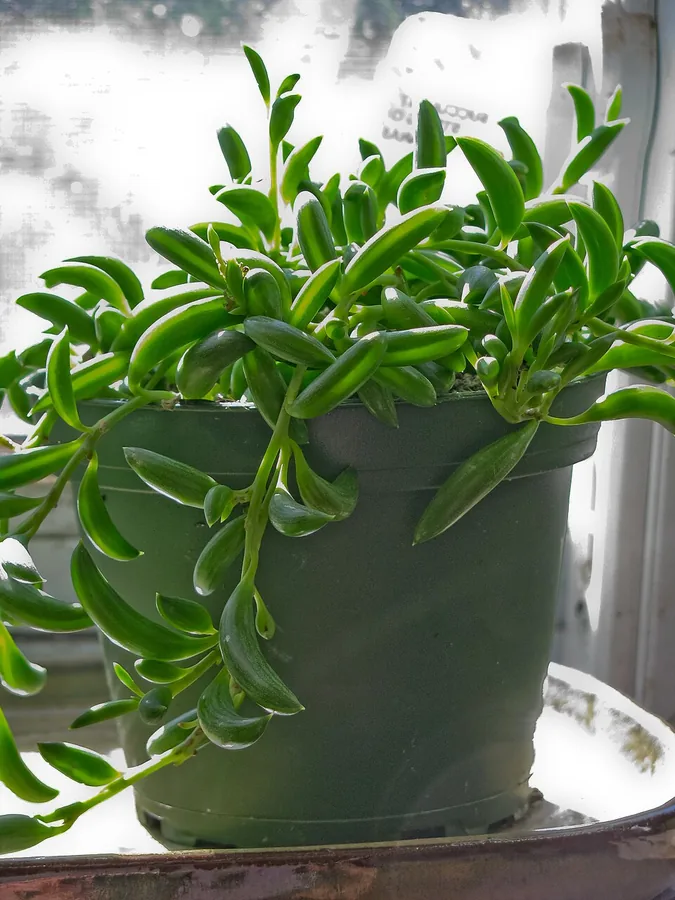
Plump, banana-shaped beads thread down long trailing stems, a curl of green spilling over the pot's edge.
Bright indirect
50–77°F · 10–25°C
USDA 10–11
12–35 in · 30–90 cm
Overview
String of bananas is a trailing succulent covered in fat, crescent leaves curved like tiny green bananas. Each one swells at the middle and tapers to a point, and they line the stems in a loose row that spills off the pot in long ropes. The plant hails from southern Africa and belongs to the daisy family.
Look closely at one leaf and a pale, translucent stripe runs along its length, a small window in the skin that lets light down into the green flesh inside. The leaves stay firm and full when the plant is well watered, packed with stored moisture, and they take on a brown or reddish tinge only when the sun turns harsh. The stems themselves are slim and green, threading from bead to bead.
In autumn and into early winter the plant can send out small white flowers like little pompoms, dotting the trailing growth. Handle a cut stem and it weeps a milky sap. Every part of that green, bead-strung growth is toxic to pets and people if eaten.
Care
The short version: bright indirect light, a coarse gritty cactus mix that sheds water quickly, and water only once the top half of the soil has dried. Water sparingly in winter, and never leave the pot standing in water.
Light
It wants bright, indirect light, the glow a few feet in from a sunny window. A little direct morning sun and some shade are fine, but fierce afternoon rays scorch the green beads to brown.
Water
Water only after the top half of the soil has dried, then soak it through and let the surplus drain. The plump leaves hold their own water, so this succulent rots if kept wet, and in winter it wants next to nothing, just enough to stop the beads from shriveling.
Soil
Pot it in a gritty, fast-draining cactus or succulent mix so water drains straight off the roots. It takes any acidity from pH 6.0 to 8.0, but a dense, wet-holding mix around the roots is what it cannot survive.
Temperature
Plain room warmth keeps the leaves firm and green, ideally 50°F to 77°F (10°C to 25°C). Hold it above freezing and clear of cold drafts, since frost ruins the tissue.
Humidity
This is a low-humidity plant built for dry air, its plump beads losing little moisture. Misting is pointless, and damp, stagnant air does more harm than good.
Feeding
Feed lightly from spring through summer while it is growing, about once a month, with a diluted balanced or cactus fertilizer. Stop over winter, when the plant slows and puts out little new growth.
Pruning
Cut back any leggy or bare stems where the beads have thinned out, and pinch the tips to fill the plant. Keep the trimmed pieces, since every bead-lined length can root into a new plant.
Repotting
Repot only every 2 to 3 years, or once the roots crowd the pot, because it flowers and grows best a little snug. The signs are roots pushing out the drainage holes and soil that dries almost the moment it is watered.
Size & spacing
The trailing stems run 12 to 35 inches (30 to 90 cm) long, hanging in green curtains about as wide as they are deep. Let them fall free from a shelf or basket so the strands stay separate rather than matting into a tangle.
Troubleshooting
Nearly every problem this plant has shows up on the leaves, where a change in their plump green shape points to a shortage of water or a flood of it. Watch how the beads look and feel. Match the appearance below to the cause and correct it before a soft wrinkle hardens into rot.
Stems gone soft, black, and slumping at the base
Stems that turn mushy, blacken, and slump signal root rot, the most lethal problem, brought on by water sitting around the roots. Stop watering and let the mix dry through, then lift the plant and cut off every brown, softened piece. Save a few firm, green stem cuttings and start them over in fresh gritty mix before the rot creeps further.
Fix:
- Stop watering and let the mix dry out
- Unpot and cut away rotted roots and stems
- Take healthy stem cuttings and restart in fresh gritty mix
- Repot into fast-draining cactus medium in a pot with drainage
Beads gone soft, creased, and flattened out
When the beads turn soft, creased, and flat, the plant is thirsty. Each leaf is a little tank, so once the soil dries out completely they shrink inward and lose their round shape. Water deeply until it runs from the base, and the beads swell back to firm and plump within a day or two.
Fix:
- Water thoroughly until it drains from the bottom
- Resume watering whenever the top half of the soil is dry
- Ensure the pot has drainage and the mix is not hydrophobic
Beads flushing brown or red on the sun-facing side
Beads that flush brown or red on the exposed face show sunburn from light too strong for them. The ones pressed toward the glass scorch first under harsh or afternoon sun. Move it into bright indirect light, screen it from the midday blaze, and raise the light again in slow stages.
Fix:
- Move to bright indirect light
- Shade from intense afternoon summer sun
- Acclimate gradually before increasing light
Toxicity
For all its soft, plump looks, this plant bites back. Every green bead and stem carries pyrrolizidine alkaloids, and a cut releases a milky, irritating sap, so it is toxic to cats and dogs and a hazard to other animals and people if eaten. Keep it hung out of reach, and wash your hands after handling the sap.
Toxic to
Cats · Dogs · Horses · Rabbits · Livestock · Birds · People
Cats Toxic
A cat that chews the beads soon drools, vomits, and turns from its food. Diarrhea and a flat, drowsy state usually follow, and a large mouthful can strain the liver.
Dogs Toxic
Dogs react the same way. After chewing the trailing stems, look for vomiting, loose stools, drooling, and a tired, dull-looking dog.
Horses Toxic
The same pyrrolizidine alkaloids run through the whole genus, so a grazing horse gets an upset stomach, and repeated browsing carries a real risk of liver damage over time.
Rabbits Caution
No rabbit-specific data exists, but the toxin works across mammals, so keep the plant away from them. A rabbit that samples a bead can end up with a churned-up gut and low energy.
Livestock Toxic
Cattle and other grazers are named among those at risk. The alkaloids gather with steady browsing and can scar the liver, on top of the nausea and dullness one feed brings.
Birds Caution
Birds have not been studied for this plant, so keep them clear as a precaution. Between the milky sap and the alkaloids, there is no reason to expect a bird to tolerate a bite.
People Caution
No part of this plant is food. Swallowing a bead can leave a person nauseous and unsettled, and the milky sap may redden or irritate skin, so wash your hands after pruning.
Wear gloves or wash hands after handling, as the irritant sap can cause contact dermatitis.
Helpline numbers

United States
ASPCA Animal Poison Control: (888) 426-4435 (fee applies)
Poison Control: (800) 222-1222



Canada
Poison Centres: 1-844-764-7669
Varieties
Few named forms exist, but one stands out by the shape of its leaves alone.
Curio radicans 'Fish Hooks'
This one carries sharply curved, hook-shaped leaves rather than gentle crescents, the very look that earned it the name string of fishhooks.
How to propagate
Those bead-covered stems root readily, so the very pieces you cut away can grow into whole new strands.
Stem cuttingsEasy
Spring through summer during active growth · About 2 to 4 weeks to root
Cuttings are the fast, near-certain method most people use. Cut a few bead-lined stems while the plant grows in spring or summer, let the raw ends dry and callus for a day, then lay or press them onto gritty, fast-draining mix. Held lightly moist, they push out roots in about 2 to 4 weeks.
SeedModerate
Spring · Several weeks to months
Seed is possible but slow, and it seldom rivals cuttings. Sow in spring on a fast-draining mix and keep it warm, then wait several weeks to months for seedlings large enough to pot on.
Myths
Its correct botanical name is Senecio radicans.
Kew's Plants of the World Online now records Curio radicans as the accepted name, with Senecio radicans dropped to an old synonym. The Senecio tag still clings to it in shops, yet Curio radicans is the current name.