Houseplant · Crassulaceae
String of Buttons
Crassula perforata
Triangular, fleshy leaves thread up the stem in tight little stacks, turning each stem into a green tower.
Bright indirect
50–77°F · 10–25°C
USDA 9–11
8–18 in · 20–45 cm
Overview
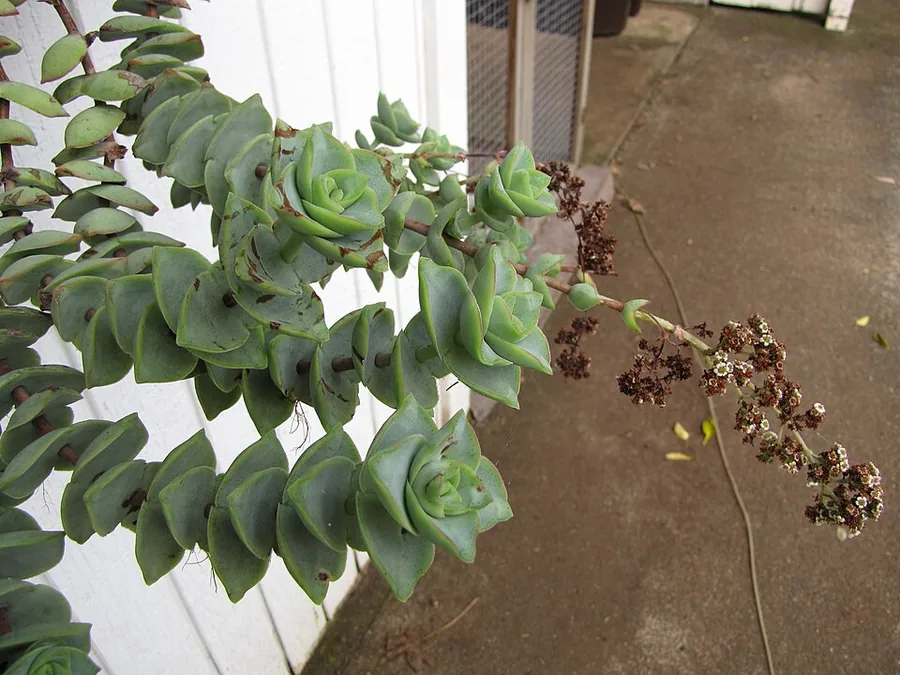
String of buttons carries small, triangular leaves that clasp the stem and stack one above the next, so a single stem reads like a row of beads threaded on a string. The leaves are thick and fleshy, plump with the water they store, and the plain species holds a cool, even green. Indoors the whole plant keeps to 8 to 18 inches (20 to 45 cm) tall, which puts those stacked towers right at eye level.
Each leaf tapers to a soft triangular point, and along a healthy stem the leaves sit close together, which is what gives the plant its crisp, geometric look. It belongs to the Crassulaceae family with jade and stonecrop, and that kinship shows in the same firm, water-swollen leaf. In spring the stems lift small star-shaped flowers in shades from pale yellow to nearly white, tiny blooms set above the green stacks.
As the stems lengthen they branch and trail, tumbling to about 12 to 24 inches (30 to 60 cm) and hanging in loose green ropes of stacked leaves. When light runs short the pattern loosens: the new growth turns pale and elongated, the gaps between leaves widen, and the stem cranes to one side. In good light the leaves pack tight again and the stacked, towered shape returns.
Care
The short version: bright light, a gritty fast-draining mix, and water only once the soil has dried out completely. Keep it warm, water less in winter, and the fleshy stacked stems mostly look after themselves.
Light
It wants bright light, ideally bright indirect with a few hours of direct sun. Hardened off, the fleshy leaves take full sun, and strong light is what keeps them packed tight up the stem. In dim light the stem draws out and the stacked leaves drift apart.
Water
Let the soil dry out completely before watering again, since each plump leaf already holds a store of water. Water less through winter dormancy. In soggy soil the firm leaves quickly turn soft, so on the dry side is the safer place to keep it.
Soil
Plant it in a gritty cactus or succulent mix that drains in seconds rather than minutes. A slightly acidic pH around 6.0 to 6.5 suits it, and the coarse grit keeps water moving past the roots instead of pooling around them.
Temperature
Hold it in the range of 50°F to 77°F (10°C to 25°C). The fleshy tissue is not frost-hardy, so it moves to a warm spot before the cold arrives, which would otherwise damage the swollen leaves.
Humidity
Low household humidity is exactly what these thick leaves want, so there's no figure to hit. Dry air and good airflow keep the surface from staying damp, which is what invites rot.
Feeding
Feed only in spring and summer during active growth, with a diluted balanced or low-nitrogen succulent fertilizer. A light seasonal feed is enough, and too much nitrogen swells the growth soft and weak instead of firm.
Pruning
Pinch or trim any leggy, stretched stems, the ones where the leaves have spread apart, to push tighter branching and a denser stack. The pieces you cut off root readily, so each trimmed stem can become a new plant.
Repotting
Repot every 2 to 3 years, or once it's crowded, in spring. The signs show in the plant: roots pushing out the drainage holes, soil drying unusually fast, and a top-heavy tangle of stacked stems leaning over the pot's edge.
Size & spacing
Indoors the stems climb to about 8 to 18 inches (20 to 45 cm) tall and trail to roughly 12 to 24 inches (30 to 60 cm) wide. Given room, they spill over the rim in stacked green ropes, or hang and drape from a raised pot.
Troubleshooting
Nearly every change you'll see in string of buttons shows up first in the leaves and stems. Thin light draws the stems out and spaces the leaves apart, standing water turns them soft and translucent, and harsh sun leaves scorched marks on the surface. Match the look below to find the cause and the fix.
Yellow, mushy leaves and a soft base
When the firm leaves turn yellow, soft, and see-through and the stem base goes dark and squishy, that's root rot from too much water in slow-draining soil. Stop watering and let it dry out. If the base is already gone, lift the plant, cut away the brown, slimy roots, and repot the firm sections in fresh gritty mix, or take cuttings from any stem that's still plump and healthy.
Fix:
- Stop watering and let soil dry fully
- Unpot, cut away rotted roots and stems, and repot healthy portions in fresh gritty mix
- Take cuttings from firm growth if the base is lost
Stems stretching out and losing their stacked shape
The look comes from etiolation, the stem drawing out toward light it can't reach. The fresh growth arrives pale and elongated, the leaves space out along the stem, and the whole thing tilts toward the window. Move it somewhere much brighter, then cut the stretched stems and root the pieces to grow back a tight, close-stacked plant.
Fix:
- Move to a brighter spot with several hours of direct or very bright indirect light
- Prune stretched stems and root the cuttings to restart compact growth
Brown or reddish scorch marks on the leaves
Brown to reddish patches on the leaf surface are sunburn, appearing where strong direct sun strikes leaves that haven't hardened off. The marks land on the faces turned toward the light, usually just after a move outdoors or to a hot window. Move it back to bright indirect light, pick off the worst-marked leaves, and bring it into full sun over a week or two.
Fix:
- Move to bright indirect light and remove badly damaged leaves
- Reintroduce direct sun gradually over one to two weeks
Toxicity
For households with pets, the plant is generally considered non-toxic and safe. A cat, dog, or rabbit that bites into one of the fleshy leaves should come to no harm. Those leaves are an ornamental succulent rather than food, so there's no reason to encourage tasting, but the plant needs no keeping out of reach.
Safe for
People · Cats · Dogs · Horses · Rabbits · Livestock · Birds
Cats None
A cat that bites into one of the fleshy leaves is safe, since string of buttons carries no known toxin.
Dogs None
A dog that chews a stacked stem comes to no harm, as the plant isn't known to poison them.
Horses None
Horses take no toxic effect from this succulent.
Rabbits None
A rabbit that nips a plump leaf stays fine, because the plant holds no toxins known to affect them.
Livestock None
Grazing goats and sheep are unaffected by the fleshy leaves and stems.
Birds None
The plant poses no recognized danger to pet birds that peck at it.
People None
For people the leaves are non-toxic, though they're a firm ornamental succulent and not something to eat.
Helpline numbers

United States
ASPCA Animal Poison Control: (888) 426-4435 (fee applies)

United Kingdom
Animal PoisonLine: 01202 509000 (fee applies)

Australia
Animal Poisons Helpline: 1300 869 738
Varieties
The plain green form is the one you'll usually see, though a single named selection wears very different color.
Crassula perforata 'Variegata'
In bright light this form washes its leaves with creamy-yellow to pinkish variegation and a pink blush that deepens along the triangular margins.
How to propagate
String of buttons roots from its own stems and leaves with little trouble, so one plant readily becomes several, each stacked stem a start for the next.
Stem cuttingsEasy
Spring through summer during active growth · 2 to 4 weeks to root
Stem cuttings are the simplest way to grow more. Cut a stacked stem segment in spring or summer, let the raw end callus over for a day or two, then lay or set it in gritty mix. Fresh roots take hold in about 2 to 4 weeks.
Leaf cuttingsModerate
Spring through summer · 4 to 8 weeks to root and sprout
A single fleshy leaf can start a plant too, with more patience. Pull a whole healthy leaf, let the base callus, and rest it on dry succulent mix in spring or summer. It takes 4 to 8 weeks to root and sprout, at a lower success rate than stem cuttings.
Myths
String of buttons must be poisonous because it looks like other toxic succulents.
Crassula perforata is generally treated as non-toxic and safe around cats and dogs. Many succulents do carry toxins, so the family's wary reputation is understandable, but this stacked-leaf one is not among the harmful sorts. The fleshy leaves are for looking at rather than eating, though a stray nibble is nothing to worry about.