Tree · Lauraceae
Sassafras
Sassafras albidum
One twig, three leaf shapes, and an autumn shift from green to orange, red, and deep purple.
Full sun
Every 7–14 days
USDA 4–9
30–60 ft · 9.1–18.3 m
Overview
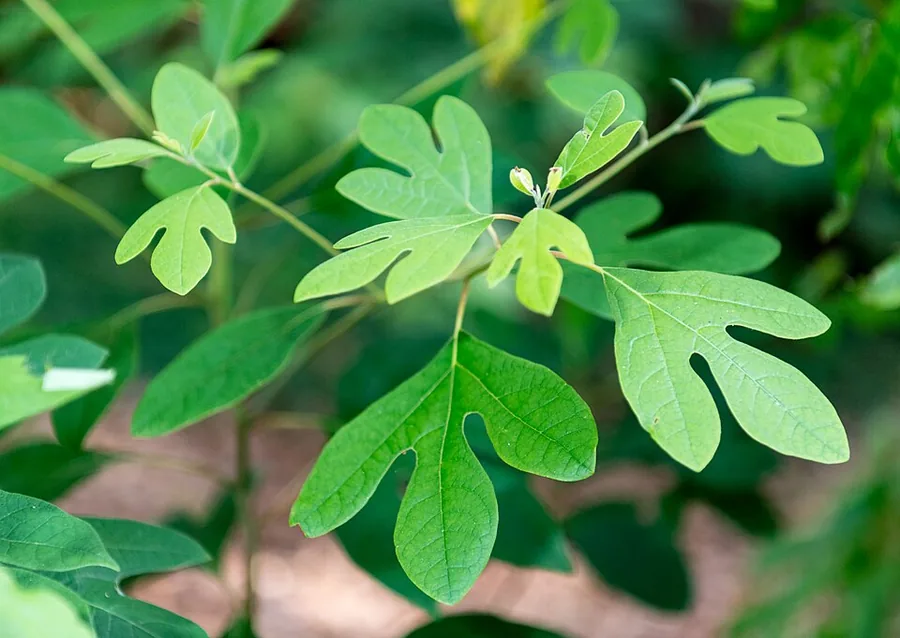
Look closely at a sassafras and the leaves refuse to settle on one outline. The same branch bears an unlobed oval, a two-lobed mitten, and a three-lobed glove, each with smooth margins and a soft green surface. Snap one between your fingers and it releases a warm, spicy scent, the same one that rises when the bark is scratched.
In autumn the green gives way to a run of hot color, the foliage turning orange, then red, then deep purple across the canopy. Spring brings its own quieter show first: small greenish-yellow flowers open in loose clusters before or just as the leaves unfold. The overall form is that of a fast-growing tree with a spreading, colonizing base.
By late summer the flowers give way to fruit. Small bluish-black drupes ride on bright red stalks, a two-color pairing that stands out against the leaves. The bark and roots hold the same aromatic oil as the foliage, the compound safrole, which is a liver toxin and the reason the fragrant wood is admired but never eaten.
Care
The short version: this fast tree wants full sun to part shade and moist, acidic, well-drained soil, steady water while young, room for its spreading roots, and sucker removal to hold a single trunk.
Light
Under full sun the fall color reaches its most saturated, the leaves burning brightest where the light is strongest. The tree still holds its own in partial sun or partial shade, though a young one visibly leans its stem and leaves toward the brightest opening.
Water
While young, the tree wants its soil kept evenly moist, taking water every 7 to 14 days. An older, established sassafras stands up to dry spells. Its roots prefer moist, well-drained ground and show stress in soggy clay.
Soil
The roots settle best in moist, acidic, well-drained loam or sandy soil at a pH of 6.0 to 7.0. They tolerate clay and dry sites, but in alkaline ground the leaves pale into chlorosis, their green washing out to yellow.
Temperature
The wood and buds are hardy through a wide swing of temperature, from winter lows near -29°F (-34°C) to summer highs of 100°F (38°C). That endurance carries the tree across most of the temperate eastern US.
Humidity
The tree asks nothing of the humidity, drawing what it needs from ordinary outdoor air. Good airflow across the canopy does more, drying the leaf surfaces and holding back the minor leaf fungi that would spot them.
Feeding
An established sassafras pulls enough from the soil that feeding is rarely needed. On thin ground, a balanced slow-release tree fertilizer in spring supports the new growth, while a tree in good soil takes none.
Pruning
In late winter the bare framework shows its dead and crossing branches clearly, the time to cut them out and to clip root suckers for a single trunk. Cut the whole tree to the ground every 2 to 3 years and it returns as a low, multi-stemmed shrub.
Repotting
Below ground the tree drives a deep taproot, which is why it resists container culture and rarely survives being moved once established. Its place is chosen once and kept.
Size & spacing
At maturity the trunk lifts the canopy to 30 to 60 feet (9 to 18 m), with a spread of 25 to 40 feet (7.6 to 12 m). Around the base, the suckers widen the whole clonal patch well past the original crown.
When to plant
The tree marks its year in color. Young plants go into the ground in spring after frost, greenish-yellow flowers appear from March to May as the leaves open, and bluish-black drupes on red stalks ripen from late summer into early fall.
Northern hemisphere
Southern hemisphere
Typical months for a temperate climate: start earlier in warm zones, later where spring frosts linger.
- Sow: Not typical; seed needs cold-moist stratification, so sow outdoors in fall or stratify 2-4 months before spring sowing
- Plant: Spring, after the last frost, using young container or root-sucker plants
- Harvest: Greenish-yellow flowers March to May before or with leaf-out; bluish-black drupes on red stalks ripen late summer to early fall
Hardiness
USDA hardiness zones: 4–9
Temperature: down to -34°C
Troubleshooting
A few visible changes signal trouble on a sassafras: a ring of new shoots at the base, wilting limbs with dark-stained wood, or chewed and spotted leaves. Only laurel wilt, seen in the southeast, is serious. Match the look of the symptom below.
Wilting limbs and dark streaks running through the sapwood
The dark streaking marks laurel wilt, a fungus the redbay ambrosia beetle carries into the sapwood, plugging the vessels until the tree can no longer move water. On the trunk the signs are pinhole entry holes, toothpick-like tubes of frass, and dark staining beneath the bark, confirmed by a diagnostic lab in the southeastern range. No cure exists, so affected trees are cut down and chipped or burned, and untreated wood is kept from moving the beetle onward.
Fix:
- No effective cure once infected; remove and properly dispose of (chip or burn) dead and dying trees to reduce beetle breeding sites
- Do not move untreated wood that could spread the beetle
A ring of fresh shoots standing up around the trunk
Those upright shoots are root suckering, new stems rising from the tree's shallow lateral roots in a vigorous clonal spread. Cutting or disturbing those roots only pushes up more of them. Mowing or cutting the shoots through the season, digging them out with a length of root attached, and a buried barrier or a mowed strip together hold the colony in place.
Fix:
- Mow or cut suckers to the ground repeatedly through the season
- Dig out unwanted suckers with attached root where practical
- Install a root barrier or maintain a mowed strip to contain the colony
Leaves eaten to lace and freckled with spots
Leaves chewed down to their veins point to Japanese beetles and other feeders such as scale, while the spots and blotches come from leaf spot fungi or powdery mildew. On an established tree the damage stays on the surface, cosmetic rather than harmful. Beetles are knocked into soapy water, fallen leaves are raked away to cut the spores, and horticultural oil is held back for heavy scale.
Fix:
- Hand-pick or knock Japanese beetles into soapy water
- Tolerate minor leaf spot; rake and remove fallen leaves to reduce fungal inoculum
- Treat heavy scale infestations with horticultural oil
Toxicity
The scent that makes sassafras so distinctive comes from safrole, held in the roots, bark, and oil. Safrole is a liver toxin and a likely carcinogen, banned from food since 1960. The leaves are low-risk to touch, but the fragrant woody parts and any homemade tea should never be swallowed.
Toxic to
Cats · Dogs · Horses · Rabbits · Livestock · Birds · People
Cats Caution
The scent-bearing roots and bark carry safrole, a compound toxic to a cat's liver, so the danger lies in a cat gnawing or licking that woody tissue rather than the leaves. Cut roots, bark, and sassafras oil are kept where a cat cannot reach.
Dogs Caution
A dog that gnaws bark, digs into the roots, or licks sassafras oil takes in safrole, which wears on the liver with repeated exposure. The green leaves are low-risk, but the woody parts are not, so fallen branches and stored roots stay out of reach.
Horses Caution
When a horse strips and chews the bark or roots, it swallows the same liver-toxic safrole the wood carries. A fence keeps horses back from any trunk in reach, and prunings are pulled from the paddock.
Rabbits Caution
A rabbit's small body needs only a small amount of safrole, which sits concentrated in the bark and roots. The animals are kept clear of the trunk and of any cut trimmings.
Livestock Caution
Cattle, goats, and sheep that peel bark or chew exposed roots take in safrole, which settles on the liver. Grazing animals are watched near the tree, and felled wood is dragged off the pasture.
Birds Caution
Wild birds strip the ripe bluish-black drupes without harm, because the safrole rests in the woody roots and bark and not in the fruit. Caged and backyard birds are kept from pecking at bark or root fragments.
People Caution
For all that traditional teas and file powder came from this tree, safrole is a hepatotoxin and a likely carcinogen banned from food in 1960. No amount of homemade root or bark tea or sassafras oil is safe, and children are kept from chewing the fragrant bark.
Foliage contact is low-risk, but do not let people or pets chew or ingest roots, bark, or sassafras oil. Avoid homemade root/bark teas and oil.
Helpline numbers

United States
ASPCA Animal Poison Control: (888) 426-4435 (fee applies)
Poison Control: (800) 222-1222



Canada
Poison Centres: 1-844-764-7669
Varieties
There is really one sassafras to look at up close: the wild native species, grown for its shifting leaf shapes and fiery fall color, with named cultivars almost absent.
Sassafras albidum (species)
This is the plain native species, recognized by its three leaf shapes and its orange-red-purple fall color, and it comes with almost no named cultivars to set it apart.
How to propagate
New sassafras plants come most readily from the tree's own roots and suckers, while seed offers a slower route that begins with a cold, moist rest.
SeedModerate
Sow outdoors in fall, or cold-moist stratify 2-4 months and sow in spring · Several months to germinate; 1-2 seasons to establish
The seed holds a deep dormancy and stays closed until a cold, moist spell breaks it, so it is sown outdoors in fall or given 2 to 4 months of cold-moist stratification before a spring sowing, the fleshy pulp rubbed off the fruit first. The sprout takes several months to show, and the seedling firms up over a season or two.
Stem cuttingsDemanding
Dig dormant root pieces or detach rooted suckers in late winter to early spring · One growing season
The surest new plants come from dormant root pieces or the tree's own rooted suckers, lifted in late winter to early spring while the wood is bare. These take hold within a single growing season. A larger plant, anchored by its deep taproot, rarely survives a move.
LayeringModerate
Spring · One to two seasons
Sassafras layers on its own through the root suckers that spread from the trunk, and in spring a small suckered stem can be severed and set elsewhere. It sinks its own roots and stands alone within one to two seasons.
Myths
Sassafras root and root-beer flavoring are a harmless natural tonic.
The aroma so easy to smell in the root is safrole, a hepatotoxin and a likely human carcinogen. It produced liver tumors in lab animals, and the FDA banned safrole and sassafras oil as food additives in 1960. The pleasant, natural scent is no measure of safety, so the old root tonics are not fit to drink.