Herb · Lauraceae
Bay Laurel
Laurus nobilis
Glossy, leathery, and evergreen, bay laurel holds its deep green leaves year-round for the kitchen.
Full sun
Every 5–10 days
USDA 8–11
3–10 ft · 0.9–3 m
Overview
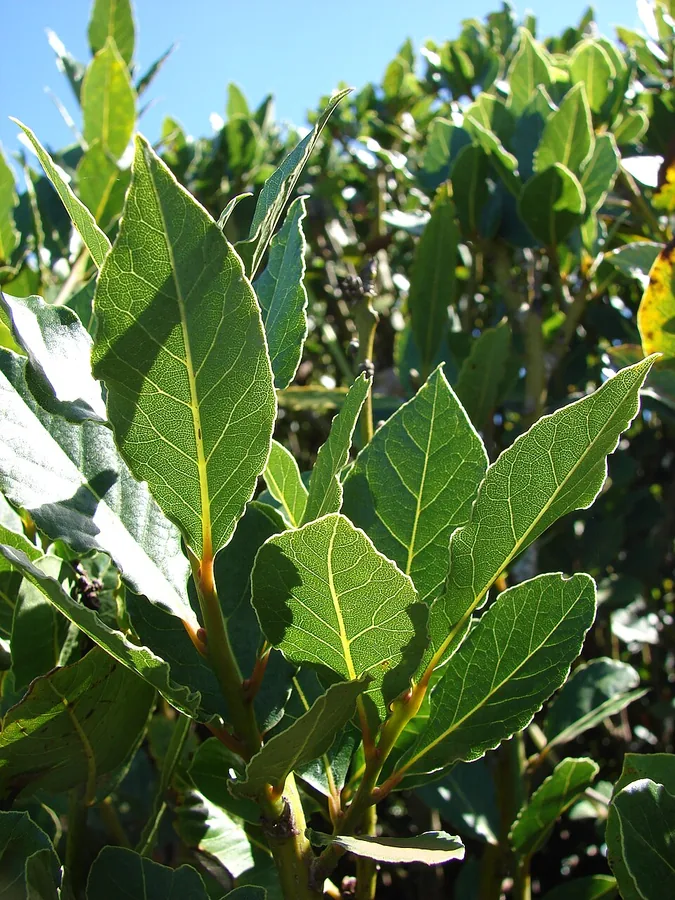
Bay laurel is the evergreen tree from which the bay leaf is picked, and close up the foliage gives it away at once. Every leaf is a stiff, leathery oval, glossy and dark on top, paler beneath, its edge faintly wavy and its tip drawn to a point. From its Mediterranean home the plant grows into a tall, aromatic shrub or small tree, and a crushed leaf breathes out the same warm, spicy fragrance in a border or a pot alike. For generations it has been sheared into topiary and standards, its crowded, deep-green canopy holding a clean edge.
The trait that marks bay most is its slow growth, adding stiff, woody stems only a fraction at a time. That unhurried rate is what lets it endure hard pruning and keep a sharp clipped line, the tightly packed leaves fusing into a dense green wall, though a plant killed by cold will take years to rebuild that bulk. Hardy through the milder zones, it turns frost-tender below about 25°F (-4°C), the threshold where the glossy leaves first go brown, so colder gardens raise it in a pot that retreats inside for winter.
Come spring a mature specimen opens small, unshowy yellowish flowers, quiet beside the bold leaves. Grant it sun, quick-draining soil, and water that never leaves the roots sodden, and it will go on unfurling those firm, aromatic leaves for picking all year. What spoils the look is waterlogged roots or a hard freeze, each dulling and browning the foliage, and each is easily kept at bay.
Care
The short version: give bay a place in full sun or light shade, a fast-draining mix that never lets its roots stew in moisture, steady balanced feeding across the growing months, and protection from a hard freeze, because the glossy foliage is tender below about 25°F (-4°C).
Light
Bay thrives in full sun and puts up with partial shade, and it is strong light that draws the dark-green leaves in tight and holds their color deep. Indoors it wants the brightest pane you can spare to keep that packed, lustrous growth.
Water
Hold the soil evenly moist but never sodden, letting the top layer dry a little between waterings. Container plants deserve the closest eye, since water left standing rots the pale roots quickly, so slacken off through winter as growth stalls.
Soil
Root it in fertile, free-draining loam or a quality potting mix. Bay takes many soils so long as the ground never turns sodden, and it rests easily across a pH of 6.0 to 7.5.
Temperature
Bay ranges from roughly 25°F to 86°F (-4°C to 30°C), the cold end being its ceiling of endurance. Frost-tender by nature, it browns its glossy leaves in a hard freeze, and a sharper cold snap can end the plant altogether.
Humidity
A moderate 40% to 60% humidity suits bay and comes easily outdoors. The winter danger indoors is dry, unmoving air, which lures scale onto the leaf undersides, so keep a little draft passing the plant.
Feeding
Feed a balanced general-purpose fertilizer through spring and summer while growth is active and new leaves unfurl at the shoot tips. Potted bay strips its soil of nutrients fast, so a monthly feeding across the season keeps the canopy full.
Pruning
Prune from spring into early summer to shape it, curb its size, or train a topiary or standard, for the dense leaves take a crisp clipped line. Bay bears hard cutting well, making this the time to lift out damaged, frost-burned, or crossing branches.
Repotting
Lift potted plants into fresh mix every 2 to 3 years, freshening the surface dressing in the years between. The tell is pale roots coiling the pot or thrusting through the drainage holes while water sluices straight past.
Size & spacing
At a slow pace bay reaches 3 to 10 feet (90 cm to 3 m) tall and spreads 3 to 8 feet (90 to 240 cm), the woody frame thickening only across years, while shears will hold it to any size. A plant in the ground needs space to attain those figures, or a pot keeps it small.
When to plant
Bay carries its leathery green leaves right through the year, so it lacks the tight planting window a vegetable keeps. Once the last frost has gone and the soil warmed, set young plants out, shape them with pruning from spring into early summer, and pull the firm, aromatic leaves whenever the moment calls. In cold regions the true timetable is plain: the potted tree goes under shelter before winter and comes back out after frost, its foliage spared the browning.
Northern hemisphere
Southern hemisphere
Typical months for a temperate climate: start earlier in warm zones, later where spring frosts linger.
- Sow: Seed can be started indoors but germination is slow and erratic; cuttings are more common
- Plant: Plant outdoors after the last frost once soil has warmed; in cold zones grow in containers and move indoors or to a sheltered spot before winter frost
- Harvest: Small, inconspicuous yellowish flowers appear in spring on mature plants; aromatic leaves can be harvested anytime, year-round
Hardiness
USDA hardiness zones: 8–11
Temperature: down to -12°C
Troubleshooting
Bay is a hardy plant, and most of what ails it comes from water and cold, not disease. The earliest hints surface in the leaves and roots, a glossy face gone dull or sticky, or soft, failing tissue down in the soil. Weigh what you see against the notes below and move early, ahead of the browning and dieback.
Limp, yellowing foliage above mushy, sour-scented roots
This is root rot, brought on nearly every time by soil that stays sodden, and overhead it reads as leaves going yellow and limp. Ease the plant from its pot and study the roots: the healthy ones are pale and firm to the touch, while the ruined ones are darkened, spongy, and smear apart between your fingers. Pull back on watering, settle the plant into fresh, free-draining mix once the rotted roots are cut away, and never leave the pot resting in a pooled saucer.
Fix:
- Reduce watering and allow soil to dry appropriately
- Repot into fresh, well-drained mix, trimming away rotted roots
- Ensure pots have drainage holes and never leave plants standing in water
Dull, tacky leaf surfaces, a sooty black film, and bumps ridging the stems
Those little brown or white lumps studding the stems and the undersides of the leaves are scale insects, and the tacky sheen glazing the once-glossy surface is the honeydew they exude, which the black sooty mold then colonizes. Rub the leaves and stems until they are clean, apply horticultural oil or insecticidal soap, and snip away any shoot thickly encrusted with them. Moving air keeps the pests from resettling, since scale takes hold on plants carried indoors for the winter.
Fix:
- Wipe off scale and sooty mold with a damp cloth or soft brush
- Treat with horticultural oil or insecticidal soap, repeating per label
- Prune out heavily infested shoots
- Improve air circulation and reduce overwintering stress
Blackened, browned leaves and shoot dieback following hard cold
Bay is frost-tender and starts to suffer below about 25°F (-4°C), so a biting freeze or a parching cold wind will scorch the deep-green blades brown and blacken the tender shoot tips. Scrape a sliver of bark to uncover the moist green tissue still alive underneath, then leave it until spring and cut the dead wood back to that living mark. Where winters bite, the remedy is a container you can shift under cover or indoors before the cold sets in.
Fix:
- Wait until spring and prune out clearly dead, brown wood back to live tissue
- Move container plants to a sheltered, frost-free location
- Protect in-ground plants with mulch and wind protection
Toxicity
Bay leaves lend flavor to a dish, but they are no food to swallow whole and no thing to leave within an animal's reach. Packed into the leaf are essential oils such as eugenol that turn the stomach, and the stiff, leathery blade never yields, making it a choking and laceration risk. Keep the trimmings away from pets, livestock, and young children, and always draw the leaf from the pot before the meal.
Toxic to
Cats · Dogs · Horses · Rabbits · Livestock · Birds · People
Cats Mild
Let a cat nibble the foliage and the essential oils usually trigger vomiting and diarrhea, while a rigid, leathery leaf swallowed whole can jam in the throat or graze the gut lining as it passes.
Dogs Mild
A dog that makes a meal of the leaves ends up nauseous, vomiting, and passing loose stools, and the unyielding whole leaf carries its own threat of choking or tearing at the digestive tract.
Horses Toxic
In a horse those same pungent oils inflame the digestive lining, stirring up stomach upset and a flow of drool, so the leathery trimmings need storing well beyond its reach.
Rabbits Toxic
A rabbit's tender gut is overwhelmed by the sheer strength of bay's oils, which can leave it refusing food and loose in the bowels, so no leaf should ever reach the hutch.
Livestock Caution
Grazing animals mostly turn from the bitter, resinous leaves, yet one that swallows a mouthful may fall to digestive upset, so the clippings do not belong in a pasture.
Birds Caution
The dense oils spell danger for a small bird, and the stiff blade can block a slender throat, so the plant is best kept clear of any pet birds.
People Caution
For a cook, bay perfumes the dish and is then drawn out; the leathery blade is never swallowed whole, for it holds its firmness and might choke or cut, so it always has to be fished from the pot.
Keep leaves and trimmings away from pets and small children. Beyond the mild GI upset from the essential oils, whole bay leaves are stiff and do not soften, so a swallowed whole leaf is also a choking and laceration hazard; bay leaves are removed from food before eating.
Helpline numbers

United States
ASPCA Animal Poison Control: (888) 426-4435 (fee applies)
Poison Control: (800) 222-1222



Canada
Poison Centres: 1-844-764-7669
Varieties
What sells as bay is nearly always the plain species, but a few named forms surface, each set apart by a leaf of its own character. These are the ones worth knowing by their foliage.
'Aurea'
Its just-unfurled leaves come through a vivid golden yellow, the tint blazing most intensely where light falls full on the plant.
'Angustifolia' (willow-leaf bay)
Narrow blades drawn out to a slender, willow-like point single it out, and it is said to shrug off a little more cold than the species does.
'Undulata'
Its signature is the leaf margin, which buckles and curls into a rippling frill around every blade.
How to propagate
Bay sits among the more stubborn herbs to propagate, where patience outweighs any trick of method. Both paths crawl, the woody stems and the seed each slow to respond, so most growers simply buy a young plant rather than raise one.
Stem cuttingsDemanding
Late summer to autumn using semi-ripe cuttings · Several months; cuttings root slowly and unreliably, often taking a season or more to establish
From late summer into autumn, take semi-ripe heel cuttings, the half-hardened shoots, dust their severed ends with rooting hormone, and keep them in warm, humid air. Prepare for a long wait, for bay puts down roots at a sluggish, uneven rate, and a cutting frequently needs a full season or more to settle in.
SeedDemanding
Spring, from fresh seed · Slow; germination is erratic and seedlings grow slowly over several years to reach usable size
Sow plump, freshly ripened seed in spring, since it germinates far more readily than stored seed after a soak and some warmth. The start comes slow and ragged, and the seedlings will spend several years inching upward before they reach any usable size.
Myths
Any plant that answers to laurel is one and the same, so its leaves can all cook like a bay leaf.
True bay, Laurus nobilis, stands alone as the laurel fit for the kitchen. Sharing the name are several unrelated and truly poisonous plants: cherry laurel loaded with cyanogenic compounds, mountain laurel bearing grayanotoxins, and oleander toxic in every part. Match the leaf to the botanical name Laurus nobilis before it ever nears your food.
Bay leaves add nothing to a dish, seeing as they are lifted out before it is eaten.
The leaf is fished back out for a single reason: it keeps a stiff, leathery firmness that could choke or scratch and refuses to soften. Yet all through the simmer it has been surrendering its aromatic oils into the dish, and lending the pot that flavor is the very reason it was added.