Herb · Lamiaceae
Bee Balm
Monarda didyma
Ragged crimson flower heads on square, aromatic stems repay sun, damp ground, and open air with a summer of hummingbird traffic.
Full sun
Every 3–7 days
USDA 4–9
2–4 ft · 0.6–1.2 m
Overview
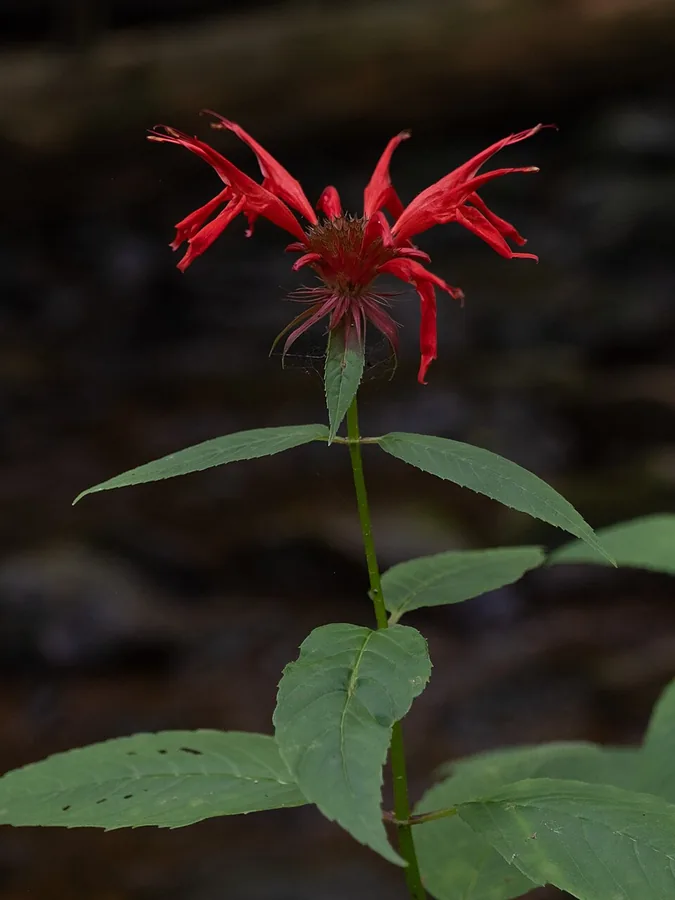
Bee balm is a North American native in the mint family, and you can read that lineage right off the plant: the stems are distinctly square in cross-section, a mint-family signature, and they carry shaggy red, pink, or wine blooms that ride above aromatic leaves. Those ragged, tufted flowerheads pull in bees, butterflies, and hummingbirds for weeks. Crush a single leaf between your fingers and a citrusy scent lifts off it, the very smell that earned the plant its other name, bergamot.
It travels by underground rhizomes, so one plant thickens into a wide clump in just a few seasons. That spreading habit is a gift in a meadow planting and a chore in a tidy border, where you'll want to divide it to keep it in bounds. The same aromatic leaves were long brewed into tea by the Oswego people, which is where the name Oswego tea comes from.
Bee balm asks for little: sun, steady moisture, and air slipping freely between the stems. Give it those and it answers with months of color. Skimp on the airflow and you invite the powdery mildew that is this plant's one real weakness.
Care
The short version: those shaggy blooms need full sun, soil that stays damp to the touch, and air moving between the square stems. Split the spreading clump every 3 to 4 years, and pinch off browning flower heads to bring on more.
Light
In full sun the stems stand sturdy and the flower heads come thick with color. Part shade thins the display, and low light is also what lets the white film of mildew find the leaves.
Water
Soil around the roots should feel damp at every check, echoing the streambank ground the species calls home. Offer water every 3 to 7 days as conditions demand, pouring it at the base; droplets left sitting on the foliage set the stage for powdery mildew.
Soil
Roots run happiest through dark, humus-heavy earth that clings to moisture, and even sticky clay is no obstacle. Keep the pH between 6.0 and 7.0, just shy of neutral on the acid side.
Temperature
Frost does not faze this perennial; its rootstock rides out winters of -29°F (-34°C), and the top growth stands summer heat as high as 90°F (32°C). Few hardy herbs span so wide a band.
Humidity
Moisture in the air matters less than movement; the standard 40% to 60% band suits the plant fine. Let a breeze thread between the stems, because heavy, motionless air around a dense clump is the exact climate the white mildew film waits for.
Feeding
Nutrients arrive once a year, in spring, as balanced fertilizer or a dark blanket of compost worked around the crowns. A meadow native by origin, the plant grows full and sturdy on that single serving.
Pruning
Pinch away flower heads as they brown and fade, and fresh buds follow; when bloom finishes, take the stems down to the rosette of basal leaves. Open up any thicket where stems press together, and leave a scatter of hollow stems upright through winter, since native bees nest inside them.
Repotting
This is a ground dweller, not a pot plant, and its keystone chore is lifting and dividing every 3 to 4 years. Watch for a browning, empty middle or thinning flower heads; both mean the clump is ready to be split.
Size & spacing
Stems rise 2 to 4 feet (60 to 120 cm) and the clump widens to 16 to 35 inches (40 to 90 cm). Leave that full measure between plants; daylight between the square stems is what keeps the mildew film off the leaves.
When to plant
The yearly cycle follows a classic cold-climate perennial script: seed goes in under cover in late winter, young plants move outside after spring's last frost, and the shaggy blooms open at summer's midpoint, carrying on into early fall. For tea, gather leaves right before the buds crack open, when the leaf flavor is at its strongest.
Northern hemisphere
Southern hemisphere
Typical months for a temperate climate: start earlier in warm zones, later where spring frosts linger.
- Sow: Late winter, 6-8 weeks before last frost
- Plant: Spring after last frost
- Harvest: Showy flowers mid-to-late summer (July-September); harvest aromatic leaves before flowering for best tea flavor
Hardiness
USDA hardiness zones: 4–9
Temperature: down to -34°C
Troubleshooting
Trouble on bee balm announces itself visibly: a dusty film on a leaf, a bald patch in the clump, stems packed so tight no air slips between them. Nearly all of it comes down to stale air or a shortage of sun. Compare the symptoms here with what the plant is showing and step in early.
A Bald, Dead Center With Growth Racing Outward
That bare, brown middle ringed by lush new shoots is textbook rhizome behavior, not sickness: the clump abandons its worn-out core as it creeps outward. Slice it apart every 3 to 4 years, reset the fresh edge pieces in the soil, and yank any runners heading where they shouldn't.
Fix:
- Divide clumps every 3-4 years, replanting vigorous outer sections
- Remove unwanted rhizomes to control spread
White Dusty Film Spreading Across the Leaves
That white, dusty film on the upper leaf surfaces is powdery mildew, the classic bee balm complaint, and crowding plus stale air bring it on every time. Overhead watering and muggy, still conditions only make it worse. Thin and divide congested clumps, water at the base, strip off the worst leaves, and lean on mildew-resistant cultivars.
Fix:
- Improve air circulation by thinning and dividing crowded clumps
- Avoid overhead watering; water at the base
- Remove and dispose of affected foliage
- Choose mildew-resistant cultivars
Orange-Brown Bumps on the Undersides of Leaves
Raised rusty pustules dotting the leaf undersides point to a rust infection. Pick off and destroy the marked leaves, open the planting up for better airflow, and keep water off the foliage so the spores have nowhere damp to settle.
Fix:
- Remove and destroy infected leaves
- Improve air circulation
- Avoid wetting foliage
Healthy Leaves but Barely Any Flowers
Two things hold back the shaggy blooms: too much shade and an overcrowded clump that has run out of room. Move the plant into full sun or thin what shades it, split a congested clump to renew its vigor, and deadhead spent blooms to coax a second flush.
Fix:
- Relocate to or thin for full sun
- Divide overcrowded clumps
- Deadhead to encourage rebloom
Toxicity
Nothing about this plant bites back. The fragrant leaves are edible, the same foliage once steeped into Oswego tea, and no extension source records any toxicity to people or animals. A pet mouthing a leaf or two comes away unharmed.
Safe for
People · Cats · Dogs · Horses · Rabbits · Livestock · Birds
Cats None
A cat that chews one of the fragrant leaves swallows nothing poisonous. Gorging on any sharply scented herb can briefly turn a feline stomach, and the upset fades without help.
Dogs None
The scented foliage holds no danger for a dog, whether brushed against or chewed outright. Swallowing a large amount may loosen the stool for a short while, a matter of sheer quantity, not poison.
Horses Safe
The old name horsemint tells the story: horses browse the plant freely and come to no harm. Nothing toxic hides in its leaves or stems.
Rabbits Safe
A rabbit can chew the aromatic foliage without consequence, though the sharp minty smell rising off the leaves usually sends it hopping elsewhere first.
Livestock Safe
Cattle crop the leafy stems as readily as sheep and goats do, and none of them suffer for it. No part of the plant endangers grazing animals.
Birds Safe
Birds take no harm from any part of the plant; the nectar-filled blooms actually pull hummingbirds in throughout the bloom season. Chickens scratching nearby can sample the leaves freely.
People Safe
For human hands and kitchens the plant is a gift: the fragrant leaves steep into Oswego tea and taste best cut before the flower heads form, while the shaggy blossoms can be scattered over a plate as an edible decoration.
Generally safe to handle; the aromatic foliage is edible. As with any plant, discourage pets from grazing large quantities.
Varieties
Named cultivars mostly vary in the color of those ragged flower heads and in how well the foliage resists the white dust of mildew. These four appear most often.
'Jacob Cline'
Big scarlet flower heads crown this one, and its foliage stays cleaner of the white mildew film than nearly any other, which cements its popularity.
'Marshall's Delight'
Its flowers open a clean, clear pink above foliage bred to stay free of mildew's dusty white coating.
'Raspberry Wine'
Deep wine-red flower heads top notably tall stems with the vigor to hold themselves upright in a crowded bed.
'Petite Delight'
The smallest of the group, a dwarf mound topped with lavender-pink heads, sized for pots and tight corners.
How to propagate
New plants come easily from a clump that is already spreading underground on its own. Division tops the list, with cuttings and seed as backup routes to more of those aromatic stems.
DivisionEasy
Spring or fall, every 3-4 years · One growing season
Nothing beats division for ease, and the clump demands it periodically regardless. Come spring or autumn, lift the whole matted root mass, cut it apart, keep the plump outer pieces with fresh shoots, and toss the woody core. Each replanted piece knits into the soil within one growing season.
Stem cuttingsModerate
Late spring to early summer from softwood growth · Several weeks to root, established by next season
Softwood tips taken from bloomless shoots root well. Gather them once spring is winding down or summer just beginning, and hold them in damp medium; several weeks pass before roots take hold, and a season later the young plants stand on their own.
SeedModerate
Start indoors late winter or sow outdoors in spring · Blooms typically in the second year
Seed can begin under cover in late winter or go straight into spring ground, though the first flower heads hold off until the second year. Seed collected off a named cultivar will not reproduce it faithfully, so division remains the way to duplicate a parent plant exactly.
Myths
Bee Balm Is the Source of the Bergamot That Flavors Earl Grey Tea.
Squeeze a leaf and the citrus scent explains the mix-up, but Earl Grey takes its bergamot from Citrus bergamia, the bergamot orange, an unrelated fruit. The herb merely smells the part. Fragrance is their only connection.