Herb · Musaceae
Banana
Musa acuminata
Give it warmth, rich soil, and steady water, and this giant herb unfurls broad green blades on stem after stem for years.
Full sun
Every 2–4 days
59–86°F · 15–30°C
270–600 days
Overview
The banana is no tree but a giant herb, the largest of them all, and the tall column that looks like a trunk is a pseudostem of smooth, glossy green leaf sheaths packed one inside the next with no wood at the heart. From its crown the leaves unroll as tight cylinders that open into broad paddle-shaped blades, bright green and ribbed, sometimes splitting into ragged fingers along the wind. Each stem shoots up, flowers and fruits once, then dies back as the suckers crowding its base take over.
Born in the tropics, banana wants heat and humidity to push out that lush foliage. It grows outdoors in USDA zones 9 to 11, while in colder spots it lives in a large pot brought inside for winter. Give it sun, deep fertile soil, and steady water, and a single plant thickens into a clump of stout green columns that renews itself again and again.
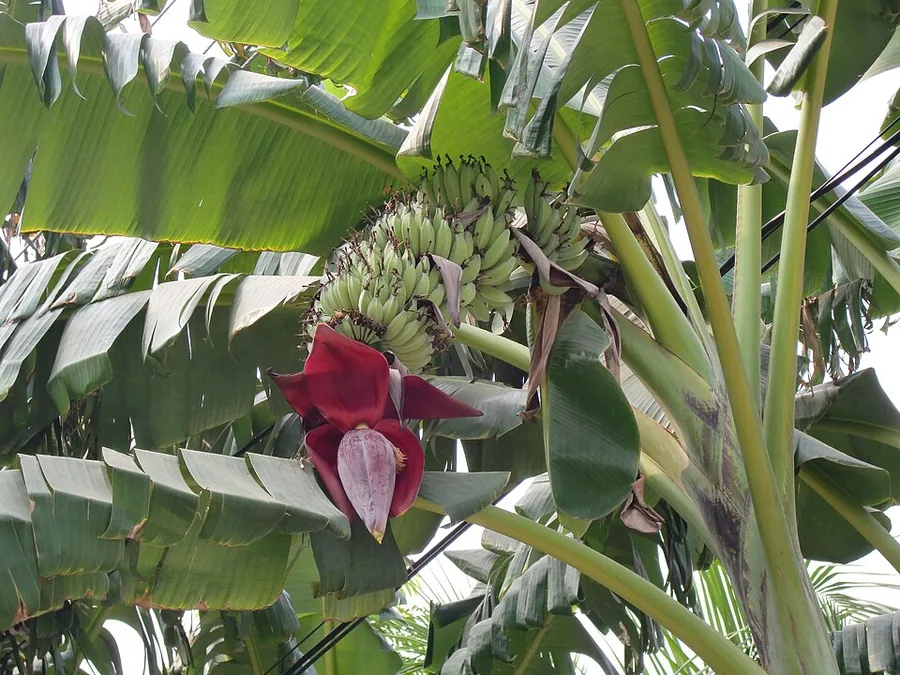
Growth is slow to fruit. A new stem needs 9 to 20 months to mature, and only then does a hanging flower spike emerge, its dusky purple-red bracts peeling back to reveal the rows of small fingers that swell into a bunch. Once a clump is set, the followers ripen in turn, and the enormous arching blades hold the eye long before any fruit forms.
Care
The short version: those broad green blades want blazing sun and real heat, a deep fertile bed that stays damp but never soggy, a monthly ration of high-potassium feed while the stem is rising, and shelter for the foliage the instant frost looms.
Light
Banana wants full sun to drive the fast unrolling of its broad blades, though it will take partial shade and still grow. The more light it gets, the thicker and greener the pseudostem and the better the fruit.
Water
This is a thirsty plant, drawing water up through its juicy stem and wide leaves. Keep the soil evenly moist at all times but never waterlogged, watering every 2 to 4 days and more often in heat or wind. Deep, well-drained ground lets you water hard without drowning the roots.
Soil
Plant in deep, fertile, well-drained loam dark with organic matter, which feeds the roots and holds the moisture banana craves. A pH between 5.5 and 7.0 suits it well.
Temperature
Banana grows best between 59°F and 86°F (15°C to 30°C). Growth slows as it cools toward 60°F (16°C), and a freeze at or below 32°F (0°C) turns the green blades black, so it needs real warmth to crop.
Humidity
Coming from the tropics, banana likes the air humid, around 50% to 80%. Dry air browns and crisps the leaf edges, so a sheltered, muggy spot or a misted indoor corner keeps the broad blades smooth and green.
Feeding
Banana is a heavy feeder with a big appetite for potassium. A high-potassium fertilizer at roughly a 3-1-6 N-P-K ratio, given about once a month through the warm growing season, keeps the leaves a deep green and the fruit fingers filling out.
Pruning
Strip off dead or torn leaves as they brown, and once a stem has hung its bunch, cut that pseudostem to the ground, since it fruits only once. Thin the crowd of green suckers to one or two followers per clump so the plant's energy stays focused.
Repotting
A container banana needs moving up every 1 to 2 years, or sooner if pale roots circle the pot, growth stalls, or suckers pack the surface. Shift it into a larger pot at the start of the warm season so the roots can stretch before growth takes off.
Size & spacing
This is a big plant, the green pseudostem running from 6.5 to 16 feet (2 to 5 m) tall and the arching blades spreading 5 to 10 feet (1.5 to 3 m) wide. Give it plenty of open room, since the clump only widens as new suckers fill in.
When to plant
Banana keeps time by warmth, not by a frost calendar. Plant in spring once the soil and air have warmed, let the green pseudostem rise and thicken through the long season, and look for the flower spike and fruit anywhere from 9 to 20 months later. Where winters bite, grow it in a pot and bring it in before the cold blackens the leaves.
Northern hemisphere
Southern hemisphere
Typical months for a temperate climate: start earlier in warm zones, later where spring frosts linger.
- Plant: Spring, after the last frost when soil and air are warm (zones 9 to 11)
- Harvest: Each pseudostem flowers and fruits once, about 9 to 20 months after planting, then is cut down and replaced by suckers
Hardiness
USDA hardiness zones: 9–11
Temperature: down to -7°C
Troubleshooting
Most banana trouble traces back to cold, hungry soil, or a fungus in the ground, and the plant writes the cause across its own tissue. Read the color of the leaves and the streaking inside a cut pseudostem and the answer is usually plain. Match the signs below, then act before a setback becomes a loss.
Bottom leaves fading yellow and hanging limp against the stem
When the lowest leaves fade to yellow and sag limp against the stem, the trouble is Panama disease, a soilborne Fusarium fungus that chokes the plant from within. Draw a knife through the pseudostem and the smooth pale flesh is shot through with brown or red streaks running the length of the tissue. There is no saving it once the streaking shows, so lift the whole plant and destroy it, and keep a vulnerable cultivar out of that soil, since the fungus lingers in the ground for years.
Fix:
- Remove and destroy infected plants
- Do not replant susceptible cultivars in the same soil
- Use resistant cultivars where available
Blackened, slumping foliage in the wake of cold weather
After a cold night the broad green blades turn slick and black, then fold and hang down the stem in tatters, the unmistakable mark of cold damage on a tropical plant. The chill begins to bite below 60°F (16°C), and a freeze at or below 32°F (0°C) blackens the foliage outright. Cut away the ruined leaves once frost danger passes, bank mulch over the buried rhizome, and pale new shoots usually push up through the soil come spring.
Fix:
- Cut away dead foliage once frost danger passes
- Mulch heavily over the rhizome
- Allow the plant to resprout from the rhizome in spring
Oldest blades paling and crisping brown along their margins
On a hungry banana the oldest blades pale first, their broad edges going yellow then crisping to a dry brown scorch while the new leaves unfurl thin and pale, the classic look of a potassium or nutrient shortage. A soil or leaf test pins the cause down. A high-potassium fertilizer at roughly a 3-1-6 N-P-K ratio, fed through the warm season, brings the deep green back to the foliage and firms up the growth.
Fix:
- Apply a high-potassium fertilizer (about 3-1-6 N-P-K)
- Feed regularly through the warm growing season
Toxicity
Good news for pet owners: the banana is non-toxic from rhizome to ripe fruit. The ASPCA lists it as safe for cats and dogs, and the same holds for other animals and people. The worst a big mouthful of the fibrous leaves might do is loosen a stomach, the way any rich plant material can.
Safe for
People · Cats · Dogs · Horses · Rabbits · Livestock · Birds
Cats None
A cat that bites into the soft green leaf blade comes to no harm, since the ASPCA lists banana as non-toxic to cats. Strip down a large amount of that leafy tissue and the most that follows is a brief upset stomach, the same as with any plant.
Dogs None
Dogs are safe with banana, and the soft, sweet ripe flesh turns up in plenty of dog treats. A dog that chews down a heap of the fibrous leaves may pass a looser stool, but there is no real toxin in the green tissue.
Horses Safe
Horses crop the long green blades without harm, and many take the peeled yellow fruit from the hand. Nothing in leaf, stem, or fruit poisons them.
Rabbits Safe
Rabbits are safe with banana, though the soft sugary flesh is rich and dense, so it is best offered as a small, occasional treat rather than a staple.
Livestock Safe
Cattle, goats, and sheep chew the broad leaves and the fibrous stems without ill effect, and across many tropical regions the plant is grown to feed them.
Birds Safe
Birds peck eagerly at the soft ripe pulp, and both the yellow fruit and the green foliage are non-toxic. Backyard hens and a pet parrot can share a piece without trouble.
People Safe
The ripe yellow fruit is an everyday food, its soft pale flesh eaten raw or cooked, and no part of the plant holds a toxin. Even the firm green fruit and the tender white inner stem are cooked and eaten in many kitchens.
Safe around pets; fruit and foliage are non-toxic, though eating large amounts of any plant material can cause mild digestive upset.
Varieties
Most bananas grown at home trace back to a few well-known cultivars, each with its own height and fruit. These are the ones worth knowing before you choose.
Dwarf Cavendish
A short, stocky seedless dessert banana whose low, sturdy pseudostem shrugs off wind and fits a container, making it the usual pick for indoor and small-space growing.
Cavendish
The smooth-skinned dessert banana piled on supermarket shelves, sterile and seedless and so grown only from suckers.
Lady Finger
A tall grower hung with small, slender, very sweet sugar bananas.
Lacatan
One of the tallest banana cultivars grown, rising on a long, slim pseudostem.
How to propagate
Banana copies itself with ease, since every clump pushes up new green shoots of its own. You start fresh plants from those shoots or from a piece of the pale underground rhizome, never from seed.
Offsets & pupsEasy
Warm season (spring to summer) · Roots in a few weeks; first fruit in about 9 to 20 months
The propagule of choice is a sword sucker, a slim young shoot about 4 to 5 feet tall whose leaves are still narrow and blade-like rather than broad, lifted with a firm chunk of the rhizome attached. Set out in the warm season it sends down roots within a few weeks, then takes about 9 to 20 months to hang its first bunch.
DivisionModerate
Warm season (spring to summer) · Several weeks to root
The rhizome can be split in the warm season into pieces, each one showing firm white flesh and a few plump buds, and each piece roots over several weeks. Seed offers nothing here, the edible bananas being sterile and seedless.
Myths
Bananas grow on trees.
The banana is a giant herbaceous perennial, not a true tree, and the smooth green column you take for a trunk is a pseudostem, built from leaf sheaths wrapped tight around one another with no wood at the core. Slice it across and the cut face is moist, pale, and ringed like an onion. It is often called the world's largest herb, a popular if debated title.
Plant the tiny dark specks inside a supermarket banana and they will sprout into a fruiting plant of your own.
Cut open a Cavendish and the soft pale flesh shows only faint dark specks where seeds would sit, because dessert bananas are sterile and seedless with nothing viable to plant. New plants rise instead from suckers, pups, or divisions of the rhizome.