Houseplant · Moraceae
Rubber Plant
Ficus elastica
Set it in bright indirect light and one steady corner, and the rubber plant unfurls into a glossy, hands-off indoor tree.
Bright indirect
60–80°F · 16–27°C
USDA 9–12
2–10 ft · 0.6–3 m
Overview
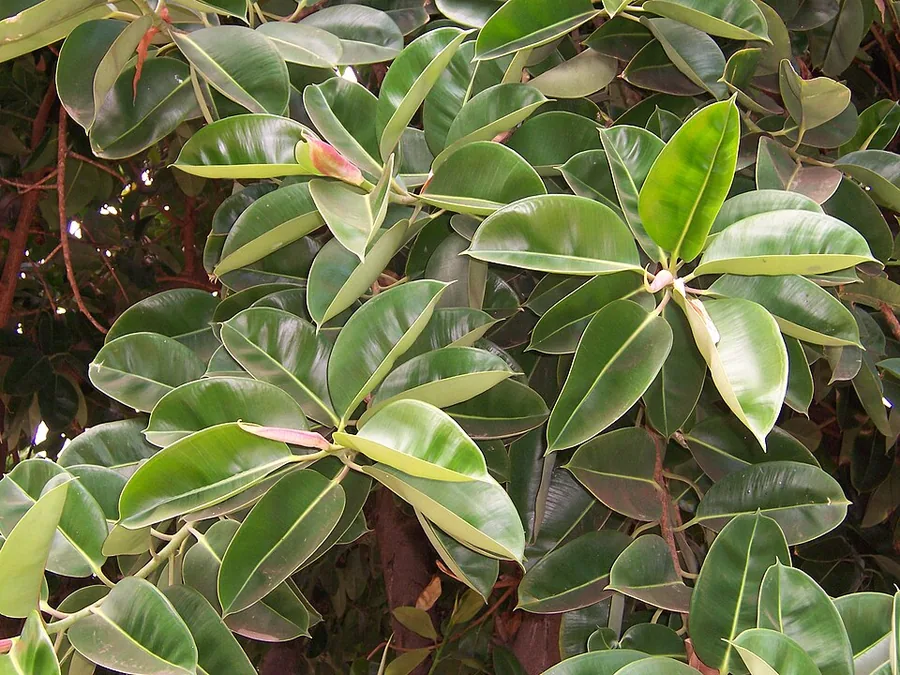
Few large houseplants are as undemanding as the rubber plant. A member of the fig family, it hails from the wet forests that run from Nepal east into southern China and on through western Malesia, where it rises into a soaring tree. Kept inside it tops out at a workable 2 to 10 feet (60 cm to 3 m), hung with broad, leathery leaves that shine like polished green and fill a corner with weight and presence.
Its easy reputation rests on how much it puts up with. Bright indirect light brings out its best, yet it endures dimmer rooms better than most big-leaved plants and forgives the odd skipped watering. What it cannot abide is upheaval, so a settled spot clear of drafts keeps every leaf anchored to the stem.
Cut any part of it and a thick milky latex sap beads up white at the wound. That sap is where the rubber plant got its name, and it is the reason gloves come out before you prune. It can sting skin and runs mildly toxic to cats and dogs, so choose its place with both your pets and your household in view.
Care
The short version: bright indirect light, a warm corner that stays put, and a deep watering only once the soil surface feels slightly dry. Feed across spring and summer, and glove up any time you cut into it.
Light
Stand the rubber plant in bright indirect light beside a window that escapes the scorching afternoon glare. It will soldier on through partial shade or low light, but growth crawls there and the variegated kinds wash out and lose their markings.
Water
Soak it through, then hold off until the soil surface has dried slightly before the next round. Confirm the pot drains freely and empty whatever gathers in the saucer, because water left standing rots the roots faster than anything. Throttle back the watering from fall into late winter, once growth idles.
Soil
Set it in a well drained, soil-based potting mix. The plant pays little mind to pH and takes anything from 6.0 to 8.0, so chase a mix that drains in a breath rather than one that turns dense and waterlogged.
Temperature
Hold it in the 60°F to 80°F (16°C to 27°C) band it favors, with warm daylight hours and cooler nights. Keep it above 55°F (13°C) and clear of cold drafts, since a sudden chill is a frequent culprit behind dropped leaves.
Humidity
Ordinary indoor air keeps it content, and there is no figure to fuss over. It tilts toward humid air yet weathers the dry warmth of winter heating without complaint.
Feeding
Feed it every two weeks across spring and summer with a water-soluble houseplant fertilizer while it is actively growing. Dial it down in dimmer light and through the cold stretch, when its appetite drops off sharply.
Pruning
Cut it back in spring to rein in the height, refresh long bare stems, or steer it toward a fuller, bushier shape. Leave it untouched and it climbs into a tall, tree-like form, so pruning is your call rather than a duty. Always wear gloves, because the wounds weep stinging latex.
Repotting
Move it up in late winter or early spring once it has filled its pot. Step it up just a size or two at a stretch into fresh, well drained mix, and keeping the gloves on serves you well here too.
Size & spacing
Inside, a rubber plant climbs to 2 to 10 feet (60 cm to 3 m) tall and races upward in good light. Spare it floor room and headroom to suit, since unpruned it keeps reaching for that tall, tree-like form.
Troubleshooting
Nearly every rubber plant complaint comes down to watering or some abrupt shift in its setting. Catch the signals in the leaves and roots early and the remedies are straightforward. Find your symptom below, then act before a small fault widens.
Drooping leaves above sodden soil
A plant that sags while its soil stays heavy and wet is in the grip of root rot. Below the surface the roots have gone soft and blackened, so they can no longer pull up water, and the leaves slump even with moisture all around them. Slash the watering back hard, snip out the rotted roots, and settle it into fresh free-draining mix in a pot that lets water run through.
Fix:
- Reduce watering
- Repot into a well-drained mix and a pot with drainage holes
- Remove affected roots
Lower leaves fading to yellow
When the broad leaves go from glossy green to washed-out yellow, the cause is nearly always roots sitting in damp soil. One or two yellowing leaves right at the base can be plain old age, but once the color creeps higher up the stem, pull back on the watering, confirm the pot is draining, and pour off anything pooling beneath it.
Fix:
- Reduce watering frequency
- Ensure the pot has drainage holes and empty the saucer
- Use a well-drained, soil-based mix
Bare stems after a move or a cold snap
The thick leaves let go whenever the plant's surroundings shift. Thin light, a chilly draft, parched air, or waterlogged roots will each trigger a drop, and so will carting it around from corner to corner. Park it in a single bright, even spot well clear of drafts and warm vents, hold it above 55°F (13°C), and look hard at your watering habits.
Fix:
- Move to a brighter, stable location with bright indirect light
- Keep away from cold drafts and heat sources; keep above 55°F
- Avoid frequently relocating the plant
- Check and correct watering
Sticky sheen, fine webs, or bumps along the stems
A handful of sap-sucking pests target the rubber plant, and every one signs its work differently. Look for the powdery white fluff of mealybugs, the small hard lumps of scale clinging to stems, the gauzy threads and speckling left by spider mites, and a tacky glaze spreading over the leaf surface. Sponge the foliage clean, dose it with insecticidal soap or horticultural oil, and stand it well away from your other plants until it pulls through.
Fix:
- Wipe or wash insects off the foliage
- Treat with insecticidal soap or horticultural oil
- Isolate the plant until the infestation clears
Toxicity
This is not a plant to let curious mouths chew on. Its milky latex sap holds ficin and a psoralen, enough to sting the mouth and stomach of cats and dogs and to leave human skin red and raw on contact. None of it is safe to eat, so set it beyond the reach of pets and small children and handle it in gloves.
Toxic to
Cats · Dogs · Horses · Rabbits · Livestock · Birds · People
Cats Mild
Bite into a leaf and a cat will usually start drooling and pawing at its mouth as the latex stings, with a queasy belly and a bit of vomiting close behind. Where the white sap touches fur-free skin, it can leave the spot red and tender.
Dogs Mild
A dog that takes a bite tends to drool and look sore around the mouth, with vomiting or an unsettled gut following soon after. The fallout stays gentle, yet the gummy sap can still redden skin wherever it lands.
Horses Caution
NC State counts the plant as toxic to horses. That same latex would sting the mouth and gut, and while a horse seldom crosses paths with an indoor fig, keep trimmings and dropped leaves where it cannot reach.
Rabbits Caution
The milky sap carries the very irritants that trouble cats and dogs, so a rabbit that nibbles the leaves courts a raw mouth and a roiling stomach. Keep it from grazing the foliage.
Livestock Caution
Any grazing animal that reaches the leaves can end up with a stinging mouth and an upset gut from the latex. It grows nowhere near a pasture, so the genuine danger is tossed clippings or a pot left within range.
Birds Caution
A pet bird that chews the leaves can react to the stinging sap, so rule the plant off-limits and keep its perches and cage well away from the foliage.
People Caution
The milky latex stings skin and eyes and can spark contact dermatitis, above all in anyone carrying a natural-rubber latex allergy. Nothing on the plant is fit to eat, so pull on gloves before pruning or repotting and keep the sap clear of bare skin.
The milky latex sap can irritate skin and eyes and cause contact dermatitis in sensitive people (Ficus latex also cross-reacts with natural-rubber latex allergy); wear gloves when pruning or repotting
Helpline numbers

United States
ASPCA Animal Poison Control: (888) 426-4435 (fee applies)
Poison Control: (800) 222-1222



Canada
Poison Centres: 1-844-764-7669
Varieties
Almost every rubber plant on a shelf is one of a few named forms, spanning plain shining green through dark maroon to bright variegation. These are the ones worth recognizing.
Robusta
Far and away the most popular pick, valued for its big, leathery leaves in deep forest green.
Decora
A wide-leaved type that has stood as a houseplant staple for generations.
Rubra
Wears foliage in reddish to deep maroon tones for a darker, more brooding cast.
Tricolor
A variegated form marbled with green, cream, and a soft blush of pink.
Doescheri
One more variegated selection ranked among the showier rubber plants.
How to propagate
Making more rubber plants asks for some patience, yet both standard routes pay off once you allow for the unhurried rooting and the sticky sap.
Stem cuttingsModerate
Spring to summer during active growth · Several weeks to a couple of months to root
Snip stem or tip cuttings across spring and summer while the plant is putting on growth. The fresh wounds weep milky latex, so rinse or dab it away before the cutting goes into its pot. Roots come grudgingly here, anywhere from several weeks to a couple of months.
Air layeringModerate
Spring to summer · Several weeks to root before separating from the parent
For a tall or bare-stemmed specimen, air layering is the method to reach for. You coax roots from a stem while it stays joined to the parent, a wait of several weeks, then sever the rooted new plant once those roots have filled in.
Myths
The rubber plant makes a safe, pet-friendly houseplant.
The ASPCA flags it as poisonous to cats and dogs, and the milky latex can sting skin or upset the stomach. The harm comes from ficin, a proteolytic enzyme, paired with a psoralen in the sap, so keep it well clear of pets and children.
Like many stinging houseplants, the rubber plant's bite traces to calcium oxalate crystals.
Those crystals are the reason philodendron and dieffenbachia sap burns, but this plant runs on a different chemistry. Its sting comes from the milky latex itself, the enzyme ficin and the psoralen ficusin, with no oxalate crystals involved.
Rubber plants want bright direct sunlight.
Full sun, the harsh afternoon kind most of all, can burn brown patches into the leaves. Bright indirect light or part shade suits them best, and they shrug off dim corners better than most foliage plants.