Houseplant · Moraceae
Ficus Audrey
Ficus benghalensis
Give it bright indirect light and steady, careful watering, and this pale-trunked banyan fig holds its deep-veined green leaves in good order.
Bright indirect
65–80°F · 18–27°C
USDA 10–12
100 ft · 30.5 m
Overview
Ficus Audrey is the houseplant form of Ficus benghalensis, the banyan fig and national tree of India, and up close it is a study in soft contrasts. Its trunk reads pale and almost chalky, near to white, and against it the foliage sits in a muted, matte green. Each leaf is broad and oval, its surface scored by deep veins that press in as faint channels and lend the blade a quilted, slightly textured feel.
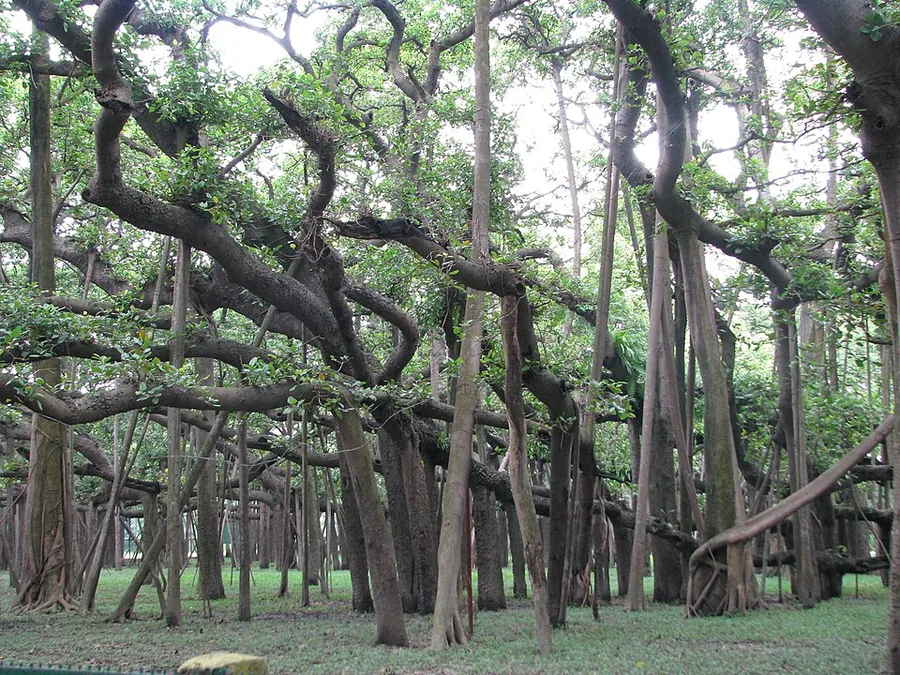
The same species, left wild in a frost-free climate, grows into a giant of a tree, starting as an epiphyte on a host before lowering aerial roots that thicken into trunks. A potted Audrey shows none of that. Indoors it holds at roughly 1 to 2 feet (30 to 60 cm) on a single slim trunk, with no aerial roots and no spreading crown, just an upright stem carrying its veined leaves.
Snap or cut any stem and the plant gives up its other signature: a bead of thick, milky white sap wells from the wound. The same latex runs through the leaves and stems, which is why the new growth at the tips looks glossy and full when the watering stays even, and why the leaves loosen and fall when it does not.
Care
The short version: give it bright indirect light, water only once the top 2 to 3 inches (5 to 7.6 cm) of soil have dried, keep the air a touch humid, and let it hold one settled spot rather than moving it around.
Light
Give it bright, indirect light near a window where the sun does not strike the leaves head-on, which keeps the matte green even and full. It will take some direct sun or a little shade, but too little light leaves it sparse and leggy, with leaves that pale and drop.
Water
Water only once the top 2 to 3 inches (5 to 7.6 cm) of soil feel dry, then let the excess drain and tip out whatever collects in the saucer. Ease off through winter as growth slows. Soggy roots are the fastest way to kill this plant, and the leaves yellow as a first sign.
Soil
Plant it in a well-drained potting mix, ideally cut with perlite so water moves freely through it. It is not fussy about pH and handles anything from 6.0 to 8.0, so the drainage matters far more than the chemistry.
Temperature
Ordinary room warmth suits it, somewhere around 65°F to 80°F (18°C to 27°C). Keep it clear of cold drafts and of the hot, dry stream from heating and AC vents, both of which crisp the leaf edges and trigger leaf drop.
Humidity
This fig prefers the air on the humid side, around 50% to 80%, which keeps the leaf margins supple and smooth. Dry indoor air, especially in winter, cracks the edges, so group plants together or run a humidifier where rooms run dry.
Feeding
Feed monthly through spring and summer with a liquid houseplant fertilizer, then stop entirely over winter while the plant rests. Pale, washed-out new leaves are the cue that it wants a little nitrogen.
Pruning
It takes pruning well, so cut it back to shape it or hold its size whenever you like. Each cut beads the irritant milky latex, the same thick white sap that runs through the stems, so wear gloves and keep it off your skin and out of your eyes.
Repotting
Move it up a pot size in late winter or early spring, with no rush, since it is content sitting a little root-bound. Pale roots creeping out the drainage holes, circling the rootball, or water running straight through tell you the time has come.
Size & spacing
As a houseplant Audrey holds at about 1 to 2 feet (30 to 60 cm) tall on its single slim trunk, far short of the roughly 100-foot (30 m) tree the species becomes in the wild. Give it enough room for air to move around the veined leaves so they sit clear of their neighbors.
Troubleshooting
Most Ficus Audrey trouble begins with watering or a change the plant disliked, and it surfaces first in the leaves, in their color, their surface, and how firmly they hold to the stem. Reading those early marks lets you act before a few dropped leaves leave a bare stem. Match what you see below, then act while it still helps.
Wilting, yellowing leaves over soft, mushy roots
This is root rot, set off when the roots sit soaked with no path to drain. Lifted from the pot, the rotted roots show brown and slick to the touch and give off a sour smell, where healthy roots would be pale and firm. Cutting the dead roots away and repotting into a fresh, fast-draining mix is the remedy, after which the surface dries before each watering and the saucer stays empty.
Fix:
- Reduce watering
- Repot into a well-drained mix and trim away rotted roots
- Ensure the pot drains freely and empty saucers
Leaves loosening and falling all at once
Leaves that let go in a sudden shower are the fig reacting to a change it disliked, whether a waterlogged pot, a cold draft, or a move across the room. Overwatering is the most common cause, so the soil is the first thing to read, and the top few centimeters should feel dry before the next watering. Held in one bright, draft-free spot with no further shuffling, the bare stems push out fresh green leaves again.
Fix:
- Stabilize conditions: keep in bright indirect light, away from heating/AC vents and cold drafts
- Water only when the top few cm of soil dry; never leave the pot in standing water
- Resume light feeding in the growing season if foliage is pale (nitrogen)
Speckled, sticky leaves with fine webbing or raised bumps
Pinprick speckling across the green, a tacky film underfoot, or small raised bumps studding the stems all signal pests at work, most often spider mites, scale, or mealybugs, with fungus gnats drifting over damp soil. A wipe of the leaves and a firm rinse knock most of them loose, and insecticidal soap or horticultural oil applied per label and repeated finishes the rest. A dry soil surface between waterings keeps the gnats from returning.
Fix:
- Wash foliage and rinse off pests
- Treat with insecticidal soap or horticultural oil per label
- Let the soil surface dry to discourage fungus gnats
Brown and yellow blotches spreading across the leaves
Blotches breaking the smooth green surface usually come down to the moisture and airflow at the leaf. Soft, spreading marks darkening outward mean still air and too much wet, while dry, light-brown patches that crisp at their centers mean the leaf went thirsty. Moving air, dry foliage, and even watering close the door on both.
Fix:
- Improve air circulation and avoid wetting foliage
- Water consistently and discard excess water
Leaf edges cracking and curling crisp
Dry indoor air is what crisps the leaf margins, and it bites hardest in winter once the heating runs. Plants grouped close, a humidifier, or a pebble tray under the pot lift the humidity toward 50% to 80% and keep the edges supple. Distance from heating vents matters, since their hot, dry stream parches the foliage faster than anything else.
Fix:
- Raise humidity (group plants, use a humidifier or pebble tray)
- Keep away from heating vents
Skin reddening after contact with the cut-stem sap
The thick, milky latex sap that beads from a cut carries ficin and psoralen, and where it meets skin it leaves a red, irritated patch. The reaction follows pruning or a snapped stem, so the cause is easy to read. Soap and water lift the residue right away, and gloves worn through any cut keep the white sap off the skin entirely.
Fix:
- Wash skin with soap and water after contact
- Wear gloves when pruning or taking cuttings
Toxicity
This is not a plant to eat or to leave within a chewing pet's reach. The leaves and the milky white sap carry ficin and psoralen, which irritate the mouth, stomach, and skin in cats, dogs, and people alike. The reaction is usually mild rather than dangerous, but no part of the plant is safe to nibble, so keep it clear of pets and children and wear gloves when you prune.
Toxic to
Cats · Dogs · Horses · Rabbits · Livestock · Birds · People
Cats Mild
A cat that bites into a leaf or the white sap drools and may bring up its food, with the mouth and stomach left irritated. The upset stays mild, and most cats settle once they leave the plant alone.
Dogs Mild
A dog that crushes a stem or leaf in its mouth drools and turns queasy, sometimes vomiting. The same milky sap can redden the skin around the muzzle where it smears.
Horses Mild
In a horse the milky sap stings the mouth and gut, bringing on drooling and digestive upset. Latex smeared on the skin can leave the muzzle raw and sore.
Rabbits Caution
The same ficin and psoralen carried in the leaves and sap make them a poor mouthful for a rabbit. The plant kept out of reach removes any chance of a nibble.
Livestock Caution
Grazing animals that reach the foliage take on the same irritated mouth and stomach the sap stirs in other mammals. A fence around it keeps stock from browsing the leaves.
Birds Caution
No part of the plant is safe to eat, and the irritant white sap means the leaves and cut stems are no place for a curious bird.
People Caution
No part of this plant is meant to be eaten, and the latex sap reddens skin on contact, so gloves belong on for pruning. A child chewing a leaf can be left with a sore mouth.
The milky latex sap can irritate skin; wear gloves when pruning or taking cuttings
Helpline numbers

United States
ASPCA Animal Poison Control: (888) 426-4435 (fee applies)
Poison Control: (800) 222-1222



Canada
Poison Centres: 1-844-764-7669
Varieties
Ficus Audrey is sold under one main name, though a close relative also turns up in the houseplant trade. The two below are easy to tell apart once you look at their size and leaves.
'Audrey'
This is the compact houseplant form sold as Ficus Audrey, standing around 1 to 2 feet (30 to 60 cm) on a pale, almost whitish trunk and carrying deep-veined green leaves, and it grows with little fuss.
Chandelier Happiness
An upright selection that climbs a little higher, around 2 to 4 feet, with oval leaves in a soft medium green.
How to propagate
You can raise a new plant from an Audrey you already own, though it takes more patience than rooting an easy trailing plant. Both methods cut into stems that bleed thick white latex, so gloves are part of the work.
Air layeringModerate
Any season (genus-level, Clemson); NC State also lists air layering for F. benghalensis · Unknown
Air layering is the more reliable route to a new plant, and figs take to it at any time of year. A section of stem is wounded and packed in damp moss until pale roots thread out into it, then the rooted piece is cut free. The wound weeps thick white latex throughout, so gloves stay on for the whole job.
Stem cuttingsModerate
Best taken in summer (genus-level, Clemson); NC State lists stem cuttings for the species · Unknown
A stem cutting is the other route, best taken in summer while the plant is in strong growth. A healthy stem is severed and potted to root. The cut end beads milky white latex that stings the skin, so gloves stay on through the work.
Myths
Every part of Ficus Audrey, leaf and sap alike, is harmless to cats and dogs.
It is not. The ASPCA lists the genus Ficus as toxic to cats, dogs, and horses through its ficin and psoralen, and NC State flags this species as poisonous to cats, dogs, and people by way of the leaves and sap. Keep it out of reach of pets and children, and treat any chewed leaf as a reason to call the vet.
The sting in the leaves comes from calcium oxalate crystals, as it does in many houseplants.
That is the wrong culprit. The irritation comes from the milky latex sap, the white liquid that beads from a wound, which carries a proteolytic enzyme called ficin along with psoralen, not the calcium oxalate crystals found in plants like pothos or dieffenbachia.
Merely a little tabletop plant with neat leaves, while the massive banyans hung with aerial roots are some other species.
It is the very same plant, Ficus benghalensis, the national tree of India. Indoors as Audrey it stays around 1 to 2 feet on a single slim trunk and never forms aerial roots, but in the wild it is a strangling fig that begins as an epiphyte, climbs to roughly 100 feet, and drops prop roots that thicken into trunks.
Sources
- Plants of the World Online, Royal Botanic Gardens Kew
- NC State Extension Gardener Plant Toolbox
- ASPCA Animal Poison Control ('Fig')
- UF/IFAS Center for Aquatic and Invasive Plants, University of Florida
- Clemson Cooperative Extension HGIC (Weeping Ficus)
- Missouri Botanical Garden Plant Finder (Ficus benjamina)