Tree · Ebenaceae
Persimmon
Diospyros kaki
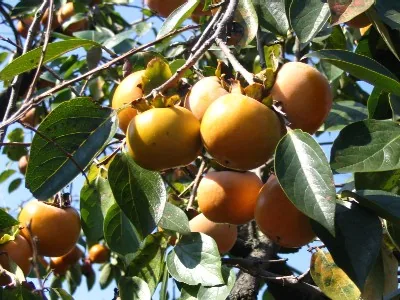
Given full sun, persimmon ripens smooth skinned, deep orange globes that glow against its gray, leafless wood far into fall.
Full sun
Every 7–14 days
USDA 7–10
20–30 ft · 6.1–9.1 m
Overview
The persimmon is a slow, easygoing fruit tree that carries broad green leaves all summer, then burns to fiery orange and red in autumn before the foliage falls. What stays behind is the striking part: rounded, glowing orange fruit clinging to bare gray branches well into winter. It belongs to the ebony family, and a full grown tree stands a generous 20 to 30 feet (6 to 9 m) tall, so it wants real room rather than a corner.
Most home growers reach for the Asian persimmon, whose fruit falls into two textures. Astringent types like Hachiya stay hard and harshly tannic until they ripen to a soft, jelly filled globe, while non astringent types like Fuyu firm up sweet and crisp, snapping under the teeth while still solid. Which kind hangs on the branch decides exactly when you pick.
Once its roots take hold, the tree is fairly drought tolerant and asks little in feeding or pruning. The patience comes early. A young tree spends its first seasons putting on modest growth before it sets its first fruit, then hangs those glowing globes on the branches for decades.
Care
The short version: full sun and deep, well drained soil, with steady water while the tree is young and setting fruit, light feeding if any, pruning kept to cleaning up the branch framework, and astringent fruit left on the branch to soften fully before you pick.
Light
Persimmon wants full sun for most of the day. The more direct light strikes the leaves and fruit, the deeper the orange the fruit colors and the sweeter it turns, and the tighter and stronger the branch framework grows.
Water
The tree drinks regularly while it establishes and right through fruit development, with the top half of the soil left to dry between waterings. Once its roots are set, it is fairly drought tolerant and rides out dry spells, but its roots will not sit in waterlogged, airless ground.
Soil
It roots best in deep, moist, well drained loam, though it takes clay, loam, or sand without complaint. The sweet spot for the soil is slightly acidic, a pH of 6.0 to 6.5.
Temperature
Asian persimmon endures a wide swing of temperatures, roughly 10°F to 95°F (-12°C to 35°C), matching hardiness zones 7 to 10. It needs a real winter chill to fruit well, yet a hard late frost can still blacken the tender spring blooms.
Humidity
Plain outdoor air around 40% to 70% humidity suits it, so there is nothing to manage. Air moving freely through the canopy counts for more, since it dries the broad leaves and keeps leaf spot from settling.
Feeding
The tree needs little feeding. A balanced fertilizer in early spring earns its place only when growth looks thin and weak, since too much nitrogen drives fruit drop rather than a heavier crop.
Pruning
Pruning stays minimal. Dead, injured, or crossing branches come off in late winter, a young tree is shaped to a strong open frame, and the root suckers pushing up from the base are cut away as soon as they show.
Repotting
Persimmon is a full sized orchard tree, not a container plant, so it is rarely repotted. It goes into its permanent spot once, with room for the crown to spread, and its roots are left undisturbed.
Size & spacing
The tree needs space to fill out. A mature specimen stands 20 to 30 feet (6 to 9 m) tall and spreads its crown 15 to 25 feet (4.5 to 7.5 m) wide, so it belongs well clear of buildings, power lines, and other trees.
When to plant
Persimmon moves through the year at a slow, deliberate pace. Young trees go into the ground in early spring once the hard frosts have passed, small clustered blooms open in mid to late spring, and the fruit swells and colors up in fall, hanging glowing on the branch into early winter.
Northern hemisphere
Southern hemisphere
Typical months for a temperate climate: start earlier in warm zones, later where spring frosts linger.
- Plant: Early spring after the last hard frost, as bare root or container trees.
- Harvest: Blooms mid to late spring; fruit ripens in fall and early winter.
Hardiness
USDA hardiness zones: 7–10
Temperature: down to -18°C
Troubleshooting
Persimmon is a sturdy, healthy tree with few real troubles. Most of what you spot on the leaves, twigs, or fruit is a surface blemish or a quirk of the fruit itself rather than a threat. Match the symptom below and the fix is usually a light one.
Undersized fruit paling to yellow and falling from the branch before ripening
Small green fruit that pales to yellow and lets go early is ordinary fruit drop for persimmon, though a thirsty tree or one bent under a heavy set sheds far more of it. Even soil moisture right through fruit development keeps the little fruit firmly attached. Thinning a crowded set early leaves the branches carrying only what they can swell to full size.
Fix:
- Keep soil evenly moist during fruit development and thin heavy crops.
Rough little bumps or snowy cotton tufts stuck fast to the twig bark, sometimes filmed in black sooty mold
Those small fixed bumps and soft cottony tufts clinging to the twigs and leaf undersides are sap feeding insects, scale or mealybugs, and the sticky black film smeared beneath them is sooty mold feeding on their honeydew. A scatter of them does the tree no real harm. When they crust the wood thickly, a coat of horticultural oil clears them, and natural predators pick off the stragglers.
Fix:
- Usually minor; treat heavy infestations with horticultural oil and encourage natural predators.
Crisp edged dark blotches with angular corners strewn over the green leaves
Dark, hard edged blotches with angular sides scattered over the leaf surface are fungal leaf spot, a blemish on the foliage that seldom sets the tree back. Clearing the fallen, spotted leaves off the ground strips the spores of a winter refuge, and a thinner, more open canopy lets air slip between the branches. A spray is almost never warranted.
Fix:
- Rake and remove fallen leaves and provide good air circulation; rarely needs treatment.
A tannic, sandpaper dry grip on the tongue from fruit bitten while hard
The dry, mouth gripping pucker of a firm fruit comes from soluble tannins packed into unripe astringent cultivars like Hachiya, and it tracks the fruit's ripeness, not its growing. An astringent persimmon left to soften to a translucent, jelly ripe pulp loses that grip and turns sweet. Non astringent types such as Fuyu stay crisp and sweet in the hand while still firm.
Fix:
- Let astringent types soften fully before eating; non astringent types such as Fuyu can be eaten firm.
Toxicity
The soft, ripe orange flesh is a safe, sweet food for people, and no part of the tree holds a chemical poison. The danger is mechanical: the hard, smooth seeds and large amounts of pulp can pack into dense indigestible masses, a real risk for horses and livestock grazing windfalls and for dogs that gorge on dropped fruit. Gathering the fallen fruit off the ground and fencing stock from the tree in fruiting season removes the hazard.
Toxic to
Cats · Dogs · Horses · Rabbits · Livestock · Birds
Safe for
People
Cats Mild
The soft orange flesh holds no chemical toxin, so a curious lick or nibble does nothing. The hazard is mechanical, since a hard swallowed seed or a stomach packed with pulp can bring on mild stomach upset.
Dogs Mild
A dog that gulps down fallen fruit may bring up vomit or pass loose stool from the smooth seeds and the sheer amount of pulp. A small dog that bolts several whole fruit, seeds and all, can rarely mass them into a blockage.
Horses Moderate
Horses face the sharpest risk. Grazing dropped persimmons through fall and winter can bind the slick seeds and soft pulp into a dense gastric phytobezoar, and that stone leads to colic, impaction, lethargy, and weight loss.
Rabbits Mild
A morsel of ripe flesh now and then will not poison a rabbit, but the hard seeds and the heavy sugar do not suit its gut. Persimmon stays a rare treat, and young rabbits get none of it.
Livestock Mild
Cattle, sheep, and goats can browse fallen fruit without chemical harm, yet a steady gorge on the seedy pulp risks the same packed impactions seen in horses. The windfalls are best fenced off through fruiting season.
Birds Mild
Wild birds strip the soft, glowing flesh from ripe persimmon and pass the small seeds with ease, doing well on it. Pet birds get only seedless scoops of ripe pulp and never the hard pits.
People Ripe fruit safe
Ripe persimmon is a sweet, safe fruit eaten fresh or dried. Astringent types want softening first, the smooth seeds stay uneaten, and the portion stays modest, since eating a great many on an empty stomach has been tied to bezoars.
Foliage and ripe flesh are not chemically toxic; the hazard comes from swallowed seeds and large amounts of fruit, especially unripe astringent fruit.
Helpline numbers

United States
ASPCA Animal Poison Control: (888) 426-4435 (fee applies)
Poison Control: (800) 222-1222



Canada
Poison Centres: 1-844-764-7669
Varieties
Persimmons sort first by the feel of the ripe fruit, astringent against non astringent, and that single trait shapes both the texture in the hand and how you eat it. These are the names you will meet most often.
Fuyu
A non astringent Asian type whose crisp, firm flesh stays sweet and snaps under the teeth even before the fruit softens.
Hachiya
An astringent Asian type that has to ripen through to a soft, translucent, jelly like pulp before the pucker leaves it.
Jiro
A non astringent Asian type shaped much like Fuyu, its firm sweet flesh ready to eat straight off the tree.
American (Diospyros virginiana)
The native American persimmon endures cold down to about minus 20°F to minus 25°F (-29°C to -32°C) and is often dioecious, so fruit usually needs a male and a female tree standing together.
How to propagate
Persimmon is propagated to carry a known fruit forward, not for ease. Grafting keeps the cultivar exactly true, while seed is a slower, more unpredictable route used mainly to raise rootstock.
GraftingDemanding
Named cultivars nearly always begin as a graft or bud joined onto seedling rootstock, the union that carries the exact fruit of a Fuyu or Hachiya forward true. Matching the cut surfaces and timing them right takes a steady hand, which places it at the demanding end of propagation.
SeedModerate
Persimmon seed sprouts readily, but the young trees rise up variable and slow to bear, their eventual fruit anyone's guess. That unpredictability is why seed grown trees are raised chiefly as rootstock for grafting rather than for a crop of their own.
Myths
Any persimmon, whichever kind it is, bites back with a drying pucker.
Only the astringent cultivars like Hachiya wear that dry grip until they soften. Non astringent types such as Fuyu and Jiro are crisp and sweet eaten firm, their flesh snapping cleanly with none of the puckering bite.