Houseplant · Crassulaceae
Panda Plant
Kalanchoe tomentosa
A fuzzy, silver-green succulent with felt-edged leaves that asks for bright light and dry soil.
Bright indirect
Every 10–21 days
50–75°F · 10–24°C
USDA 9–11
Overview
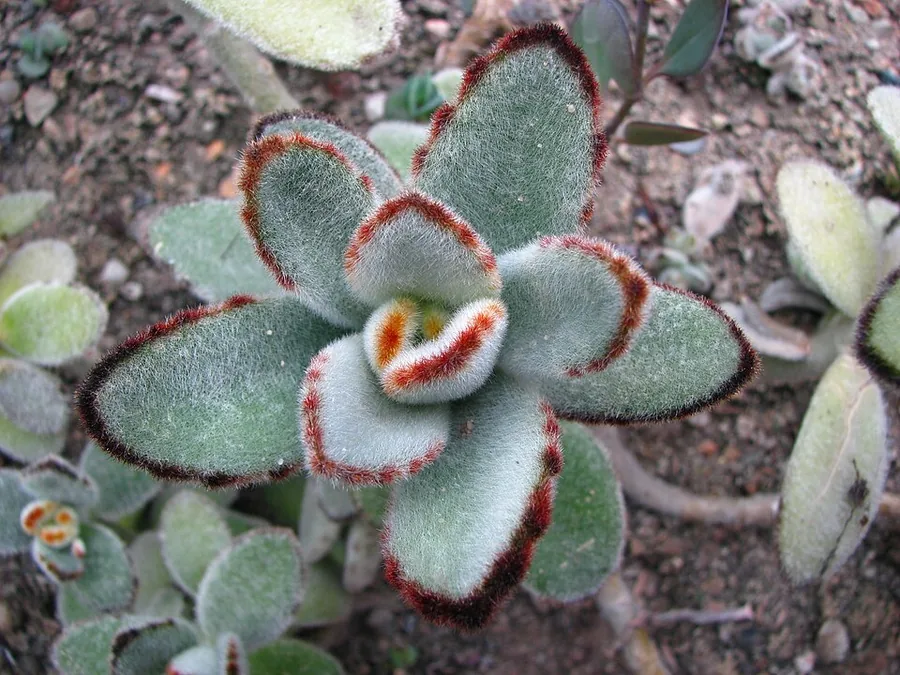
The panda plant earns its name from thick, oval leaves coated in dense silvery fuzz that catches the light in a soft grey-green, each leaf tipped and edged with rust-brown felted margins like the print of a small paw. It is a slow-growing succulent from Madagascar, its plump leaves swollen with stored water for the long dry spells it evolved to survive. Grown indoors it stays small and low, reaching only 12 to 18 inches (30 to 45 cm) across many years.
Run a finger over a leaf and the surface feels warm and plush, more like felt than any smooth-skinned succulent. That coat of fine hairs is what stores and shields its water, and it is also why the plant resents fuss. Most that fail were simply given too much water. A bright windowsill and a gritty pot that drains fast are close to all it asks.
One trait sits behind that soft appearance: every part of the plant is toxic to animals. The fuzzy leaves carry bufadienolides, heart-acting compounds that rule it out within reach of curious pets. Its place is somewhere cats, dogs, and other animals cannot get to it.
Care
The short version: bright light, a gritty fast-draining mix, and water only once the soil has dried out completely. Keep it warm, feed it lightly in the growing season, and leave its plush leaves undisturbed.
Light
It wants bright indirect light, and it does best where some direct sun reaches it through a window. It tolerates full sun once acclimated, but in dim light the stems draw out long and the silvery fuzz grows thin and sparse.
Water
Let the soil dry out completely between waterings, which usually falls every 10 to 21 days and even less in winter. Pour at the soil line and keep water off the felted leaves, where it beads among the hairs and leaves spots. Overwatering claims more of these plants than any other cause.
Soil
It roots in a gritty cactus or succulent mix that drains fast and never stays soggy against the stem. A slightly acidic pH of 6.0 to 6.5 suits it, and a pot with open drainage holes is essential here.
Temperature
It holds well in the 50°F to 75°F (10°C to 24°C) range, ordinary room temperature through most of the year. It carries no frost tolerance, so keep it clear of cold windowpanes in winter.
Humidity
Low humidity is what it wants, so plain dry indoor air suits it well. Do not mist it or crowd it into a steamy bathroom, since moisture settling on the fuzzy leaves invites rot.
Feeding
It feeds lightly from spring through summer while it is in active growth, about once a month. A diluted balanced or low-nitrogen succulent fertilizer is right, and feeding stops through the dormant winter months.
Pruning
Pruning is barely needed. Pinch or cut back any long, drawn stems to push fresh branching and a fuller shape, and take off damaged leaves with a clean blade. Let the cut ends dry to a callus before they touch soil.
Repotting
It needs repotting only every 2 to 3 years, or sooner once roots push through the drainage holes and the plant grows top-heavy. Do it in spring, moving up a single pot size into fresh gritty mix.
Size & spacing
It stays a compact plant of 12 to 18 inches (30 to 45 cm) tall and 8 to 12 inches (20 to 30 cm) wide. Growth is slow, so a single plant keeps its plush, low shape for years on a windowsill.
Troubleshooting
Almost every panda plant problem is written in the leaves and stems, and almost every one comes back to water or light. Watch the fuzzy surfaces and the base closely and the cause reads clearly. Match what you see below, then act before rot or stretching sets in.
The base darkens and the tissue turns soft and wet
When the base blackens and the once-firm tissue caves in soft and wet under a finger, that is rot. It sets in where soil clings damp too long or water pools among the fuzz of the crown. Collapsed tissue never firms up again, so a clean blade cuts it all away. Firm leaves become cuttings, the sound growth returns to fresh gritty mix, and the soil dries hard between waterings.
Fix:
- Stop watering immediately and allow the soil to dry
- Cut away all soft, rotted tissue with a clean blade
- Take healthy leaf or stem cuttings to propagate if the base is lost
- Repot remaining healthy growth into fresh gritty, fast-draining mix
Stems draw out long with the leaves spaced thin
When the stems draw out long and bare, with plush leaves spaced far apart instead of clustered tight, the plant is starved of light. This stretching is etiolation, and the whole stem cranes toward the nearest window. A brighter spot puts an end to it, the light stepped up over a week or two so the fuzzy surfaces do not scorch, and the drawn stems then cut back to root as fresh growth.
Fix:
- Move to a brighter spot with bright indirect or some direct sun
- Acclimate gradually to stronger light to avoid scorch
- Prune leggy stems and propagate the cuttings
Dry brown blotches mark the leaves facing the sun
Dry brown blotches burned into the silvery fuzz of the sun-facing leaves are sunscald. They appear when light climbs faster than the plant can keep up, as when a plant leaves a shaded corner for harsh sun in a single move. Bright indirect light lets the fuzz recover, and stronger sun then returns in slow steps over one to two weeks.
Fix:
- Move the plant to bright indirect light
- Introduce stronger sun gradually over one to two weeks
Toxicity
For all its soft, touchable look, this is a plant to keep out of reach. The leaves, stems, and flowers all hold bufadienolide cardiac glycosides, which cause drooling and vomiting and, in a large mouthful, can disturb the heartbeat. It is dangerous to cats, dogs, horses, and other animals, and no part of it is safe for people to eat.
Toxic to
Cats · Dogs · Horses · Rabbits · Livestock · Birds · People
Cats Toxic
A single chewed leaf brings on drooling, vomiting, and diarrhea within a few hours. Cats are the ones most drawn to gnaw the fuzzy leaves, and a larger dose of the cardiac glycosides can throw off the heartbeat, so a wobbly or sluggish cat calls for a vet.
Dogs Toxic
A dog that bites into the fuzzy leaves tends to drool, vomit, and pass loose stool. The graver danger is a large mouthful carrying bufadienolides to the heart, where they can slow or scramble the rhythm, so a weak or collapsing dog needs veterinary help.
Horses Toxic
Every Kalanchoe is dangerous to horses. The cardiac glycosides irritate the gut and act on the heart, so colic, depression, and an irregular pulse can follow. The plant belongs well out of a grazing horse's reach.
Rabbits Toxic
A rabbit should never reach it. The same heart-acting compounds that strike cats and dogs are no gentler on a small grazer, and at that body size a small bite carries a heavy dose.
Livestock Toxic
Cattle, goats, and sheep can all be poisoned by Kalanchoe, with the toxin driving digestive upset and serious heart trouble. Grazing animals that break into a stand of it face a genuine hazard.
Birds Toxic
Birds are not spared. The bufadienolides act on their hearts by the same route, so pet birds belong well away from the leaves.
People Caution
No part of the panda plant is edible, so it stays off limits and clear of small children. The fine hairs that coat the leaves can also itch sensitive skin, so hands get washed after handling it.
The fine leaf hairs (trichomes) may irritate sensitive skin in some people; wash hands after handling.
Helpline numbers

United States
ASPCA Animal Poison Control: (888) 426-4435 (fee applies)
Poison Control: (800) 222-1222



Canada
Poison Centres: 1-844-764-7669
Varieties
A few named cultivars grow alongside the common species, set apart by the color of their leaves and the markings that trace the felted edges.
Kalanchoe tomentosa 'Chocolate Soldier'
Its leaf edges are lined with darker brown to rust-colored felted teeth, deep enough to trim the whole plant in chocolate tones.
Kalanchoe tomentosa 'Golden Girl'
Its leaves grow larger and carry a golden to silvery cast, with softer, lighter markings tracing the edges.
Kalanchoe tomentosa 'Nigra'
Its leaf tips are stained a dark, almost black-brown that stands out hard against the silvery fuzz below.
How to propagate
The panda plant multiplies with ease, and a single plush leaf or stem tip is enough to raise a whole new plant.
Leaf cuttingsEasy
Spring to summer during active growth · 4 to 8 weeks to root and form plantlets
A single plush leaf can raise a new plant, and leaf cuttings take best in spring or summer during active growth. A whole healthy leaf twists free, its cut end dries to a firm callus over a day or two, and it then rests on or barely into gritty mix with only sparing water. Fine roots and tiny plantlets push out at the base over 4 to 8 weeks.
Stem cuttingsEasy
Spring to summer · 3 to 6 weeks to root
A drawn-out, leggy stem makes good cutting material, taken in spring or summer during active growth. A stem tip is cut, the wound seals to a callus, and it sits in dry gritty mix with light water only once roots form, over roughly 3 to 6 weeks. New shoots usually break from the parent just below the cut.
Myths
Fuzzy succulents like the panda plant love regular misting and high humidity.
The panda plant is a dry-air succulent, and it hoards its own water inside those thick, plush leaves. A fine mist does not evaporate off the felted surface, it beads and lingers among the hairs, and that trapped film brings on spotting and rot. The mister stays away, and the soil is left to dry out instead.