Tree · Meliaceae
Neem Tree
Azadirachta indica
Set it in heat, sun, and fast-draining ground, and this broad-crowned evergreen stands green through drought and thin soil for decades on end.
Full sun
Every 7–21 days
USDA 10–12
50–75 ft · 15.2–22.9 m
Overview
A member of the mahogany family, neem grows fast and keeps its glossy green foliage through the year. Its native ground is south Asia, though it now stands across the warm reaches of Asia and Africa. Reach the open and its trunk lifts a wide, densely leaved crown that pools cool shade on the earth below. Its twigs have long been chewed for cleaning, and its seeds crushed for their oil.
Inside each hard seed sits the oil that makes neem famous, thick with azadirachtin. That compound spoils an insect's appetite and disturbs how it grows and breeds, which is why gardeners press the seed into a natural pesticide. The leaves hold a medicinal tradition all their own and stay far gentler than the concentrated oil.
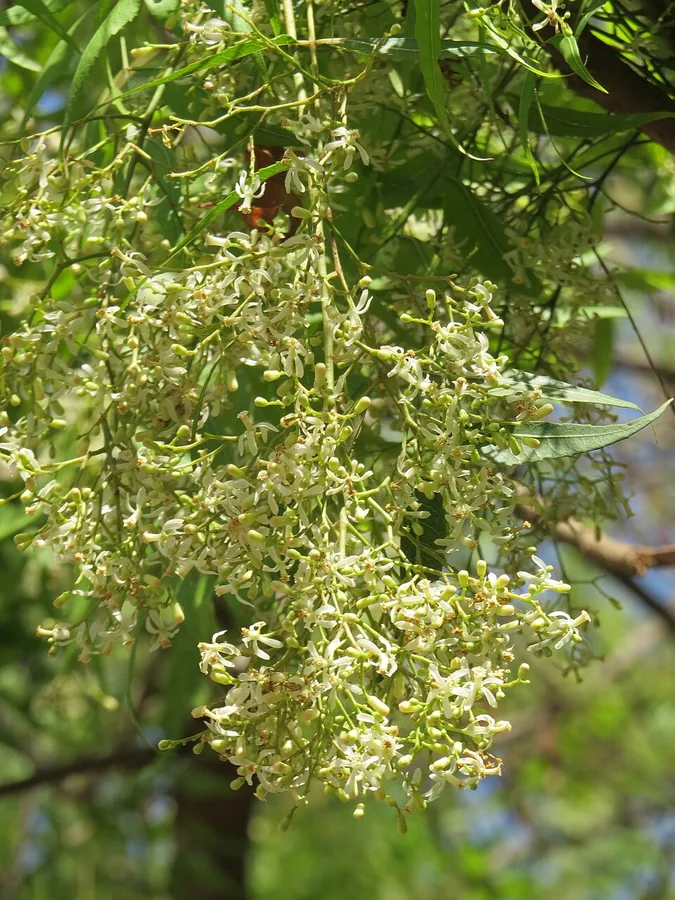
Come spring the crown fills with small white, fragrant flowers, and from summer into early fall they turn to olive-like drupes hanging among the greenery. Heat holds no fear for the tree, which stands the climb to 113°F (45°C), waves off drought, and roots into poor, rocky, even mildly salty ground. Frost is the single weakness: cold scorches the leaves brown, a hard freeze can end a young tree, and so it lives outside only where winters stay warmest.
Care
The short version: bright open sun and warmth, deep soil that drains freely, and a thorough soak for young trees through dry spells, with the top of the ground left to dry in between. A settled neem shoulders drought and thin soil unaided, yet its green canopy has no defense against frost.
Light
Give neem full sun for its quickest growth; open ground suits it, though partial sun or light shade are tolerated too. The stronger the direct light, the fuller and more solid the leafy crown grows overhead.
Water
Through dry spells, soak a young tree well at the roots, then hold off until the top half of the soil dries out, which lands somewhere around every 7 to 21 days. A grown neem meets genuine drought without flinching; the one insult it never pardons is soggy, waterlogged ground.
Soil
Set it into deep sandy or loamy soil that drains well. Poor, rocky, even faintly saline ground gives neem no trouble, and it ranges comfortably over a broad pH of 6.0 to 8.0. Above all it needs to drain, because roots left sitting in wet soil will rot.
Temperature
Tropical to subtropical by nature, neem basks in warmth right up to 113°F (45°C). Its trouble comes at the cold end, near 41°F (5°C) and lower, where frost turns the leaves a scorched brown and a true freeze can finish off a sapling.
Humidity
A middling 40% to 70% humidity is all neem asks, and the parched air of semiarid country suits it just fine. Leave the mister on the shelf; the moisture in the air is not worth a second thought.
Feeding
Across spring and summer, a single seasonal helping of balanced slow-release fertilizer or compost covers its needs. Lean ground already grows neem well, so a heavy hand only invites pests by forcing out soft, sappy shoots the tree gains little from.
Pruning
Cut in late winter to early spring, shaping the crown while you clear out branches that are dead, injured, or rubbing across one another. Hard cuts and even pollarding leave neem unbothered, so it lends itself readily to a tightly clipped hedge.
Repotting
While young in a pot, neem wants fresh potting every 2 to 3 years, done before its roots wind around and strangle themselves inside. Where frost never comes, the wiser course over the long run is to settle it directly in open earth.
Size & spacing
Grown out, neem is a large tree that lifts to 50 to 75 feet (15 to 23 m) and throws a wide, leaf-heavy canopy stretching 40 to 60 feet (12 to 18 m) from side to side. Hand it generous open space, well away from walls, paving, and any smaller plants nearby.
When to plant
Warmth is everything to neem, and frost kills it. Start fresh seed under cover through late winter or early spring; move young trees into open ground in spring, after the soil warms and the last chill lifts. The fragrant white bloom opens in spring, and the olive-like drupes color up from summer into early fall.
Northern hemisphere
Southern hemisphere
Typical months for a temperate climate: start earlier in warm zones, later where spring frosts linger.
- Sow: Late winter to early spring in frost-free warmth; sow fresh seed because viability is short
- Plant: Spring after all danger of frost, once soil is warm
- Harvest: White fragrant flowers in spring; olive-like drupes ripen summer to early fall
Hardiness
USDA hardiness zones: 10–12
Temperature: down to -1°C
Troubleshooting
Set in a climate that suits it, neem rarely falters, and when it does the cause is usually cold, waterlogged ground, or sap-sucking insects. Watch the foliage and the roots: a shift in their color or firmness is the earliest tell. Find the description below that fits, then step in while your effort can still turn things around.
Limp, yellowing leaves and slimy, dark-brown roots
A neem in waterlogged ground droops and its leaves fade from green to yellow, the first look of root rot. Below the surface, roots that should be firm and pale have gone brown and soft, slipping apart between the fingers. Nothing brings those rotted roots back, so stop the overwatering, open up the drainage, and reset the tree into deep, sandy soil whose surface dries between waterings.
Fix:
- Improve drainage and stop overwatering
- Remove affected plant material
- Replant in deep, sandy, well-drained soil
Brown, crisped leaves and blackened branch tips after cold
Neem is a tropical tree that cannot stand frost, and cold turns the exposed outer foliage from green to a dry, scorched brown once temperatures fall below about 41°F (5°C), with the bare branch tips dying back behind it. The tree keeps its leaves only in zones 10 to 12. Cut the dead, brittle wood out once the frost danger has passed, and hold young trees under cover or in a pot that shifts indoors before the cold returns.
Fix:
- Prune out dead wood after the danger of frost has passed
- Protect young trees with frost cloth or grow in containers that can be moved indoors
- Site in a warm, sheltered location
Glossy sticky patches and black soot dulling the leaves
A dull black crust spreading over the green leaf surface, tacky to the touch, is sooty mold feeding on the sugary honeydew that scale, whitefly, or aphids drip as they feed above. The black layer sits on top of the leaf and lifts away with a wipe, so the small insects clustered on the shoot tips and leaf undersides are the true source. Rinse the leaves back to green, treat the pests with horticultural soap or oil, and let natural predators finish the job.
Fix:
- Rinse foliage and wipe off mold
- Control the sap-sucking insects with horticultural soap or oil
- Encourage natural predators
Toxicity
Low in toxicity and long used in traditional medicine, the leaves make a stray nibble little to worry about. Where care is truly needed is with the concentrated neem oil and the seeds: both run high in azadirachtin, and a large swallow can make pets and people ill. Because cats feel it worst of all, shelve the oil and any seed products somewhere they cannot be reached.
Toxic to
Cats · Dogs · People
Safe for
Horses · Rabbits · Livestock · Birds
Cats Mild
Low in toxicity as the foliage is, no animal reacts to concentrated neem oil as sharply as a cat. Swallowing the undiluted oil, or being dosed with it, can bring drooling, vomiting, and a flat, listless mood, with tremors, twitching, and convulsions on record. Store the seed oil and its extracts far from a cat's reach.
Dogs Mild
For a dog, a chewed leaf here and there comes to little. The danger sits in the concentrated oil: gulped down or slathered on too heavily, it can leave a dog vomiting, drooling, and heavy-footed. A properly diluted topical dose sits easier on dogs than on cats.
People Caution
Long woven into traditional medicine, neem leaves rate low in toxicity, but the concentrated oil and the seeds stand apart. Downing them in any quantity can set off vomiting and graver effects, a danger that weighs heaviest on small children, so shelve the oil and seed products somewhere secure.
Horses Safe
A grazing horse takes little harm from the leaves. Just keep the concentrated oil and any seed products locked away where a horse cannot nose into them.
Rabbits Safe
Leaves a rabbit browses carry little toxicity. Real harm would take the concentrated oil or a mouthful of crushed seed, and neither belongs anywhere a rabbit can get to it.
Livestock Safe
Cattle, goats, and sheep can crop neem foliage at little risk, and across parts of its range the leaves serve outright as fodder. The one thing to withhold is the seed oil, which should never be fed.
Birds Safe
At the level of leaf or fruit, neem presents birds no special danger. The only thing to fence off is the concentrated oil or extract.
Keep concentrated neem oil and neem seed products away from pets; never apply undiluted neem oil to a cat or dog or allow them to ingest it.
Helpline numbers

United States
ASPCA Animal Poison Control: (888) 426-4435 (fee applies)
Poison Control: (800) 222-1222



Canada
Poison Centres: 1-844-764-7669
Varieties
Two forms of neem dominate cultivation: one grown to be eaten, the other valued for the strength of the oil in its seed. Knowing which is which is worth the trouble.
Azadirachta indica var. siamensis (Thai neem)
On this Southeast Asian form the tender young leaves and flowers stay mild enough to serve as a vegetable, while the ordinary neem is bitter past eating.
Common neem (typical var. indica)
What makes the common South Asian type valuable is the azadirachtin-rich oil held in its seed, which gardeners extract and put to work as a botanical biopesticide.
Companions
Neem earns its keep near vegetable and fruit crops, where its leaf and seed extracts deter many garden pests, but its dense shade, hungry roots, and allelopathic leaves make poor company for small plants growing right beneath it.
Plant near
Vegetable and fruit crops: Neem leaf and seed extracts are used as a botanical biopesticide that deters many garden pests.
Keep apart
Shallow-rooted understory plants: Its dense shade, vigorous roots and allelopathic leaf compounds suppress small plants growing directly beneath it.
How to propagate
Getting more neem is straightforward, and seed does nearly all of it. Cuttings wait in the wings for the times fresh seed cannot be had, or when an exact copy of one chosen tree is the goal.
SeedEasy
Sow fresh seed in spring in warm conditions · Germinates in 1 to 3 weeks; transplant after a few months
Almost all neem starts from seed, and timing is the whole trick. Viability fades quickly, so the seed goes into warm spring ground not long after the drupe ripens. A green shoot pushes up within 1 to 3 weeks, and a few months on it is ready to move.
Stem cuttingsModerate
Warm season from semi-hardwood cuttings · Roots in several weeks under warmth and humidity
When fresh seed is out of season, or an exact copy of one tree is what you're after, reach for semi-hardwood cuttings taken during the warm months. Given warmth and steady humidity, they set roots across several weeks.
Myths
A natural oil like neem must be totally safe for any pet.
Being natural buys it no safety: the active compound azadirachtin can trigger drooling, vomiting, and tremors, and the undiluted oil has made cats gravely ill, killing some in reported cases. Dilute it heavily every time, and keep the raw concentrate out of any animal's reach.
Neem strikes down every insect it contacts at once.
Neem largely puts insects off their food and throws their growth and breeding cycles out of order, so its effect unfolds across days rather than in an instant. It slowly whittles a pest population down instead of felling everything the moment it touches.