Houseplant · Crassulaceae
Mother of Thousands
Kalanchoe daigremontiana
An easy succulent that rims every leaf edge with tiny green babies, and one to keep well away from pets.
Bright indirect
50–86°F · 10–30°C
USDA 9–11
12–35 in · 30–90 cm
Overview
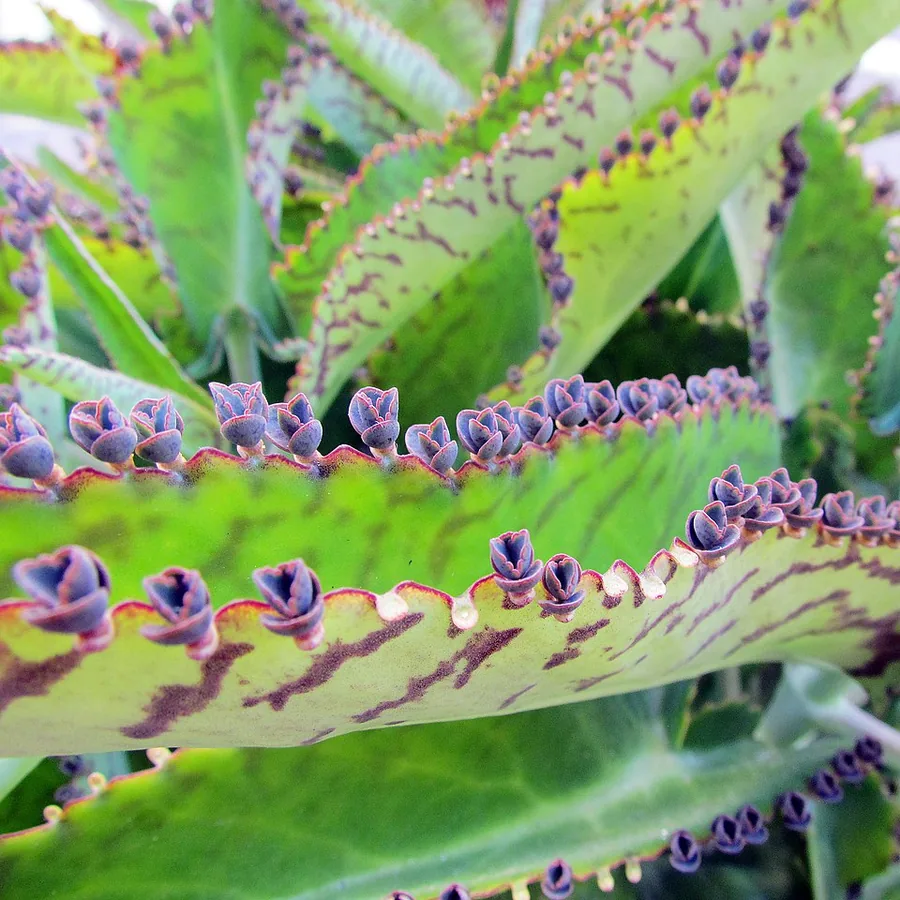
Look closely at mother of thousands and its name is written along every leaf. The scalloped rim of each fleshy, blue-green blade carries a dense row of tiny ready-made plantlets, and each miniature rosette already trails fine white roots into the air. The leaves themselves are thick and firm, tapering to a point, plump with the water this succulent hoards. It comes from the dry southwest of Madagascar and shows it in every drought-hardened cell.
Up close the whole plant reads as sculpture in soft blue-green. Given a bright window and a gritty pot, the fleshy leaves stack up an upright stem to 12 to 35 inches (30 to 90 cm), each blade edged with its fringe of plantlets. That fringe is also the catch: the little rosettes drop away and root in any pot they reach, so the plant spreads fast and has naturalized in warm regions it was never meant to reach.
For all its handsome texture, one hidden fact sets it apart from a mild succulent like jade. Every fleshy part holds bufadienolides, cardiac glycosides that are toxic to pets and people alike. It is a striking plant for a home without animals or small children, kept somewhere they cannot reach the leaves.
Care
The short version: bright indirect light, a gritty fast-draining mix, and water only once the soil has dried out completely. Feed it lightly through the growing season, keep it warm, and pick the tiny plantlets off the leaf edges before they take over.
Light
In bright indirect light the leaves stay short, thick, and deep blue-green. It takes some partial sun, but harsh afternoon glare dries the surface to brown scorch, while too little light stretches the stems pale and thin between widely spaced leaves.
Water
Those swollen leaves are a built-in reservoir, so water it like the succulent it is. Soak the mix through, then let it dry out completely before the next drink, easing off further through winter dormancy. Standing moisture blackens the base into root rot, which this plant is prone to.
Soil
Set it in a gritty cactus or succulent mix that drains within seconds and leaves no wet pocket around the fleshy roots. Ordinary potting soil clings to far too much water, so a pot with a drainage hole matters as much as the mix itself.
Temperature
It holds its plump, firm form between 50°F to 86°F (10°C to 30°C), a range most rooms meet year round. It has no frost hardiness, so a plant summered outdoors comes back in well before the first chill can blacken the leaves.
Humidity
Low humidity is exactly what the waxy blue-green leaves are built for, so there is no figure to chase and no need to mist. The plain dry air of a warm room suits them better than any steamy corner.
Feeding
Feed lightly from spring through summer, about once a month, with a diluted balanced or cactus fertilizer. The plant grows plump on very little, so a gentle hand keeps it firm and compact, and feeding stops through the winter rest.
Pruning
Pinch back any stem that draws out long and bare, and snip off spent flower stalks. The main job is running a finger along each leaf edge to lift off the tiny plantlets before they drop, or fresh rosettes root in every nearby pot.
Repotting
Move it up a pot size every 2 to 3 years, or once the fleshy roots crowd the container. Roots pushing through the drainage holes, the plant lifting from the pot, and water rushing straight through all show it is time.
Size & spacing
Indoors the fleshy stem reaches 12 to 35 inches (30 to 90 cm) tall with a spread of 12 to 24 inches (30 to 60 cm) across its blue-green leaves. A little clear space around it keeps the shed plantlets from rooting into whatever pot stands alongside.
Troubleshooting
Nearly every trouble sign shows up on the leaves and stems themselves, and nearly all of it traces to water or light. Too much water blackens and softens the base; too little light draws the stems long and pale. Match what you see below and put right the cause behind it.
Blackened mushy stems and a wilt over wet soil
When the base turns dark and soft and the plant sags over soil that still feels wet, that is root rot setting in. Slide it from the pot and the roots come up brown, soft, and sour-smelling instead of firm and pale. Cut back to clean tissue, tuck it into a dry gritty mix, and leave the water off until the leaves stand plump and firm again.
Fix:
- Cut away all rotted tissue
- Repot into dry gritty succulent mix
- Withhold water until the plant recovers
White cottony masses and a sticky film on the leaves
Small white tufts that look like scraps of cotton wool gather in the leaf joints, and a clear sticky film spreads over the surface beneath them: those are mealybugs. A cotton swab wet with isopropyl alcohol wipes each tuft away, and insecticidal soap clears any it misses. New plants often carry them in, so a close look and a spell apart keeps them off the others.
Fix:
- Wipe with isopropyl alcohol on a swab
- Treat with insecticidal soap
Dry brown scorch across the sun-struck leaves
Harsh afternoon sun scorches the fleshy leaves, drying the surface into brittle brown patches on the side turned toward the glass. The blue-green fades to tan exactly where the light strikes hardest. Bright indirect light out of the midday glare stops the damage, and any move into direct sun works best eased in a little at a time.
Fix:
- Move to bright indirect light
- Avoid the hot midday sun
Pale, stretched stems with leaves set far apart
Short on light, the stems draw out long and pale and the leaves sit spaced far apart along them, the classic leggy stretch. The newest growth tilts visibly toward the window. Brighter, bright indirect light draws the plant back toward tight, blue-green rosettes, and a turn of the pot now and then keeps the leaves filling in on every side.
Fix:
- Move to a brighter spot with bright indirect light
- Rotate the pot periodically
Toxicity
Treat every fleshy part of this plant as toxic to the animals in your home. All of it holds bufadienolides, cardiac glycosides that bring on drooling, vomiting, and diarrhea, and in any real amount can throw off the heartbeat. No part is safe to eat and the sap can redden and irritate skin, so keep it well out of reach of pets and small children.
Toxic to
Cats · Dogs · Horses · Rabbits · Livestock · Birds · People
Cats Toxic
A cat that bites into the fleshy leaf tends to drool and vomit, with loose stools trailing after. A larger mouthful is the real danger, since the bufadienolides in the sap can disturb the heartbeat.
Dogs Toxic
A dog that chews the leaves drools heavily and brings up vomit and diarrhea within a few hours. A good mouthful carries the same heart-rhythm danger, so the vet is the right call rather than a wait.
Horses Toxic
Horses feel the cardiac glycosides sharply. Drooling and a churning gut appear first, and a real dose can throw the heartbeat off enough to threaten a horse's life.
Rabbits Toxic
Rabbits should stay well clear of it. The same toxin upsets the gut and strains the heart, and a small body needs only a mouthful of leaf to be in trouble.
Livestock Toxic
Cattle, goats, and sheep can be poisoned where the plant creeps into pasture. Stomach upset comes first, then dangerous heart effects once any quantity of the fleshy leaves is eaten.
Birds Toxic
Birds should have no access to it. Their small size means even a nibble of the leaf can deliver a meaningful dose of the heart-acting glycosides.
People Caution
No part of this plant is meant to be eaten, and the bufadienolides make even a taste unsafe. The milky sap can also redden and irritate skin, so gloves help and it stays out of reach of small children.
Sap can cause contact dermatitis; wear gloves when handling the plant or removing plantlets.
Helpline numbers

United States
ASPCA Animal Poison Control: (888) 426-4435 (fee applies)
Poison Control: (800) 222-1222



Canada
Poison Centres: 1-844-764-7669
Varieties
Beyond the species itself, one variety stands out to the eye, a hybrid that took the parent's spreading habit even further.
Kalanchoe × houghtonii
A hybrid of K. daigremontiana and K. delagoensis, it carries noticeably narrower leaves, spreads even more freely than its parent, and has become a global invader.
How to propagate
Making more of this plant asks nothing at all. The harder task is holding it back, since every leaf edge is already busy propagating it for you.
Offsets & pupsEasy
Spring · 2-4 weeks
The little plantlets ringing each leaf edge drop off with pale threadlike roots already showing and grip wherever they land, rooting in within 2 to 4 weeks in spring. Nothing about it takes effort, which is exactly why the plant spreads so freely. Any that are not wanted are best gathered before those roots catch.
Leaf cuttingsEasy
Spring to summer · 3-6 weeks
A whole fleshy leaf set flat on gritty mix in spring or summer sprouts new plantlets and fine roots all along its scalloped rim over the next 3 to 6 weeks. The mix stays only barely damp, since too much water rots the leaf before it can establish.
Myths
Mother of thousands is safe around pets because it is a common houseplant.
A plant turning up on shelves everywhere says nothing about whether it is safe. The ASPCA lists it as toxic to cats and dogs because of bufadienolides, cardiac glycosides that upset the gut and can disturb the heartbeat. Keep it out of reach of every animal in the house.
The plantlets are harmless and will not spread.
Each of the tiny leaf-edge plantlets falls away with fine roots already trailing from it and grips wherever it settles. That is the whole reason it spreads so fast and naturalizes across warm regions, so the fallen ones are worth sweeping up rather than leaving.