Ornamental · Polemoniaceae
Jacob's Ladder
Polemonium caeruleum
Set in cool shade over moist ground, Jacob's ladder stacks its paired leaflets into fine green rungs and hangs nodding blue flowers above them each spring.
Partial shade
Every 3–7 days
USDA 4–8
18–24 in · 46–61 cm
Overview
The leaves tell you at a glance how Jacob's ladder earned its name: small paired leaflets sit rung by rung along each slender stem, stacking into a fine, ferny mound. It is a clump-forming perennial of the phlox family, at home in the cool, damp meadows and woodland edges of the northern hemisphere. In spring, loose sprays of small blue flowers nod on thin stalks that rise above that low cushion of foliage.
Up close the foliage reads as neat, feathery, and soft green, each leaflet paired against its partner along the rachis. This is an easy, low-fuss plant for shade that keeps that crisp, ladder-rung texture from spring well into the season. When the fine leaflet tips brown and crisp, that dryness is the plant showing plainly that the soil has gone too dry.
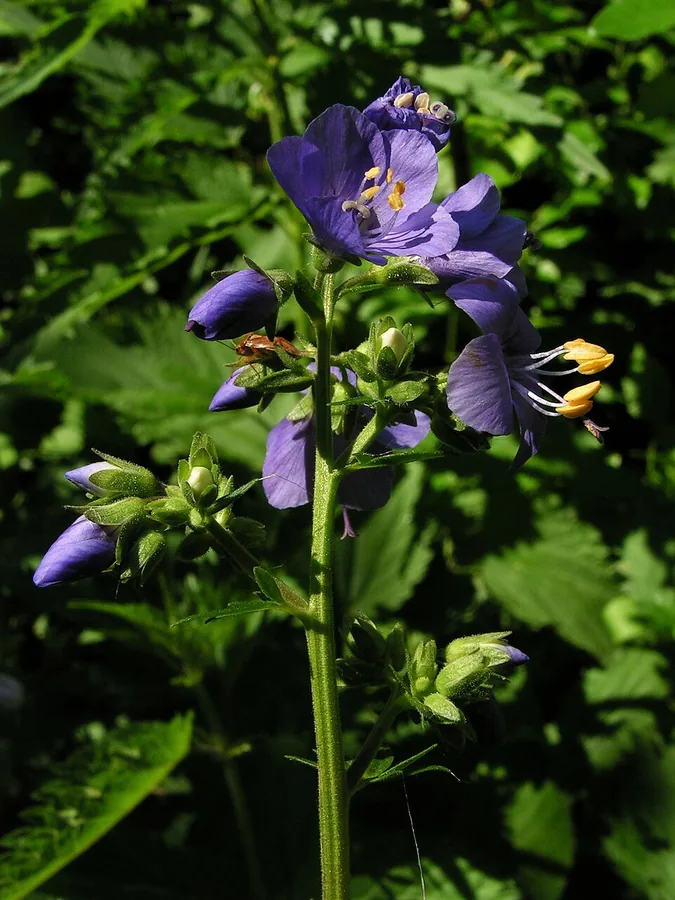
The nodding blue flowers open in loose clusters, small and bell-shaped, hanging above the green. Despite an old mix-up with a toxic look-alike, Polemonium caeruleum is not poisonous, and a related species even carries a long record of human use.
Care
The short version: part to full shade, rich humusy soil kept evenly moist, and a spot with good air movement. Divide the clump every few years and cut it back after bloom, and it more or less keeps itself.
Light
Grow Jacob's ladder in part to full shade. It stands a little morning sun, but strong afternoon light scorches the fine leaflets brown at the tips, so the deeper the shade in a hot garden, the cleaner the green foliage stays.
Water
Keep the soil evenly moist at all times, watering every 3 to 7 days as the weather shifts. The plant will not take drying out, and the first sign it has is the fine leaflet tips turning brown and crisp along their edges.
Soil
Set it in rich, humusy loam that holds moisture yet drains freely. Compost or leaf mold worked through gives that dark, spongy, organic feel of a woodland floor, which is the ground this plant roots into best.
Temperature
It runs cool, holding its green from about 19°F to 75°F (-7°C to 24°C) and hardy through zones 4 to 8. Heat, not cold, is what crisps the foliage, so summer shade keeps the leaflets fresh and unmarked.
Humidity
Average outdoor humidity suits it. Air movement counts for far more, since still, muggy air lets leaf spot fleck the green and powdery mildew dust it white.
Feeding
It asks for little. One spring feeding of balanced fertilizer, or a simple top-dressing of compost, keeps the mound of leaflets green through the season.
Pruning
Once the blue flowers fade, the plant can be cut back to its basal foliage, clearing the spent stalks and leaving a fresh low cushion of ladder-rung leaves. That neat green mound then carries the look through the rest of the year.
Repotting
Lift and divide the clump every 2 to 4 years to keep it dense. A center dying out and bare, thinner flowering, or crowded and fading leaflets all show that the clump is ready to be split.
Size & spacing
It builds a low mound around 18 to 24 inches (46 to 61 cm) tall and just as wide across the foliage. Give each plant that same 18 to 24 inches (46 to 61 cm) so air slips between the clumps and disease stays off the leaves.
When to plant
Jacob's ladder keeps to the cool end of the year. Seed starts indoors in late winter or under glass in autumn, plants go out in spring once frost has passed or in fall, and the small blue flowers open from April into May.
Northern hemisphere
Southern hemisphere
Typical months for a temperate climate: start earlier in warm zones, later where spring frosts linger.
- Sow: Late winter to early spring, or autumn under glass
- Plant: Spring after frost, or autumn
- Harvest: April to May
Hardiness
USDA hardiness zones: 4–8
Temperature: down to -34°C
Troubleshooting
Nearly every problem with this plant shows on the leaves, and it traces to one of two things: too much sun and dryness, or too much humidity in stagnant air. The foliage itself gives the diagnosis. Match what you see below and adjust the spot before it spreads.
White powder dulling the leaflets or dark flecks marking the green
Dark flecks spreading across the green leaflets are leaf spot, while a chalky white bloom that dulls their surface is powdery mildew, both settling in when warm, humid air hangs motionless. The marked leaves come off and go in the bin. A thinned, well-spaced clump lets air slip between the leaflets, and foliage kept dry gives the film no damp surface to cling to.
Fix:
- Remove and discard affected foliage
- Improve air circulation by thinning or spacing plants
- Avoid overhead watering
Leaflet tips crisping brown or whole leaves scorched in the sun
Dry, papery brown creeping in at the fine leaflet tips is leaf scorch, brought on by too much sun or soil left to dry. Cool shade and evenly damp ground restore the crisp green, so the plant belongs in part to full shade over moist soil, with a blanket of mulch holding that dampness through the heat. Fresh leaflets then come in clean and unmarked.
Fix:
- Move or transplant to part to full shade
- Keep soil consistently moist
- Mulch to conserve soil moisture
Gaping chewed holes and silver slime streaks appearing by morning
Torn, ragged holes bitten through the leaflets and a glinting silver trail across the green are the mark of slugs, feeding at night in cool, damp shade. Picking them off after dark clears the feeders, while traps or iron-phosphate bait thin their numbers, and raking out the moist debris strips their cover. Mulch drawn back from the crown leaves the base bare and offers them no hollow to hide in.
Fix:
- Handpick slugs in the evening
- Use slug traps or iron-phosphate baits
- Reduce moist hiding spots near plants
Toxicity
For anyone with pets or small children, the answer is easy: Jacob's ladder is not toxic. Its soft leaflets and blue flowers belong to the harmless phlox family, and the warnings online point to a different plant that happens to share the name. It can grow wherever animals and children brush past.
Safe for
People · Cats · Dogs · Horses · Rabbits · Livestock · Birds
Cats None
Cats are safe with it. A curious mouthful of a leaflet or a blue flower brings no poisoning.
Dogs None
Dogs are safe too. A stem chewed to fibrous shreds may bring a mild stomach upset from the roughage and nothing worse.
Horses Safe
Horses are safe around the plant, which holds no toxic compounds in its foliage or flowers.
Rabbits Safe
Rabbits browse the ferny leaflets without harm, though a hungry one may crop a young clump close enough to set it back.
Livestock Safe
Grazing cattle, goats, and sheep face no poisoning risk from the leaves or stems.
Birds Safe
Birds are safe near it. The nodding blue flowers draw bees and other pollinators rather than posing any danger.
People Safe
People are safe with it, and a related species carries a long record of human use. Even so, it stays an ornamental rather than something for the plate.
No special handling precautions reported; routine garden plant.
Varieties
The straight species shows blue flowers over green ladder-rung leaves, but a few selections stand out for their variegated foliage or a different bloom color. These are the ones most often found.
Brise d'Anjou
A clump-former grown for its ladder-like leaves finely edged in cream against the green.
Snow and Sapphires
Its white-margined variegated leaflets stand beneath the usual blue flowers in a crisp two-tone contrast.
White Pearl
This selection opens clean white flowers where the species shows blue.
How to propagate
Multiplying Jacob's ladder asks little. An established clump splits cleanly into new pieces, or the plant simply drops seed and sows itself around.
DivisionEasy
Early spring or fall · One growing season
Splitting the clump keeps its ferny mound thick and full. Lift and divide it in early spring or fall every 2 to 4 years, leaving pale roots and green shoots on each piece, and the fresh divisions knit back into a solid clump over a single growing season.
SeedEasy
Spring or autumn · Self-seeds freely; blooms typically the following year
Left alone, the plant drops seed freely in spring or autumn, and the small seedlings usually raise their first blue flowers the following year. To hold that spread in check, snip off the spent flowers or cut the plant back before the ripe seed shakes loose.
Myths
Jacob's ladder counts as a toxic plant for dogs and cats.
This plant sits in the phlox family and carries no reported toxicity. The confusion springs from an ASPCA listing for 'Jacob's ladder' that actually names a different plant, Smilax herbacea. Polemonium caeruleum is safe to grow around pets and children.