Ornamental · Polemoniaceae
Creeping Phlox
Phlox subulata
In full sun and sharp drainage, creeping phlox lays a tight green mat that sheets over with spring flowers.
Full sun
Every 7–14 days
USDA 3–9
4–6 in · 10–15 cm
Overview
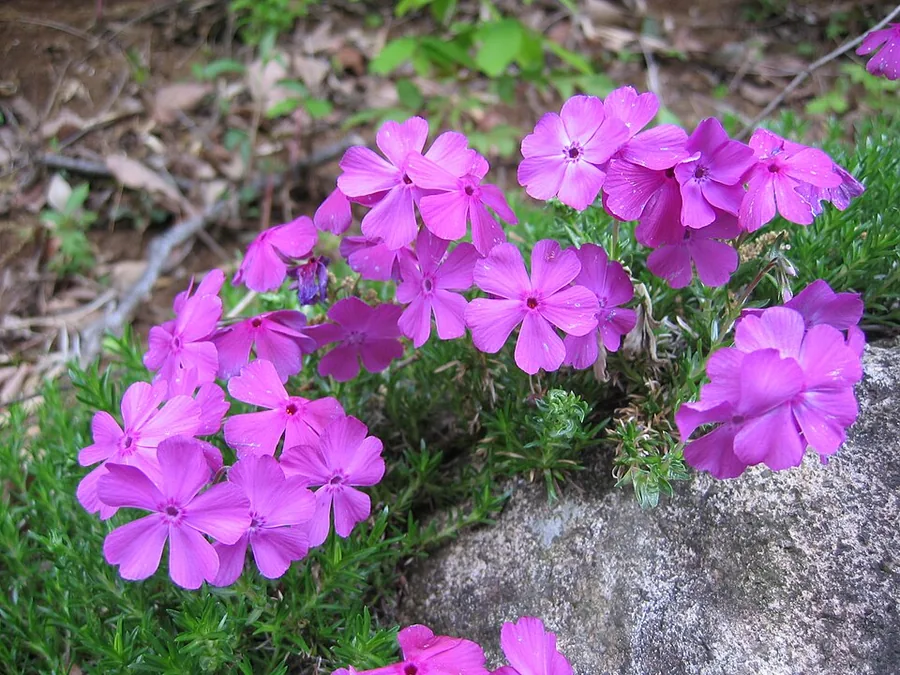
Creeping phlox grows as a low cushion of slender, needle-like leaves packed so tight along its trailing stems that the plant reads as a single green mat. Then, in early to mid spring, the small five-petaled flowers open in such numbers that they hide the foliage almost completely. The wiry stems run flat over dry, rocky ground, fitting themselves into slopes, walls, and rock gardens.
Outside its bloom, the plant is a dense weave of fine, stiff foliage that stays green and present through hot summers and hard winters, taking cold as deep as -40°F (-40°C). The narrow leaves are firm and almost bristly to the touch, evergreen, and crowded along stems that creep rather than climb. Once rooted, it gets by on sun and free-draining soil.
It looks nothing like garden phlox, the tall summer plant that shares the name. Creeping phlox stays ankle high and spreads outward along the soil instead of standing up on tall stems, so the whole plant is a flat, ground-hugging carpet of needle foliage rather than an upright clump.
Care
The short version: creeping phlox takes full sun and sharp-draining sandy or gravelly soil, and once established it needs water only through long dry spells. A shearing by half after the flowers fade keeps the needle-leaved mat tight and dense.
Light
Creeping phlox opens the most flowers in full sun, covering its needle foliage edge to edge. It will grow in partial shade, but the bloom thins and the green mat shows through more the shadier the spot.
Water
Once rooted, the plant is drought tolerant and wants water only through long dry spells. Its fine roots run through fast-draining ground and even dry, rocky pockets, so the top half of the soil should dry between waterings.
Soil
Set its roots into sandy or gravelly, humus-rich soil that drains freely, since soggy ground rots the low stems. A pH of 5.5 to 7.0 suits it, and a slope or raised bed lets water slide off the mat.
Temperature
The stiff, needle-like foliage shrugs off -40°F to 95°F (-40°C to 35°C). The mat needs no winter cover anywhere in its range and greens up again each spring.
Humidity
Plain outdoor air suits the foliage, so there is no level to chase. Drainage and airflow matter more, since damp, still air trapped in the dense mat is what warps and spots the leaves.
Feeding
The plant carries its tight foliage on lean soil. A light feed of balanced general-purpose fertilizer in spring is plenty, while heavier feeding stretches the stems soft and floppy and loosens the mat.
Pruning
As the flowers fade, cut the stems back by about half. That single shearing crowds fresh growth over the mat, keeps the woody center hidden under green, and holds the needle foliage dense.
Size & spacing
Each cushion stands only 4 to 6 inches (10 to 15 cm) tall yet creeps 24 to 35 inches (60 to 90 cm) across. Spaced to that width, the trailing stems lace into one unbroken sheet of needle leaves.
When to plant
Creeping phlox is grown for the spring flush that buries its foliage in bloom, so the year centers on planting and a single post-bloom cut. New plants go in during spring or early fall, the flowers open from April into May, and the mat is sheared once they fade.
Northern hemisphere
Southern hemisphere
Typical months for a temperate climate: start earlier in warm zones, later where spring frosts linger.
- Sow: Usually propagated vegetatively rather than from seed; not typically sown indoors.
- Plant: Plant in spring or early fall in a sunny, well-drained site.
- Harvest: Blooms in early to mid spring, roughly April to May.
Hardiness
USDA hardiness zones: 3–9
Temperature: down to -40°C
Troubleshooting
Creeping phlox stays trouble-free most years, and what does appear shows on the slim leaves or as a thinning, opening mat. The few signs below pin down the cause early. Match what the foliage shows, then act while it still helps.
Silver-flecked needles under threads of pale silk
The needle-like leaves turn freckled with tiny pale dots and lose their green where spider mites have fed, leaving a faint, silken webbing strung along the undersides. The mites crowd in through hot, dry weather. A hard jet of water knocks them off the foliage, steady moisture keeps the leaves from crisping, and insecticidal soap or horticultural oil clears the stragglers.
Fix:
- Spray foliage with a strong jet of water to dislodge mites
- Improve airflow and avoid drought stress
- Treat with insecticidal soap or horticultural oil if needed
Puckered leaves marked with blotches after damp weeks
In long warm, wet stretches the slim leaves buckle and curl, blotched in dull brown patches where foliar nematodes have burrowed into the tissue. The marred foliage is best pinched off and destroyed the moment it appears. Watering low at the base and opening the dense mat to moving air dries the conditions the nematodes need.
Fix:
- Remove and destroy affected foliage
- Avoid overhead watering and improve drainage
Blunt-ended shoots grazed down to stubble
Stems sheared off in sharp, clean angles low against the soil mark where rabbits have nipped through the needle-like foliage. A low fence or a repellent turns them back. The soft new growth tempts them most, so the youngest plantings come first for protection where rabbits are thick.
Fix:
- Use fencing or repellents to deter rabbits
A ring of green around a balding, woody core
Left uncut, the heart of the cushion hardens into bare, woody, leafless stems while only the green rim keeps inching outward, opening a hollow ring in the middle. Shearing the stems back by roughly half just after the flowers drop pushes soft, crowded new shoots over the gap. The healthy outer pieces can also be lifted and tucked back into the bare center to knit it closed.
Fix:
- Shear stems back by about half after bloom to promote dense regrowth
- Divide and replant vigorous outer sections
Toxicity
For pet owners and anyone with grazing animals, creeping phlox is safe all around. The ASPCA lists moss phlox as non-toxic to cats, dogs, and horses, and it poses no risk to other animals or people. Even the foliage chewed down to the stem causes no harm.
Safe for
People · Cats · Dogs · Horses · Rabbits · Livestock · Birds
Cats Safe
A cat that bites into the bristly foliage is unharmed, since the ASPCA lists moss phlox as non-toxic to cats.
Dogs Safe
A dog can mouth the wiry stems and needle-like leaves without harm, as the plant holds no toxin that affects them.
Horses Safe
Horses cropping the low foliage are unharmed, since creeping phlox carries no poison for them.
Rabbits Safe
Rabbits chew the slim leaves and stems down close, yet the plant does them no harm in the eating.
Livestock Safe
Cattle, goats, and sheep that graze the mat take no harm, as it holds nothing toxic to farm animals.
Birds Safe
Birds picking at the small flowers or seeds come to no harm from this plant.
People Safe
It is harmless to people, though the plant is raised for its bloom rather than for the table.
Varieties
A range of named cultivars exists, told apart mostly by flower color and how well they resist disease. The few below are worth knowing.
Emerald Blue
Carries bluish purple flowers packed so thickly they sheet over a low, even mat.
Fort Hill
Holds firm against Phytophthora, the root and stem rot that breaks down weaker plants.
White Delight
Opens crisp white flowers and also turns aside southern blight.
How to propagate
Creeping phlox multiplies easily, whether you split a dense old cushion or root a few short cuttings off a plant you already grow.
DivisionEasy
Divide in early spring or after flowering. · One growing season
Division comes easiest: an established cushion is dug up and pulled apart in early spring or once the flowers fade. The dense, leafy outer growth is torn free of the woody, spent center and replanted into well-drained soil, where the green pieces take root over a single growing season.
Stem cuttingsEasy
Take cuttings in late spring or early summer. · Several weeks to root
Short stem cuttings taken in late spring or early summer root just as readily. Pressed into moist, well-drained media, the trimmed shoots send out roots within a few weeks and grow into plants identical to the one they came from.
Myths
The low creeper and the tall garden phlox are one identical species.
The name is shared, but the two plants look nothing alike. Creeping phlox hugs the ground in a needle-leaved mat and blooms in spring, while garden phlox throws up tall, leafy stems that flower in summer. They are two different species with very different forms, so the label settles which one is in the pot.
This spring carpet is a poison risk for cats and dogs.
Nothing in the plant harms a pet that bites it. The ASPCA lists moss phlox as non-toxic to dogs, cats, and horses, so chewed foliage causes no trouble. It can grow where animals roam without any danger.