Ornamental · Polemoniaceae
Cup-and-saucer Vine
Cobaea scandens
Give it full sun and a tall, sturdy support, and this fast climber hangs a wall with green-to-purple bells by late summer.
Full sun
Every 3–7 days
75–120 days
USDA 9–11
Overview
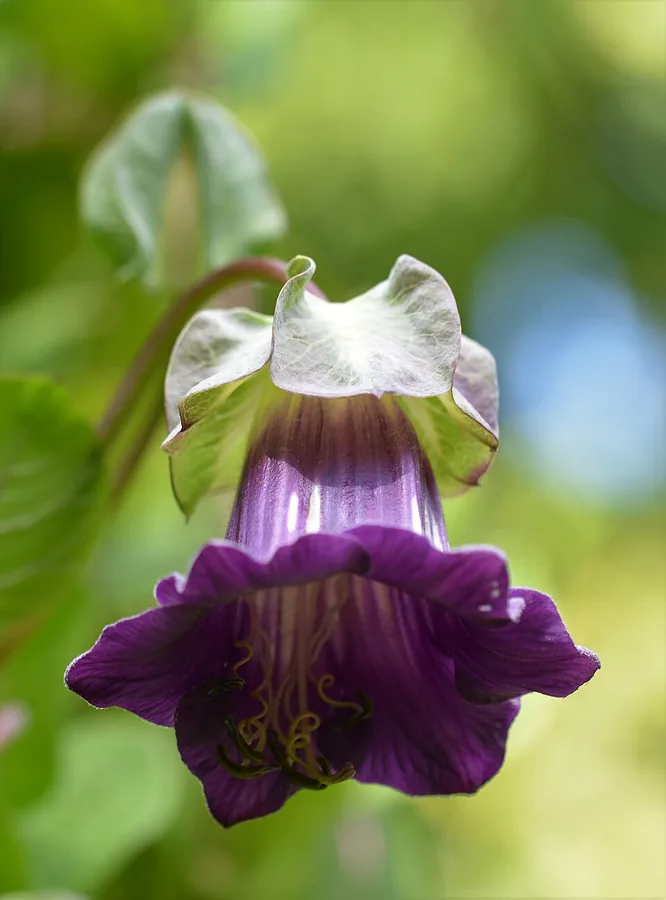
The flower is the whole story behind the name. A deep, bell-shaped cup hangs from a slender stalk, and beneath it spreads a wide, leafy green calyx that fans out like a saucer holding the cup in place. Each bell opens a pale, creamy green and slowly steeps to a rich violet-purple, so a single vine carries bells at every stage of that color shift at once. The plant traces back to the highlands of Mexico, the reason cold-region gardeners grow it as a tender plant rather than a perennial.
Up close the vine is all motion and reach. Its green stems lengthen 10 to 20 feet or more in one season, and every leaf tapers into a branched tendril, a fine forked thread that gropes the air and coils tight around any twig, wire, or wall it brushes. Set a fence, an arbor, or a tall trellis nearby and the leafy stems lace through it by late summer.
For all that vigor in the leaf, the plant needs little once it is climbing: a strong support, full sun, and a light hand at feeding, since rich soil and heavy nitrogen swell the foliage and starve the bells. Each green leaf carries its grasping tendril right at the tip. Hold that feeding line and the cups keep coming from summer until the first frost.
Care
The short version: full sun, a tall sturdy support for the forked tendrils to grip, and steady even moisture in fertile but not over-rich soil, with light nitrogen so the vine sets bells instead of running to leaf.
Light
The bells come thickest in full sun, though the vine takes a little afternoon shade. A spot against a warm, sunny wall suits it, since the radiated heat drives the green stems up and pulls more cups out of the foliage.
Water
The soil stays evenly moist through the season, watered on a regular beat while the green stems lengthen. It should not parch in hot weather, but the ground must drain freely, since the roots will not sit in soggy soil.
Soil
The vine roots into loam, sand, or clay wherever drainage runs free, across a pH of 5.5 to 7.5. Fertile ground suits it over heavily enriched soil, since too much richness swells the leaves and thins the bells.
Temperature
The green growth weathers a wide span of roughly 25°F to 90°F (-4°C to 32°C), but a hard frost blackens it outright. It is tender, set outdoors only once the cold has cleared.
Humidity
Plain outdoor humidity is enough, so there is no figure to chase. Air sliding through the foliage matters more, drying the leaf surfaces and keeping the sap-feeders that target them in check.
Feeding
A balanced or lower-nitrogen liquid feed goes on monthly through spring and summer. The nitrogen stays light, since an excess fattens the leaves into a green mass and leaves the bells few and far between.
Pruning
Grown as an annual it needs little cutting. Pinching the young tips sets the stems branching, and they are tied to their support as the green growth climbs. Where it lives on as an evergreen, it is cut back in late winter to shape it and clear any diseased stems.
Repotting
Seedlings are potted on as their roots fill out, then set outdoors once frost has passed. A container plant moves to a wider pot when the roots fill the old one or thread out through the drainage holes.
Size & spacing
This is a long-reaching climber, its green stems running 10 to 20 feet (3 to 6 m) in one season and fanning out to a spread of 3 to 6 feet (91 to 183 cm). It wants that much room and a support tall enough to carry the weight of leaf and bell.
When to plant
This is a warmth-driven vine, and frost is what blackens it. The seed starts indoors in late winter, the young green plants go out only once the cold has gone and the soil has warmed, and the bells open from summer right up to the first frost.
Northern hemisphere
Southern hemisphere
Typical months for a temperate climate: start earlier in warm zones, later where spring frosts linger.
- Sow: Start seed indoors about 8-10 weeks before last frost; sow seeds on edge and keep warm (about 68-72 degrees F), germinating in roughly 14 days.
- Plant: Transplant out after all danger of frost has passed and soil is warm.
- Harvest: Blooms summer into fall until frost; flowers open creamy-green and age to deep violet-purple, each cup sitting on a leafy green calyx saucer.
Hardiness
USDA hardiness zones: 9–11
Temperature: down to -7°C
Troubleshooting
Most of what shows on this vine is plain to read on the leaves and stems and quick to put right. The usual signs are a plant heavy with leaf but bare of bells, stippled and curling foliage betraying sap-feeders underneath, and stems trailing flat with nothing to grip. Match the look below and act early.
Thick green growth but bare of bells
When the vine throws out leaf after leaf yet the bell-shaped buds stay scarce, the cause is usually too much nitrogen driving foliage instead of flower. A short, cool season and shade hold the buds back too. Trim the nitrogen, set the vine in full sun against a warm wall, and start the seed earlier so more bells have time to swell and open before frost.
Fix:
- Reduce nitrogen and switch to a balanced or lower-nitrogen fertilizer
- Site in full sun against a warm wall or trellis
- Start seed earlier indoors (8-10 weeks before last frost) to lengthen the growing season
Stems sprawling and tangling with nothing to grip
Each leaf of this vine ends in a branched tendril, a fine forked thread that reaches out and coils around whatever it touches. With no tall, sturdy frame within reach, those fast green stems trail flat across the soil or knot themselves over nearby plants. A firm trellis, fence, arbor, or wall set up before planting gives the tendrils their hold, and young stems guided and loosely tied climb on until the tendrils lock on themselves.
Fix:
- Install a tall sturdy trellis, fence, arbor, or wall before or at planting
- Guide and loosely tie young stems onto the support until tendrils take hold
Leaves curling, speckled, and yellowing under fine webbing
Leaves that pucker, freckle with pale stippling, and fade to yellow are showing the work of sap-feeders. Along the undersides crawl soft, pear-shaped aphids, dust-tiny spider mites spinning their thread-fine webbing, and whiteflies that scatter into a pale haze when the foliage is jostled. A hard jet of water strips most of them away, and insecticidal soap or horticultural oil rubbed into the undersides finishes the holdouts.
Fix:
- Spray off pests with a strong jet of water
- Apply insecticidal soap or horticultural oil, covering leaf undersides
- Repeat treatment and improve air circulation
Toxicity
For homes with pets and children the verdict is easy: cup-and-saucer vine is not toxic. Neither its soft green leaves nor its bell-shaped flowers appear on the ASPCA's poison lists, and no poisoning has been reported in animals or people, so it can clothe a fence or arbor without worry. It is grown for the look of those cups, not for eating.
Safe for
People · Cats · Dogs · Horses · Rabbits · Livestock · Birds
Cats None
A cat is safe nosing among these leaves and bells. A mouthful of the soft green foliage might leave it briefly queasy, as any strange leaf can, but nothing in the vine carries a toxin that poses a real threat.
Dogs None
A dog that chews a green stem or a leaf comes to no harm, since no toxicity is recorded for them. A large mouthful of any plant material can loosen the stomach for a short spell, nothing more.
Horses Safe
The leaves and stems are safe for horses, with nothing on record to suggest the foliage harms a grazing horse that crops a taste.
Rabbits Safe
A rabbit can nibble at the low green growth without worry, as none of the vine's parts hold a toxin known to trouble them.
Livestock Safe
No poisoning has been reported in cattle, goats, or sheep, so the leafy growth is regarded as safe near grazing stock.
Birds Safe
Birds are safe among the foliage and flowers, kept or wild, since the leaves and bells hold no compound flagged as toxic to them.
People Safe
The plant is not toxic to people, so a child who picks a bell-shaped flower or a leaf is in no danger, though the vine is grown for its looks rather than the table.
No special handling required; wash hands after gardening as a general practice.
Varieties
In the wild type the bells travel from green to purple as they age, but a few named selections hold one shade from open to close. These are the ones worth knowing.
'Alba'
A white form whose cups stay a clean creamy-white through their whole life rather than deepening to the species' violet-purple.
'Key Lime'
Its bells glow a fresh green to chartreuse lime and keep that bright tone instead of darkening to purple.
'Royal Plum'
Its cups carry the richest, deepest purple the vine produces, saturated to the edge of every petal.
How to propagate
Cup-and-saucer vine starts readily from its flat seed for plenty of plants, or from a length of green stem when one particular flower color needs to carry through true.
SeedEasy
Start indoors 8-10 weeks before last frost; transplant out after frost. · Germinates in about 14 days at 68-72 degrees F; can be slow to start, then grows rapidly.
Most of these vines begin as flat, papery seeds set on edge in a warm tray held at 68°F to 72°F (20°C to 22°C), sown 8 to 10 weeks before the last frost. The seed is slow to break, taking about 14 days to push up its first shoot, and from there the seedlings stretch fast into wiry green stems. They move outdoors only after frost has passed.
Stem cuttingsModerate
Spring or summer during active growth · Several weeks to root
A length of soft, green-stemmed growth cut in spring or summer while the vine is in full stride will copy a named selection true to its flower color, which seed cannot reliably do. The cutting takes several weeks to push roots from its base before it is firm enough to plant on.
Myths
A vine with bells this exotic and tropical-looking must be hard and slow to grow.
The plump, bell-shaped blooms look like the work of a fussy plant, yet it is easy and races from seed, sending green stems 10 to 20 feet or more up a support in a single season. In cold climates it simply runs as a warm-season annual and is sown afresh each spring.