Tree · Ginkgoaceae
Ginkgo
Ginkgo biloba
Slow, tough, and all but indestructible, the ginkgo wears fan-shaped leaves you will not mistake for any other tree.
Full sun
Every 7–14 days
USDA 3–8
50–80 ft · 15.2–24.4 m
Overview
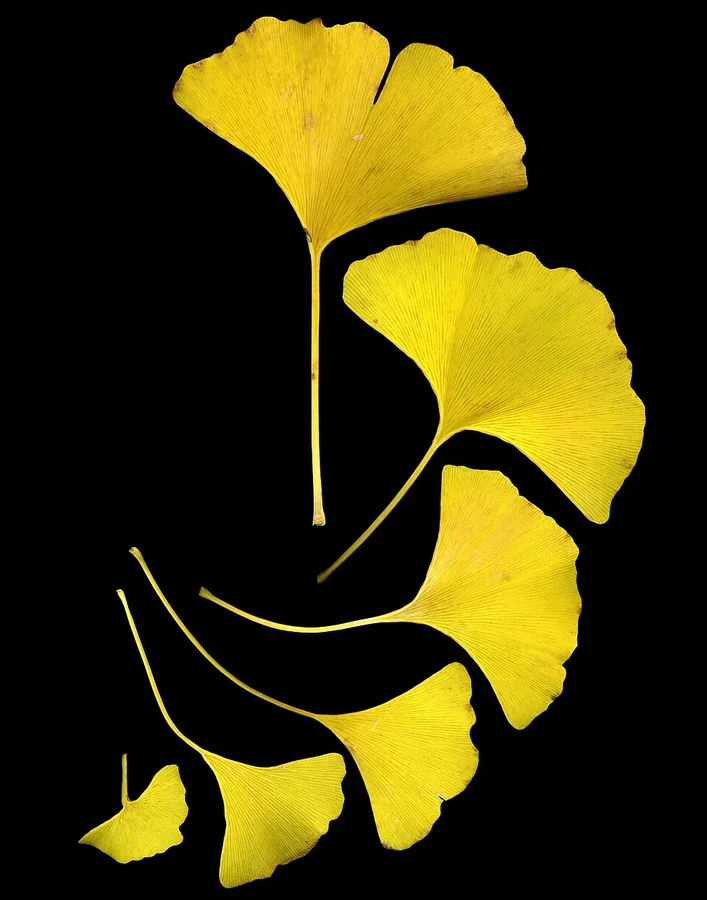
The ginkgo is a living fossil, the last survivor of a plant line reaching back more than 200 million years, and its leaves give it away at a glance. Each one is a small green fan, split down the middle and flaring out to a broad, notched edge, borne on a slender stalk unlike the flat blades of any neighboring tree. Beneath that distinctive foliage the tree is remarkably durable, shrugging off drought, heat, pollution, road salt, and pests that wear down most shade trees.
It grows slowly and lives a very long time, thickening its trunk and lifting its limbs into a wide, open crown that reaches 50 to 80 feet (15.2 to 24.4 m) tall over the years. The branches spread loosely rather than crowd together, so light filters through the layered fans of foliage. The whole canopy holds its green through the season, then in autumn every fan turns at once to a clear, bright gold and drops, often within a day or two.
One physical trait shapes the tree more than any other: the ginkgo is dioecious, so each tree is either male or female. A female sets soft, plum-like fruit that ripens and falls in autumn with a foul smell, while the fruitless male cultivars carry only bare, clean branches. Nearly every tree sold for landscaping is a grafted male for exactly that reason.
Care
The short version: set it in full sun and well-drained soil, keep it watered through its first few years while the roots take hold, and once established the ginkgo carries on with almost no help.
Light
Give a ginkgo full sun, where the crown fills in thick with overlapping green fans and colors deepest in fall. It takes partial shade, but the canopy opens and the layers of foliage thin the less light it gets.
Water
Keep a young tree steadily watered through its first few years while the roots take hold, letting the top half of the soil dry between drinks. Once settled, the ginkgo is genuinely drought-tolerant and needs extra water only through a long dry spell.
Soil
It is not fussy about the ground and roots into loam, sand, or clay wherever the site drains. A pH anywhere from 5.0 to 8.0 suits it, a span that covers most yards without any amendment.
Temperature
This is a cold-hardy, heat-tough tree that takes anything from -40°F to 100°F (-40°C to 38°C). That range is why it holds its fans of foliage from northern zones down through hot southern streets.
Humidity
Ordinary outdoor air is all it needs, so there is nothing to manage here. Average humidity suits it fine in any climate where it is hardy.
Feeding
Feed a young tree a balanced slow-release tree fertilizer in spring to push firm early growth. An established ginkgo rarely needs feeding and lives on what the soil already holds.
Pruning
Prune a young tree in late winter to set one strong central leader and a clean, open branch structure. A mature ginkgo needs very little, so once the frame of limbs is built it mostly keeps its own shape.
Repotting
A ginkgo is a landscape tree and is rarely repotted, but a young one held in a container shows when it has outgrown its pot. Look for roots circling the wall or pushing out the drainage holes, water running straight through, and new growth stalling.
Size & spacing
Plan for a large tree that lifts to 50 to 80 feet (15.2 to 24.4 m) tall and spreads its limbs 30 to 40 feet (9 to 12 m) wide. Give it that much open ground away from buildings, walks, and power lines so the broad crown of fans can fill out.
When to plant
The ginkgo is hardy from zone 3 to zone 8 and goes in the ground in spring or fall, when mild weather lets its roots take hold before the next stress. It grows slowly, so the early years turn on steady watering rather than fast height, and the reward is that sheet of clear gold across every fan-shaped leaf each autumn.
Northern hemisphere
Southern hemisphere
Typical months for a temperate climate: start earlier in warm zones, later where spring frosts linger.
- Plant: spring or fall
- Harvest: April (inconspicuous; dioecious)
Hardiness
USDA hardiness zones: 3–8
Temperature: down to -40°C
Troubleshooting
A ginkgo gives you very little trouble, which fits its plain, durable character. The few issues that surface tie to a young tree still rooting in, or to the soft, fallen fruit and the irritation from a female tree. Match what you are seeing below, then act while it still helps.
Dry brown rims creeping in along the leaf edges with twig dieback
When a young tree browns in an even band right along the fan-shaped leaf edges during hot, dry weather, that dry, crisp rim is usually plain heat or drought stress. The graver look is bacterial leaf scorch, where the browning creeps across the canopy one section at a time over several seasons. Give a stressed sapling a deep soak and a ring of mulch, but a tree confirmed with the bacterial form is best removed.
Fix:
- Water deeply during drought, especially for newly planted trees
- Mulch to conserve soil moisture
- Remove severely declining trees if bacterial scorch is confirmed
An itchy rash and small blisters where the pulp smeared the skin
The soft pulp inside a female tree's fruit is loaded with ginkgolic acids, urushiol-like compounds that raise blisters on bare skin the way poison ivy does. Wash the area well with soap and water, then care for the rash exactly as you would a poison-ivy reaction. Gloves keep the sticky pulp off your hands, and a male cultivar bears no fruit at all.
Fix:
- Wash the affected skin thoroughly with soap and water
- Treat dermatitis symptomatically as for poison ivy
A sour reek and squashed, glossy fruit strewn across the ground in autumn
Those plum-like seeds squashed across the ground come from a female ginkgo, and their soft, fleshy coats carry butyric acid that turns to the smell of rancid butter as they break down. Rake the slippery fruit up before it gets crushed and tracked around, and pull on gloves so the pulp cannot irritate your skin. A fruitless male cultivar never sets that fruit in the first place.
Fix:
- Rake and remove fallen fruit promptly
- Wear gloves when handling crushed fruit to avoid skin irritation
Toxicity
The ginkgo is a low-toxicity tree, and its thin, fan-shaped leaves pose little risk to pets, livestock, or people. The caution rests with the female tree's soft fruit and the raw seed inside: the fleshy pulp can raise a poison-ivy-like rash on bare skin, and raw or large amounts of the inner seed carry ginkgotoxin. Most landscape trees are fruitless males, but where a female drops fruit, keep pets and curious children away from the litter.
Toxic to
Cats · Dogs · Horses · Rabbits · Livestock · Birds · People
Cats Caution
The thin, fan-shaped leaves are low in toxicity, so a nibble of foliage is no real worry for a cat. The catch is a female tree's soft fallen fruit and the raw seed inside, which can upset the stomach, so keep a cat away from the slippery litter under the tree.
Dogs Caution
A dog mouthing the leaves is unlikely to be harmed. Watch instead for one chewing the plump, dropped fruit or the raw seed inside, which can bring on drooling and stomach trouble, with a big mouthful the greater concern.
Horses Caution
The foliage carries little toxicity for a horse. The sensible caution is to keep them off the windfall of fleshy fruit and its raw seed, since that inner seed holds ginkgotoxin.
Rabbits Caution
A leaf or two will not trouble a rabbit, given how low the foliage runs in toxins. Keep one away from the raw seed at the core of the fruit, though, because a small animal handles ginkgotoxin poorly.
Livestock Caution
Cattle, goats, and sheep can browse the leaves without much risk. The part to fence off is the autumn drop of soft fleshy fruit and the raw seed within beneath a female tree.
Birds Caution
Birds scatter the fallen seeds far and wide, and the foliage poses no real problem for them. Still, the raw inner seed carries ginkgotoxin, so it is not something to set out for backyard poultry.
People Caution
The leaves and leaf extracts are low in toxicity, but two things deserve care. Handling the soft pulp of the female fruit can raise a poison-ivy-like rash, and eating raw or large amounts of the inner seed can cause ginkgotoxin poisoning, so cooked seeds are kept to small servings.
Only FEMALE trees produce fleshy seed coats; the fruit pulp contains ginkgolic acids (urushiol-like) that can cause poison-ivy-like contact dermatitis in people handling the crushed fruit, and RAW seeds/nuts contain ginkgotoxin (4'-O-methylpyridoxine) which can cause toxicity such as seizures if many are eaten raw. Plant fruitless male cultivars.
Helpline numbers

United States
ASPCA Animal Poison Control: (888) 426-4435 (fee applies)
Poison Control: (800) 222-1222



Canada
Poison Centres: 1-844-764-7669
Varieties
Almost every ginkgo planted in a yard or along a street is a fruitless male cultivar, chosen so no soft fruit ever hits the ground. The selections below are the ones you will run into most.
Autumn Gold
A fruitless male whose broad, even crown flares to a clear, bright gold in fall, filling out to roughly 50 feet (15 m) tall and 30 feet (9 m) wide.
Princeton Sentry
A fruitless male drawn into a narrow, upright, conical outline that tapers to a point and slips into tight spots and street-side rows.
Magyar
A fruitless male with a crisp, even columnar-to-pyramidal shape that gives it the clean profile of a street tree.
How to propagate
Ginkgos are propagated to secure a known male, fruitless tree, so the usual routes are grafting and cuttings rather than seed.
GraftingDemanding
Late winter to spring (dormant scion onto seedling understock) · 1-2 years
Grafting is how the fruitless male cultivars are carried on. A bare, dormant scion is fitted onto seedling rootstock in late winter or spring, which keeps the cultivar true and guarantees a male tree, and the join fuses over a year or two. The work is fine and exacting, which puts it at the demanding end of propagation.
Stem cuttingsModerate
Midsummer (semi-hardwood) · 1-2 years
Firm, semi-hardwood cuttings of 10 to 15 cm are clipped from a mature male tree in midsummer, dipped in IBA rooting hormone, and kept under a fine mist. They knit roots over a year or two and grow slowly from there, but they carry the parent's known sex, which is the whole point.
SeedDemanding
Fall, after cleaning and stratifying seed · Several years
The seed can be cleaned free of its fleshy coat, stratified in fall, and sown, but the seedlings creep along and take several years to settle in. The deeper problem is sex: a ginkgo hides whether it is male or female for 15 to 20 years or more, so seed is a poor route to a guaranteed fruitless male.
Myths
Ginkgos are poisonous, a hazard to any pet living beside one.
The ginkgo is not on the ASPCA toxic-plant lists, and the fruitless male trees sold for landscaping are treated as non-toxic to cats and dogs. The worry is a narrow one: it is the female tree's soft fallen fruit and the raw seed inside, not the fan-shaped leaves or the wood, that you keep pets away from.
All ginkgos scatter a stinking, rotting mess underfoot each fall.
Only the female tree forms those plum-like fleshy seed coats, and it is the butyric acid in them that reeks as they soften and rot on the ground. The male cultivars sold for landscaping set no fruit and stay odor-free, which is exactly why they fill the nursery lots.