Tree · Lythraceae
Crepe Myrtle
Lagerstroemia indica
Crinkled, crepe-paper flowers crowd the branches all summer, and in winter the bark peels back to smooth, mottled wood.
Full sun
Every 7–14 days
USDA 6–9
15–25 ft · 4.6–7.6 m
Overview
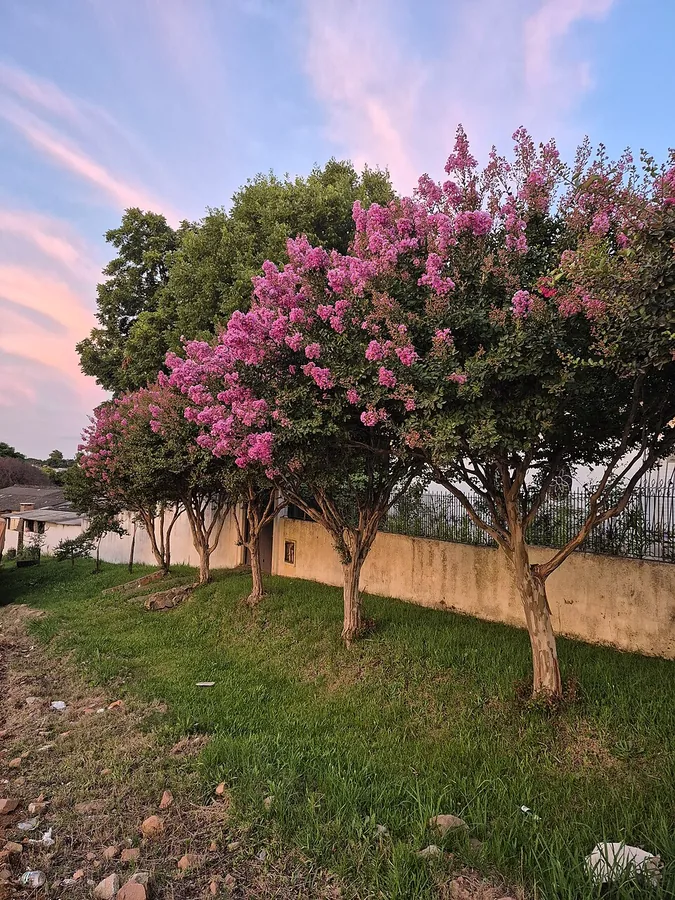
Up close, the crepe myrtle is all texture. Its flowers open crimped and ruffled like crepe paper, clustered into full heads that crowd the branch tips from July into September in white, pink, lavender, and deep red. When the blooms finish, the bark itself becomes the show, flaking away in thin sheets to leave smooth, mottled wood underneath. It grows fast, and the tree shrugs off heat, drought, and a range of soils once its roots set.
Stand back and the form fills out fast. A mature crepe myrtle reaches 15 to 25 feet tall and spreads close to that, the branches arching out into a broad, open crown. That flowering bulk is what earned it the name lilac of the south, since it stacks color high where true lilacs cannot. Given room, the limbs sweep into a graceful, vase-like shape on their own.
What undoes that natural shape is heavy cutting. Left alone, the tree sets flowers thickly along the new growth and needs only sun, drainage, and a light prune. Hard topping leaves knuckled stubs and a thicket of thin, whippy shoots in place of those clean, sculptural limbs.
Care
The short version: full sun, well-drained soil, and a deep soak only while the tree is young. A light late-winter prune keeps the limbs clean, a modest hand with nitrogen keeps the crepe-paper flowers coming, and open air keeps mildew and scale off the leaves and bark.
Light
Plant a crepe myrtle in full sun, ideally 6 or more hours a day, and the flower heads pack the branch tips tight. In shade the bloom thins out and a powdery white film spreads more freely over the leaves, so the sunniest spot keeps it both fuller and cleaner.
Water
A young tree drinks regularly through its first year while the roots reach down. After that the tree is heat- and drought-tolerant and seldom needs more than a deep soak in a long dry spell. The top half of the soil should dry between waterings, leaving the surface crumbly to the touch.
Soil
The tree is unfussy underfoot, rooting into clay, loam, sand, or shallow rocky ground as long as the water drains away. It tolerates a wide pH range from 5.0 to 8.0, so most ground holds it without amendment.
Temperature
Crepe myrtle takes summer heat up to 100°F (38°C) without scorching, the leaves and crinkled blooms holding through the worst of it. It is hardy to about -9°F (-23°C), reliable through zone 6, though a hard freeze can kill the top and send fresh shoots up from the base.
Humidity
Ordinary outdoor humidity asks nothing of the tree, so there is no number to hit. Airflow matters more, since still, damp air pooled among crowded branches lets a powdery white film and yellow leaf spots settle on the foliage.
Feeding
A balanced fertilizer in spring keeps the tree growing, guided by a soil test of what the ground lacks. Nitrogen stays modest, because an excess pushes out leafy green growth and thins the crepe-paper flower heads.
Pruning
Prune lightly in late winter or early spring. Crossing limbs, suckers, and the dry brown seed heads come out, and the lower branches limb up over time to expose the smooth, peeling trunk. Never top it hard, which leaves blunt knuckles and a burst of thin, whippy shoots.
Repotting
Crepe myrtle is a landscape tree and rarely stays potted for long. A container-grown one needs repotting only occasionally, signaled by roots circling and poking through the drainage holes and soil that dries almost as fast as it is watered.
Size & spacing
A mature tree stands roughly 15 to 25 feet (4.5 to 7.5 m) tall and spreads to match, the limbs fanning into a broad crown. The full width lets air slip through the canopy, which keeps the leaves and bark cleaner.
When to plant
Crepe myrtle is hardy from zone 6 through 9 and moves with the warm season. A new tree planted in spring or fall settles its roots before heat or cold, and the crimped flower heads then crowd the branch tips from July through September.
Northern hemisphere
Southern hemisphere
Typical months for a temperate climate: start earlier in warm zones, later where spring frosts linger.
- Plant: spring or fall
- Harvest: July to September
Hardiness
USDA hardiness zones: 6–9
Temperature: down to -23°C
Troubleshooting
Most crepe myrtle trouble is fungal or insect-driven, and it marks the leaves or the bark first, where a close look catches it. Caught early, a quick fix usually keeps the flowers coming. Match the visible signs below before the trouble spreads across the canopy.
White powdery coating on leaves and buds that stay shut
The white to grayish dust filming the leaves, new shoots, and flower buds is powdery mildew, a fungus that flares in the mild, damp stretches of spring and fall and can seal buds shut for good. Sun and moving air dry it out, the crowded basal sprouts need clearing, and a labeled fungicide is for severe cases only.
Fix:
- Site in full sun with good air circulation
- Remove basal sprouts and crowded growth to improve airflow
- Apply a labeled fungicide such as myclobutanil, propiconazole, or thiophanate-methyl if severe
Tiny yellow leaf spots with a late-summer drop
Small yellow spots speckling the upper leaf surface, with pale fungal growth on the undersides, are Cercospora leaf spot, which can strip a tree bare by late summer. Dry foliage and an open canopy slow it down. The fallen, spotted leaves carry the fungus through winter and need raking up.
Fix:
- Improve air circulation and avoid wetting foliage
- Rake and remove fallen infected leaves
- Apply thiophanate-methyl or myclobutanil if needed
Felty white crusts on the bark that ooze pink
The white to gray, felt-like crusts caking the trunk and branches are crapemyrtle bark scale, and crushing one squeezes out a telltale pink fluid. The insects ooze honeydew that blackens the whole tree with sooty mold. Mild soapy water and a soft brush scrub the white scale and black grime off the bark, and a spring systemic soil drench paired with a late-winter dormant oil spray breaks the cycle.
Fix:
- Wash trunk and branches with mild soapy water and a soft brush to remove scale and mold
- Apply a systemic soil drench (e.g., imidacloprid) in spring per label
- Use dormant horticultural oil sprays in late winter
Sticky, blackened leaves with a sooty film
The sticky glaze on the leaves is honeydew from crape myrtle aphids, pale yellow-green specks dotted with black on the leaf undersides, and the black sooty mold is a harmless fungus coating that sugar. A hard jet of water knocks the aphids loose, insecticidal soap or neem oil follows, and lady beetles and lacewings finish them off. With the aphids gone, the black film weathers away on its own.
Fix:
- Spray plants with a strong stream of water to dislodge aphids
- Use insecticidal soap or horticultural/neem oil
- Encourage predators such as lady beetles and lacewings
Toxicity
Good news for pet owners and parents: crepe myrtle is safe all around. The ASPCA lists it as non-toxic to cats, dogs, and horses, with no known danger to other animals or people. The only mess to expect is fallen petals staining a walkway or car.
Safe for
People · Cats · Dogs · Horses · Rabbits · Livestock · Birds
Cats None
The ASPCA lists crepe myrtle as non-toxic to cats, so a curious nibble on a leaf or a fallen bloom is nothing to worry about.
Dogs None
Dogs can mouth the leaves, flowers, or bark without harm. A chewed low branch is safe, though a large helping of any plant may pass an upset stomach.
Horses None
Horses grazing near a crepe myrtle are fine. The plant is not poisonous to horses, and no special fencing is called for.
Rabbits Safe
Rabbits face no risk from the leaves or stems. The plant carries no known toxin, so a stray bite will not hurt them.
Livestock Safe
Cattle, goats, and sheep can browse around a crepe myrtle without trouble, since the foliage holds nothing toxic to them.
Birds Safe
Backyard and wild birds are in no danger here. They often pick at the seed capsules, and the plant is safe for them.
People Safe
Crepe myrtle is harmless to people, children included. None of its parts are a known food, so there is no reason to eat it, but a tasted petal or leaf does no harm.
No special toxicity precautions are needed; fallen flowers may stain walkways or vehicles.
Varieties
Hundreds of crepe myrtles are sold, set apart by flower color, bark, and fall foliage. The best garden picks are the disease-resistant hybrids, and these four turn up again and again.
Natchez
A vigorous indica and fauriei hybrid reaching about 30 feet, with white flowers, cinnamon-brown bark that peels away in thin winter sheets, and strong resistance to powdery mildew.
Muskogee
An indica and fauriei hybrid topping 20 feet, marked by soft, light lavender flower heads, a long bloom season, and good mildew resistance.
Tuscarora
An indica and fauriei hybrid in shades of coral-pink to dark pink, with solid resistance to both powdery mildew and Cercospora leaf spot.
Sioux
A mildew-resistant indica and fauriei hybrid that sets bright pink summer flowers and then flushes a deep red-purple across the leaves in fall.
How to propagate
Crepe myrtle multiplies several ways, and the choice depends on whether an exact copy of a named tree is wanted or a variable seedling will do.
Stem cuttingsEasy
Softwood cuttings in late spring to summer; hardwood cuttings in winter · 4 to 8 weeks to root
Cuttings copy a named tree exactly, the new plant a faithful match for its parent. Softwood cuttings taken in late spring or summer, or hardwood cuttings over winter, push roots in 4 to 8 weeks.
SeedModerate
Collect ripe seed in fall and sow · One or more seasons
The ripe seed capsules, small woody rounds that split open in fall, can be collected and sown, but the seedlings come up variable and will not match a named tree. A seed-grown plant takes a season or more to amount to anything.
LayeringModerate
Growing season · Several months
A low-slung branch can be pinned against the soil through the growing season and left to root where it touches. Layering runs several months, after which the rooted new plant is cut free from its parent.
Myths
Crepe myrtles need a hard yearly chop, the so-called crepe murder, to bloom well.
Topping a crepe myrtle does nothing for its flowers and disfigures its shape. The tree sets blooms thickly on its own, while severe cuts leave knuckled stubs that erupt in weak, whippy shoots in place of clean limbs. A light shaping in late winter is all it ever needs.