Ornamental · Lythraceae
Cuphea
Cuphea ignea
Under full sun and a few pinches, cuphea lights its slim tubular blooms from spring to frost.
Full sun
Every 3–7 days
USDA 9–12
2–3 ft · 0.5–0.9 m
Overview
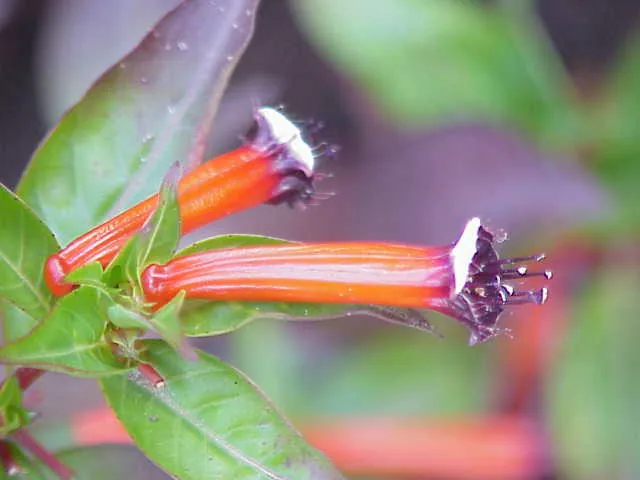
Cuphea is a heat-loving flower whose blooms carry it from late spring until frost. On the cigar flower, Cuphea ignea, each flower is a slim tube about an inch long, glowing reddish-orange along its body and finished at the mouth with a pale white tip ringed in dark, so the whole bloom reads like a tiny lit cigar. The plant sits in the Lythraceae family and grows as a tender perennial, hardy in zones 9 to 12 and grown as a warm-season annual everywhere colder.
Up close, the show is in the steady stream of those small tubular flowers, opening almost without a break through the warm season. Because the plant is self-cleaning, each spent bloom loosens and falls on its own, leaving fresh tubes to take its place with no deadheading. Hummingbirds slip their bills into the narrow flowers all summer, drawn to the very shape of them.
The plant builds a compact, twiggy mound of fine foliage on semi-woody stems, standing about 1.5 to 3 feet (46 to 91 cm) tall and roughly as wide. Given sun, steady moisture, and the odd pinch, it knits dense and full. Left unpinched it runs leggy and open, the stems lengthening until the flowers strand at the tips and the lower wood shows bare.
Care
The short version: full sun, soil kept evenly moist but well-drained, a balanced feed through the season, and a few pinches to hold the stems short, dense, and bushy.
Light
Cuphea flowers thickest in full sun, which also packs the stems short and dense. It will take partial sun or light shade, but a shadier spot thins the flowers and lets the stems run looser and floppier.
Water
Keep the soil evenly moist in well-drained ground, watering roughly every 3 to 7 days as the heat and the bed decide. Once the roots take hold the plant turns somewhat drought tolerant, so the real danger is the other way: waterlogging rots the roots.
Soil
Plant it in organically rich, well-drained loam or sand that holds moisture without packing wet. A pH of 5.5 to 7.5 suits it, so most garden beds will serve with a little compost worked through.
Temperature
This is a warm-season plant, easy in heat up to about 95°F (35°C) and damaged as the air drops near freezing. It hangs on down to roughly 36°F (2°C), but frost blackens the stems and ends the show, so grow it as an annual where winters bite.
Humidity
Average outdoor humidity suits the foliage fine, with no number to chase. The plant stays untroubled as long as the air moves around its fine leaves.
Feeding
Feed it every two weeks through the growing season with a balanced water-soluble fertilizer, or work a slow-release granular into the soil at planting. Steady feeding keeps the slim tubular flowers coming.
Pruning
Pinch the soft stem tips back several times through active growth to keep the stems from running long and to thicken the plant into a fuller mound. No deadheading is needed, since cuphea sheds each spent flower on its own.
Size & spacing
The plant builds to about 1.5 to 3 feet (46 to 91 cm) tall and spreads to a similar width. Give each one room to reach that mature spread so air slips between the stems and the foliage fills out evenly.
When to plant
Cuphea wants warmth and will not stand a frost. Start the seed indoors well ahead of the last spring frost, set the young plants out once the cold has gone and the soil has warmed, and the slim tubular flowers open from late spring through fall until the first freeze.
Northern hemisphere
Southern hemisphere
Typical months for a temperate climate: start earlier in warm zones, later where spring frosts linger.
- Sow: 10 to 12 weeks before the last spring frost
- Plant: After all danger of frost has passed and soil has warmed in spring
- Harvest: Blooms almost nonstop from late spring through fall until first frost
Hardiness
USDA hardiness zones: 9–12
Temperature: down to -7°C
Troubleshooting
Cuphea is an easy plant that rarely falters, and the few troubles you might see read plainly on the stems and leaves. They run from open, stretched growth to a winter dieback. Match the look below to your plant and act early.
Sticky leaves, twisted new growth, or insects on the foliage
A tacky film on the leaves and puckered, twisting new shoots point to mealybugs, thrips, and whiteflies, which gather thickest on plants kept indoors or under glass. Turn a leaf over and the undersides and growing tips reveal white cottony tufts, minute flyers that lift in a cloud, or a pale stippling pricked across the green. A rinse of water washes a light coating away, and insecticidal soap or horticultural oil clears the stubborn holdouts.
Fix:
- Rinse off light infestations with water
- Treat with insecticidal soap or horticultural oil as needed
Stems blacken and die back over winter
Cuphea is a tender perennial, so a frost or hard freeze turns the green stems black and slack as the plant collapses to the ground. In zones 8 to 9 a thick mulch over the crown shelters it, and fresh shoots push up from the base in spring. Where the cold cuts deeper, the plant runs as a warm-season annual, or a few rooted cuttings hold over indoors until planting time.
Fix:
- Mulch well so the plant can resprout from the base in spring in zones 8 to 9
- Grow as a warm-season annual or overwinter cuttings indoors in colder regions
Open, floppy growth with bare lower stems
An unpinched cuphea draws itself out long and thin, going leggy as the semi-woody stems lengthen and lean. The flowers cluster at the very tips, leaving the lower stems stripped to bare wood, and low light stretches them further. Pinch those stem tips back a few times through the season and set the plant in full sun, and the growth knits in close and bushy again.
Fix:
- Pinch back the tips of the semi-woody stems a few times during the growing season
- Site in full sun for denser, more compact growth
Toxicity
For homes with pets and small children, cuphea is non-toxic straight across the board. No part of the plant, leaf, stem, or tubular flower, is known to harm cats, dogs, livestock, or people, so it can grow near a play area or a pet run without concern.
Safe for
People · Cats · Dogs · Horses · Rabbits · Livestock · Birds
Cats None
Cuphea carries no known toxins, so a cat that bites into a leaf or a tubular flower comes to no harm.
Dogs None
A dog can mouth the green stems or push through the foliage unharmed, since the plant is not listed as poisonous.
Horses Safe
No part of the plant, leaf, stem, or flower, is known to harm horses that graze nearby.
Rabbits Safe
Rabbits can nip the small leaves without risk, since cuphea holds no compounds that would upset them.
Livestock Safe
Cattle, goats, and sheep face no poisoning from the foliage in a pasture or border.
Birds Safe
Hummingbirds probe the slender tubular flowers, and garden birds run no risk from the plant at all.
People Safe
Cuphea counts as non-toxic, so there is no worry when children turn the leaves or the small blooms in their hands.
Varieties
Cuphea spans a wide group, from low shrubs studded with purple trumpets to fiery firecracker types. These are the ones you will see most often.
Cuphea hyssopifolia (Mexican heather, false heather)
A densely branched sub-shrub of 1 to 2 feet packed with fine foliage and scattered all over with tiny lavender-purple trumpet flowers, and pink and white cultivars carry the same form.
Cuphea ignea (cigar flower)
Each inch-long tubular bloom burns reddish-orange down its length, then ends in a white tip ringed with dark, the very look of a lit cigar that hummingbirds probe.
Vermillionaire (Cuphea hybrid 'Cupver')
A vigorous firecracker-type hybrid that covers itself in slim orange tubular flowers and keeps throwing them through real heat.
How to propagate
Cuphea multiplies easily, whether from fine seed sown in late winter or from soft tip cuttings rooted to carry a favorite through the cold.
Stem cuttingsEasy
Take tip cuttings in fall and root indoors over winter for overwintering · A few weeks to root
Snip the soft stem tips in fall and root them indoors to carry a plant through winter, and they strike roots in only a few weeks. Ease the watering back through fall and winter while the cuttings settle, since cool, damp conditions invite rot in the young stems.
SeedEasy
Start indoors 10 to 12 weeks before the last spring frost · Germinate and grow on for transplanting after frost
Sow the fine seed indoors 10 to 12 weeks before the last spring frost, then grow the small seedlings on for transplanting once the cold has passed. If that head start runs too long, nursery transplants take just as readily.
Myths
Cuphea must be deadheaded to keep it blooming.
These plants are self-cleaning, letting each faded tubular flower drop away on its own. New blooms keep opening from spring until the first frost with no deadheading needed.
Cigar flower can only survive as a houseplant in cold climates.
It is a tender perennial, hardy in the open ground through zones 9 to 12. Where the cold runs deeper it grows as a warm-season annual, or a few cuttings hold over, with no windowsill required.