Ornamental · Dryopteridaceae
Christmas Fern
Polystichum acrostichoides
Given shade and well-drained soil, the Christmas fern holds its leathery green fronds through winter.
Partial shade
Every 5–10 days
USDA 3–9
12–35 in · 30–90 cm
Overview
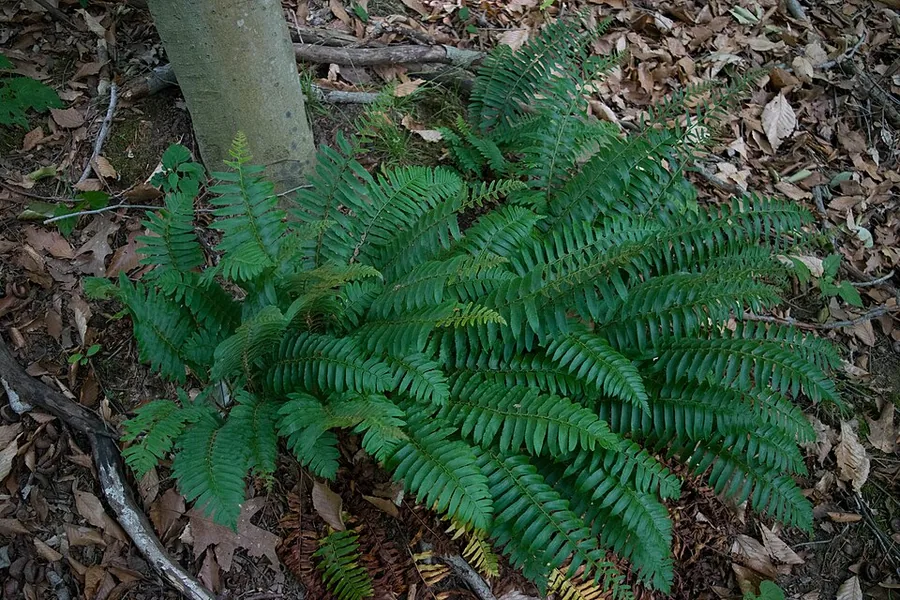
The Christmas fern shows its character in the fronds themselves: long, arching blades of leathery, dark green tissue that feel stiff and substantial between the fingers. Each frond is lined with rows of small leaflets, and every leaflet carries a tiny lobe at its base that gives it the outline of a Christmas stocking, the detail behind the common name. It is a wood fern from the eastern woodlands, and it draws the clump into a neat, non-spreading rosette.
Those fronds are built to last. Their thick, leathery surface shrugs off cold to -40°F (-40°C) and stays green where thinner ferns brown and wither, and the plant holds in deep shade and dry, rocky, root-filled ground. In spring the new growth rises as fiddleheads, tightly coiled crosiers clad in pale scales that unroll into fresh fronds while last year's still stand around them.
Up close the clump reads as layered green all year. Old fronds arch outward at the base while the fresh ones lift from the center, so there is always a standing crown of foliage rather than bare soil. The species keeps this evergreen form for years, the leaflets dark and firm from spring through the depths of winter.
Care
The short version: the leathery-fronded fern wants part to full shade in rich, well-drained soil, even moisture while it establishes, and little attention afterward.
Light
This is a shade plant through and through. It does best in partial to full shade and takes deep shade in stride, which makes it a rare fit for the darkest corners. A little morning sun is fine, but harsh afternoon light bleaches and scorches the dark green fronds.
Water
Keep the soil evenly moist while the fern establishes, watering every 5 to 10 days when rain is short. Once the roots take hold the leathery fronds carry it through brief dry spells without wilting, so you can ease off. Standing water is the one thing it will not endure.
Soil
Plant it in rich, well-drained loam full of organic matter, though the fern also takes to sandy or shallow rocky ground. It leans slightly acidic, around a pH of 5.0 to 6.5. Drainage matters most of all, since soggy ground rots the crown.
Temperature
Few garden plants are this hardy. The fronds come through -40°F to 86°F (-40°C to 30°C), covering USDA zones 3 through 9. Winter cold does not faze them, and they hold their deep green color straight through the frost.
Humidity
Ordinary outdoor humidity suits it fine, so there is no number to chase. Steady soil moisture matters far more to these fronds than any dampness in the air.
Feeding
This fern barely needs feeding. A light topdressing of compost or a balanced slow-release fertilizer in spring is plenty, and many gardeners skip even that. Overfeeding does more harm than good.
Pruning
Pruning is a once-a-year job. In late winter or early spring, before the coiled fiddleheads push up, cut away the old, tattered, or winter-damaged fronds so the fresh growth unrolls clean.
Size & spacing
Each clump arches 12 to 35 inches (30 to 90 cm) tall with a matching spread of fronds. Space plants about that far apart so the blades have room to arch outward, and the non-spreading crown holds its tidy rosette without crowding.
When to plant
A fern raises no flowers and ripens no fruit, so there is no bloom or harvest to mark. The fronds go out in spring as the soil warms and the coiled fiddleheads start to lift, and the clump fills in over the next season or two.
Northern hemisphere
Southern hemisphere
Typical months for a temperate climate: start earlier in warm zones, later where spring frosts linger.
- Plant: spring
Hardiness
USDA hardiness zones: 3–9
Temperature: down to -40°C
Troubleshooting
This fern keeps its dark, leathery fronds in good order with little fuss, so trouble is rare and usually traces back to soggy soil or a hungry pest chewing the foliage. Learn the two signs below to read them off the fronds early. Match what you see, then act before it spreads.
Limp fronds above a soft, blackened crown
Fronds that hang limp above a crown gone soft and inky black are showing crown rot, which takes hold where the soil stays sodden, especially through a wet winter. Ease off the water and open up the drainage, then cut away every spongy, darkened scrap of tissue at the base until only firm growth remains. Setting the rhizome back at a slight tilt lets water bead and run off the crown rather than soaking into it.
Fix:
- Improve drainage and reduce watering
- Plant the rhizome at an angle to shed water from the crown
- Remove and discard affected tissue
Leaflets gnawed ragged and stems left bare
Leaflet edges gnawed to ragged notches, with stems left bare and skeletal, mark the feeding of the Florida fern caterpillar, which works after dark and can strip a frond to its midrib in one night. A flashlight passed over the foliage after sunset catches the larvae mid-meal, and they lift off cleanly by hand. Only a heavy infestation calls for an appropriate insecticide, since a careful eye and an early pick usually halt the damage.
Fix:
- Hand-pick caterpillars
- Treat with an appropriate insecticide if infestation is heavy
Toxicity
For households with pets and children, the verdict is easy: the Christmas fern is safe all around. The ASPCA lists it as non-toxic to cats, dogs, and horses, and there is no poison in the coarse green fronds to worry about for other animals or people.
Safe for
People · Cats · Dogs · Horses · Rabbits · Livestock · Birds
Cats None
The ASPCA lists this fern as non-toxic to cats, so a curious nibble at the leathery leaflets means nothing. A cat that swallows a larger mouthful of the coarse green fronds may feel briefly queasy, as any plant fiber can cause, but no poison is at work.
Dogs None
Dogs are safe beside this fern, which carries no toxins. A few chewed fronds do no harm, though a big helping of the stiff, fibrous greenery may pass through messily.
Horses None
Confirmed non-toxic to horses, the fern poses no danger to a grazing animal. Its dark green fronds hold nothing poisonous.
Rabbits Safe
Rabbits can browse the fronds without harm, since the fern holds no toxin to trouble them.
Livestock Safe
Cattle, goats, and sheep can graze near this fern safely, as it carries nothing poisonous. It lacks the toxicity that turns some pasture ferns into a hazard.
Birds Safe
Pet and backyard birds stay safe around this fern. Nothing in the fronds will harm them.
People Safe
The plant poses no poisoning risk to people, children who handle the bristly fronds included. It is not grown to be eaten, so there is no reason to taste it, but a touch or a taste does no harm.
Varieties
Unlike many garden plants, this fern is grown almost entirely as the wild species, with named cultivars hard to come by. There is really just the one form to know, fronds and all.
Polystichum acrostichoides (species)
It is grown almost entirely as the straight species, its leathery, evergreen, dark green fronds lined with small stocking-shaped leaflets that keep their deep color through winter into the Christmas season, and named cultivars are rare.
How to propagate
Making more Christmas ferns is straightforward, whether you split the rooted crown of a clump you already have or take the slower path of raising them from spores.
DivisionEasy
Spring · 1 to 2 growing seasons
The simplest way to make more is to divide an established clump in spring, prying the crown apart into rooted sections and replanting them, where they knit in and bulk out over a season or two. Spores ripen on the upper third of the fertile fronds and can raise new plants too, though that route is far slower.
Myths
The Christmas fern is named for blooming or fruiting at Christmas.
Ferns never open a flower or set a berry, so the name owes nothing to a winter bloom. It points instead to the leathery fronds that stay green through winter into the Christmas season, and to the leaflets, each cut into the shape of a little Christmas stocking.