Ornamental · Poaceae
Big Bluestem
Andropogon gerardii
Hand it full sun and lean soil, and this towering native grass holds its height from summer well into winter.
Full sun
Every 7–21 days
60–90 days
USDA 3–9
Overview
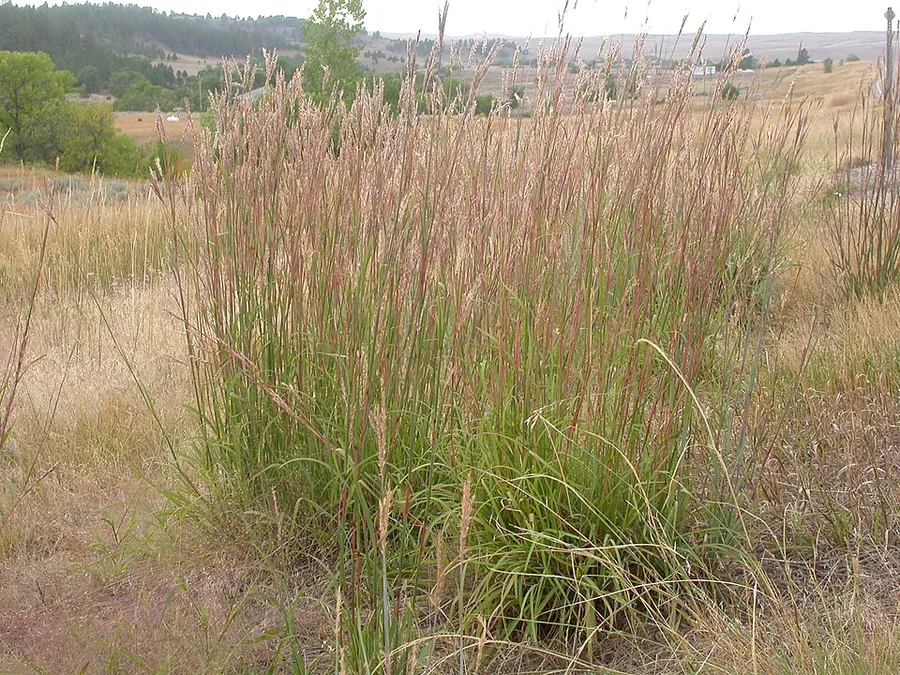
Big bluestem once dominated the tallgrass prairie, the reign that earned it the title King of the Prairie Grasses. A warm-season native, it climbs 4 to 8 feet (122 to 244 cm) in one season, throwing up blue-green stems that color over with copper and red as fall sets in. Each seed head divides into three slim fingers at the tip, and that forked silhouette is the reason it also goes by turkeyfoot.
Few plants are easier to grow, mainly because it asks for almost nothing. Once its deep roots dig in it brushes off drought, copes with clay, sand, or thin soil, and never wants a feeding. Hand it sun and sharp drainage and it largely tends itself.
A wild streak runs through it all the same. Big bluestem self-seeds and spreads wherever the site suits it, and it grows tall enough to engulf a small bed, so it does its best work in meadows, deep borders, and naturalistic plantings with room to roam. Left up through the cold, the bleached canes and forked heads feed the birds and keep their shape against the snow.
Care
The short version: full sun, lean and well-drained soil, no fertilizer. Give it water while it roots in, then turn it over to the rain, and shear the spent growth once a year in late winter.
Light
Big bluestem wants full sun, which means 6 or more hours of direct light each day. A bit of shade it will put up with, but the stems turn weak and topple without strong light, so the more sun it draws the more upright it holds.
Water
Give it steady water only while it settles in. Beyond that it is drought tolerant, getting by on rainfall in average to dry soil and asking for a drink just every 7 to 21 days during a true dry stretch.
Soil
Set it in lean, well-drained ground, anything from dry to medium. Poor, sandy, or clay soil it takes in stride across a pH of 5.0 to 7.5, but rich, wet soil leaves it soft and prone to flop, so leave the heavy amendments out.
Temperature
This is a wide-range grass, hardy through harsh cold and summer scorch alike, holding from roughly -29°F to 104°F (-34°C to 40°C). It dies to the ground every winter and sends up fresh growth in the warmth of late spring.
Humidity
Plain outdoor air is all it needs, so there is no level to fuss over. Good airflow counts for more than any humidity figure, since open spacing keeps the odd bout of leaf rust from taking hold.
Feeding
Skip the feeding. Big bluestem is a native that thrives on poor soil, and any extra fertility from fertilizer just grows weak, leggy canes that lie down.
Pruning
Shear the entire clump to a few inches in late winter or early spring, before fresh growth breaks. Leave it standing through the cold, when the dried stems and seed heads hold their form and feed wildlife.
Repotting
Big bluestem seldom needs lifting. Should an old clump begin to hollow out at the center or fade in vigor after years in place, dig and divide it in spring to refresh the planting.
Size & spacing
Look for a mature plant to stand 4 to 8 feet (122 to 244 cm) tall on a base of 2 to 3 feet (61 to 91 cm). Allow it that whole footprint so air can pass through and the clump can stand without pressing on its neighbors.
When to plant
Big bluestem lives on summer heat and sleeps through the cold. Begin seed indoors in late winter after a cold-moist chill, move plants out once frost is past in spring, or broadcast seed dormant across fall and winter. The purplish turkey-foot heads come on from late summer into fall.
Northern hemisphere
Southern hemisphere
Typical months for a temperate climate: start earlier in warm zones, later where spring frosts linger.
- Sow: Late winter to early spring, 8-10 weeks before last frost (cold-moist stratify seed)
- Plant: Spring after last frost, or dormant-seed in fall/winter
- Harvest: Late summer to fall (purplish turkey-foot seed heads)
Hardiness
USDA hardiness zones: 3–9
Temperature: down to -40°C
Troubleshooting
Tough as it is, big bluestem brings only a short roster of troubles, and most of them trace to too much shade or too rich a spot. The stems and leaves flag the early signs, and the cure is usually plain. Find your match below, then move before it shapes the whole clump.
Stems splay outward and the clump tears open at its core
When the stems lie down and the middle of the clump gapes open, the cause is nearly always too little sun or too much feeding. Starved of light or planted on rich ground, the canes shoot up thin and soft and lose the stiffness to stay vertical. Shift it into full sun, quit the fertilizer, and shear it low in late winter so the next flush comes back rigid. A stiff-stemmed cultivar like 'Blackhawks' ends the trouble outright.
Fix:
- Site in full sun
- Stop fertilizing and avoid rich amendments
- Cut back hard in late winter so sturdy new growth emerges
- Choose an upright cultivar such as 'Blackhawks' if flopping persists
Stray seedlings appear and the clump edges past its place
Big bluestem self-seeds freely and creeps wider on short rhizomes, doing both most readily on sunny, fertile, damp ground. Snip the seed heads and carry them off before they ripen if you want to rein it in. Splitting the clump in spring helps too, and any unwanted volunteers pull or lift out easily.
Fix:
- Cut and remove seed heads before they mature to limit self-seeding
- Divide and reduce the clump in spring
- Pull or transplant volunteer seedlings
A hulking clump that smothers a small bed and its neighbors
At its core this is a tallgrass-prairie giant, rising 4 to 8 feet (122 to 244 cm) on a 2 to 3 foot (61 to 91 cm) base, big enough to overshadow anything tucked beside it. Set it as a backdrop or a screen, or shift it to a spot where it can spread out. If it has to stay put, splitting the clump pares back its spread.
Fix:
- Relocate to a larger space or use as a backdrop/screen
- Divide to reduce footprint
Rusty orange flecks dotted over the leaf blades
Those raised orange dots are rust, a fungus that shows up here and there but seldom causes lasting damage. Loosen the clump for better airflow, pull off any leaves that are heavily blotched, and shear the whole stand in late winter to strip out the spores that ride through the cold. Past that, this grass draws no pests worth naming.
Fix:
- Improve air circulation
- Remove and dispose of heavily affected foliage
- Cut back in late winter to remove overwintering inoculum
Toxicity
Big bluestem is safe across the board. It is a native prairie grass with no poisonous parts, absent from every ASPCA toxic-plant roster, and in fact valued as livestock forage. The one thing to mind is the pollen, which can stir hay fever in people already touchy to grasses.
Safe for
People · Cats · Dogs · Horses · Rabbits · Livestock · Birds
Cats None
Safe to keep nearby. A cat that crunches a blade or two may bring it back up the way cats do with grass, but there is nothing toxic in the plant itself.
Dogs None
Nothing to worry about. The blades carry no toxins, so a dog can sniff or chew them with no harm done.
Horses None
Entirely safe. Horses graze big bluestem willingly, and it ranks among the finer native pasture grasses for them.
Rabbits None
Safe for rabbits to crop. It is just a grass, with no poisonous parts at all.
Livestock None
Valued as forage, not a hazard. Cattle, goats, and sheep all browse it, and it stands as top-quality grazing across the prairie.
Birds None
No danger to birds, which eat the seed and tuck into the standing clumps for cover all winter.
People None
Safe to touch and stand among. The single catch is the pollen, which can spark hay fever in anyone who already reacts to grasses.
Grass pollen can trigger seasonal hay-fever allergies in sensitive people, and pets that nibble grass may occasionally vomit, but the plant is not poisonous.
Varieties
Most big bluestem offered for gardens is chosen for fall color or for a firmer, more upright stance. These are the named selections worth knowing.
Blackhawks
A stiff, upright pick that resists flopping; its dark green spring blades darken toward near-black by autumn, and it took Perennial Plant of the Year for 2026.
Red October
Selected for autumn drama, when the foliage shifts to a deep red and red-purple.
Indian Warrior
Sought out for the rich red-purple cast its leaves take on through fall.
Dancing Wind
Notable for the red-tinged foliage it keeps as the season turns to fall.
Andropogon hallii (sand bluestem)
A near relative suited to dry, sandy ground that closely resembles big bluestem itself.
Companions
Big bluestem pairs naturally with the other tallgrass-prairie plants it grew up alongside, grasses and sun-loving forbs that share its taste for full sun and well-drained ground.
Plant near
Switchgrass (Panicum virgatum): Companion warm-season prairie grass often planted together for forage and naturalistic plantings.
Indiangrass (Sorghastrum nutans): Co-dominant tallgrass-prairie grass with matching site needs for meadow and restoration plantings.
Purple coneflower (Echinacea purpurea): Full-sun prairie forb that pairs well with big bluestem in native borders and meadows.
How to propagate
Big bluestem comes either from seed or from a split clump, and both routes make it a simple plant to multiply once its timing is clear.
SeedEasy
Spring sowing, or dormant fall/winter seeding; cold-moist stratify for best germination · Somewhat slow to establish (1-2 seasons), then vigorous
Seed is how most plantings begin, sown in spring or broadcast dormant across fall and winter, given a cold and moist chill first to break dormancy. The seedlings rise sturdy, but the stand needs a season or two to find its footing before it hits full stride. From there it carries on by itself, self-seeding freely wherever the site agrees with it.
DivisionEasy
Spring as new growth begins · One growing season
For quick new plants or to cut down an overgrown clump, lift and split an established one right as it breaks growth in spring. The pieces strike root and bulk up over a single season.
Myths
Big bluestem and little bluestem are the same plant.
They sit in separate genera and are not one grass. Big bluestem, Andropogon gerardii, reaches up to 4 to 8 feet (122 to 244 cm) and tops out in the three-pronged turkey-foot seed head that gives it its name. Little bluestem, Schizachyrium scoparium, belongs to a different genus and holds at a slim 1 to 3 feet tall. The names rhyme, but the plants do not swap one for the other.