Ornamental · Poaceae
Switchgrass
Panicum virgatum
Slim blades rise in a vase-shaped clump, tipped with airy, pink-tinged plumes that fade to golden-tan by winter.
Full sun
Every 7–14 days
60–90 days
USDA 3–9
Overview
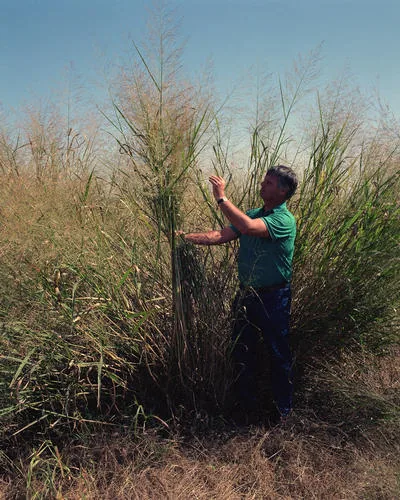
Up close, switchgrass reads as a fountain of narrow, slender blades gathered into an upright, vase-shaped clump. By midsummer thin stems push above the leaves and open into airy, pink-tinged panicles, so airy they blur into a soft haze over the foliage. As fall deepens the blades and plumes shift to a warm golden-tan, a color the clump keeps standing through winter.
The blades themselves are thin and pliant, catching and rocking with the faintest stir of air. The whole clump rises 3 to 6 feet (91 to 183 cm) in a tight, vertical sheaf, taller once the flower stems clear the top. It is this narrow, upright silhouette, held firm and vertical, that gives the plant its clean line.
After bloom, the panicles ripen from pink toward a golden-tan that carries into the cold months, and the seed heads hang on above the standing blades. Even bare of green, the clump keeps its vase shape as a pale, upright column. The texture stays light and open, never dense, right through winter.
Care
The short version: the clump wants full sun and lean, well-drained soil, little water once established, and almost no feeding. The blades are cut low in late winter, and the clump is divided every few years as its center thins.
Light
The blades stand stiffest and most vertical in full sun. Under partial sun or light shade the same leaves grow soft and lean out of the clump, so the more light they take, the tighter and more upright the sheaf holds.
Water
Through the first season the roots need steady water as they reach down, and after that the plant draws on almost none. Once established, the same clump holds up under drought and under flooding, across soils from wet to dry.
Soil
The roots take hold across almost any ground, from wet to dry and heavy clay to loose sand, and even where salt is in the soil. The blades stand firmest on lean ground at a pH of 5.0 to 8.0, since rich soil loosens the clump into a flop.
Temperature
The clump survives winter cold down to -40°F (-40°C) and summer heat up to 100°F (38°C). Across that wide span the blades come back each year in nearly any temperate garden, unprotected.
Humidity
The open, airy form means outdoor humidity leaves no mark to manage. Air moving through the blades matters more, because a dense, still clump is where orange rust settles on the leaves.
Feeding
Fed too well, the blades grow soft and lean out, so the clump is best left mostly unfed. Rich or over-fed soil weakens the stems, and at most a light spring feeding helps only where the ground is truly poor.
Pruning
The clump is cut back to a few inches of stubble in late winter or early spring, just before fresh blades push up. Left until then, the tan foliage and seed heads stand right through winter as an upright, pale column.
Repotting
The clump is lifted and split every few years, or once the center dies out and leaves a bare hole ringed by living blades. That outer ring around an empty middle, along with thinner flowering, is the visible sign to divide.
Size & spacing
The blades build a sheaf 3 to 6 feet (91 to 183 cm) tall, rising higher where the flower stems clear the top. Set clumps 2 to 3 feet (61 to 91 cm) apart so air slips between them and each narrow column stands clear.
When to plant
As a warm-season grass, switchgrass greens up only once the soil warms. Seed sown indoors in late winter, after a cold, moist chill, gives early plants, while spring after frost or early fall suits setting them out, and the thin panicles rise from midsummer into a long winter of standing, tan blades.
Northern hemisphere
Southern hemisphere
Typical months for a temperate climate: start earlier in warm zones, later where spring frosts linger.
- Sow: Late winter to early spring, 6 to 8 weeks before last frost; seed benefits from cold-moist stratification
- Plant: Spring after last frost, or in early fall; warm-season grass that establishes as soils warm
- Harvest: Airy pink-tinged panicles from mid to late summer (July onward), maturing to golden-tan and persisting into winter
Hardiness
USDA hardiness zones: 3–9
Temperature: down to -40°C
Troubleshooting
Most of what goes wrong with switchgrass shows in the plant itself rather than in pests or disease, and the look of the clump usually tells the story. Watch the stems, the leaves, and the center of the clump, since the early signs there point to more sun, leaner soil, or a timely division.
Seedlings dot the ground and the clump goes bare in the middle
A vigorous switchgrass loads its panicles with seed and creeps outward on short rhizomes, so fine seedlings speckle the soil around it and the stand widens. Cutting the seed heads off in fall before they shatter holds it back, and stray seedlings lift out easily. In time the middle of the clump dies out, leaving a ring of live blades to split off and replant.
Fix:
- Cut back and remove seed heads before they drop if self-seeding is unwanted
- Dig and remove unwanted seedlings
- Lift, divide, and replant vigorous outer divisions when the center dies out
Blades lean out and the vase-shaped clump splits open
Flopping shows when the blades soften and lean away from the center, opening the vase shape, and it follows from too little sun or ground too rich and moist. Full sun with restrained water and feed firms the stems back up. On rich sites the stiff, upright blades of 'Northwind' or 'Heavy Metal' hold their line, and a hard late-winter cut brings back a clean column.
Fix:
- Move or plant in full sun
- Withhold fertilizer and avoid rich, overly moist soil
- Choose sturdy strongly upright cultivars such as 'Northwind' or 'Heavy Metal'
- Cut back hard in late winter to renew growth
Orange pustules or dark smut spotting the blades
In hot, humid spells rust dusts the blades with raised orange-brown pustules, and here and there smut turns the tissue dark and sooty. The marks are surface-level and do little real harm. Thinning and spacing the clump, full sun, and moving air keep the blades cleaner, and the spotted foliage comes off at the late-winter cut.
Fix:
- Improve air circulation by proper spacing and dividing crowded clumps
- Cut back and remove affected foliage in late winter
- Site in full sun with good airflow
Toxicity
Handled or brushed against, switchgrass is safe around cats, dogs, rabbits, birds, and people, with nothing toxic in the blades, stems, or seed heads of the ornamental clump. The single caution is for grazing animals, whose intake of the plant's saponins can cause photosensitization in livestock, sheep most of all and horses to a lesser degree, when they eat large amounts as forage or hay.
Safe for
People · Cats · Dogs · Horses · Rabbits · Livestock · Birds
Cats None
The blades hold no toxin, so a cat that nibbles them takes no harm. A large mouthful of the coarse, fibrous foliage may come back up, but nothing about it is dangerous.
Dogs None
A dog can chew the blades or push through the clump with no ill effect, since the plant carries nothing poisonous in its tissue.
Horses Caution
A few blades cropped now and then do a horse no harm, but large amounts eaten over time can bring on liver-linked photosensitization, marked by jaundice and sunburn-like sores on pale or exposed skin. The risk climbs where the grass fills a pasture.
Rabbits Safe
A rabbit can graze the blades and stems freely, as neither holds any toxin.
Livestock Caution
Sheep react most, with goats and cattle behind them: heavy grazing or switchgrass hay can injure the liver and bring photosensitization, showing as jaundice and sunburn-like sores on light skin. The grass is safest as a small share of the ration.
Birds Safe
Birds strip the seed from the panicles and tuck into the standing blades for cover, unharmed, so the plant reads as food and shelter rather than a hazard.
People Safe
The blades and seed heads are safe to handle and grow around, with no risk to people, and the clump is fine near children.
Safe for pets and people as a garden ornamental. However, switchgrass and other Panicum species contain steroidal saponins (yielding diosgenin) that can cause hepatogenous photosensitization (liver damage with sunburn-like skin lesions) in grazing livestock, especially sheep, goats, and horses, when they graze or are fed large amounts. This is a grazing/forage concern only and does not affect the safety of the ornamental clump for cats, dogs, or humans.
Varieties
The straight species is handsome enough, but the named cultivars sharpen the details, differing in the exact height of the clump, how stiffly the blades stand, and the color they turn in fall. These are the ones worth a close look.
Heavy Metal
Its narrow blades stand stiff and strictly vertical in a cool, metallic blue-green, then turn a clear yellow in fall.
Northwind
A dense, sturdy column of olive-green blades that stay emphatically upright and hold their line rather than flopping.
Shenandoah
Green blades flushed with red that saturates into a deep wine-red as late summer moves into fall.
Cheyenne Sky
A short, compact sheaf whose blades color early, flooding to wine-red ahead of the taller kinds.
Cloud Nine
A tall grass of 6 feet or more, its blue-green blades massing into a soft, loose, billowing head.
Companions
Switchgrass shines next to sun-loving prairie flowers that share its taste for lean, dry ground, setting off their bloom with its upright blades and seed heads.
Plant near
Echinacea purpurea (purple coneflower): Classic prairie/meadow companion with matching full-sun, lean-soil needs and contrasting flower form
Rudbeckia (black-eyed Susan): Native prairie partner sharing sun and soil tolerance for naturalistic plantings
Sedum / Hylotelephium (autumn stonecrop): Sun-loving, drought-tolerant companion that complements the grass for fall and winter interest
How to propagate
Switchgrass can be increased in two ways, and the choice turns on whether the fine points of a named cultivar need to carry through.
DivisionEasy
Spring as new growth begins, or early fall · One growing season
Splitting the clump is the dependable route, and the only one that carries a named cultivar's exact form through. In spring as fresh blades emerge, or in early fall, the clump is dug up, the dead center pulled out, and the living outer sections replanted. These knit together and fill their space within a single growing season.
SeedModerate
Sow indoors in late winter or direct sow in spring; cold-moist stratification improves germination · One to two growing seasons
Seed grows readily, but the seedlings differ from one another and will not copy a named cultivar. Sown indoors in late winter or straight into spring ground, and given a cold, moist chill first, it germinates once the soil warms, then thickens into a full clump over one to two growing seasons.
Myths
A tough native prairie grass like switchgrass shows no flaws and can harm nothing near it.
The clump is low fuss, but not flawless. Its blades lean and open in shade or rich, moist ground, its panicles self-seed enough to spread, and its center dies out with age and needs splitting. To the touch it stays harmless to pets and people, yet the steroidal saponins in its tissue can cause photosensitization in grazing livestock, sheep most of all and horses to a lesser degree, that eat large amounts.