Ornamental · Asteraceae
Zinnia
Zinnia elegans
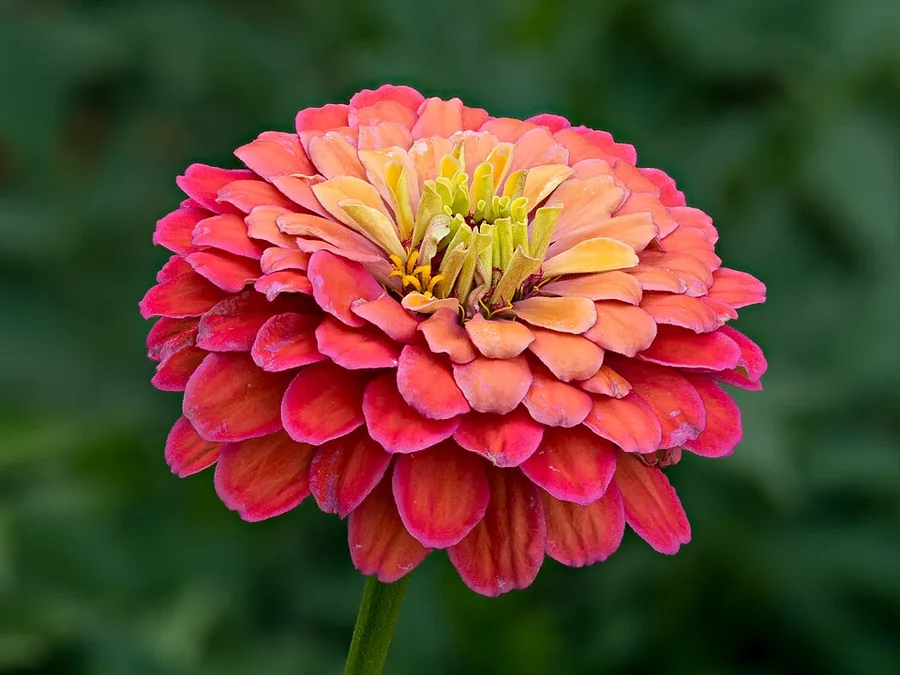
Flat, open flowers in layered color sit atop the zinnia's upright stems.
Full sun
Every 5–7 days
68–86°F · 20–30°C
60–70 days
Overview
Up close, the zinnia shows the flat, open flower of the daisy family it belongs to, a form carried from its wild Mexican origins. Petals ring a central eye, and in the fullest types they pack into dense, dahlia-like whorls. As a warm-season annual, the plant runs its whole form from a spring seedling to a frost-struck stem.
The plant's build shifts sharply with type. The smallest are low, leafy mounds near 6 inches high, while the tall cutting forms send up straight stems to about 4 feet, each topped by a single broad bloom. Bees and butterflies land on the open flower faces, and cut stems keep pushing fresh buds along the branches.
Color is where the zinnia holds the eye. The petals run from clean lime-green to muted, antique blends, layered thick in the double kinds. That same open face that shows the color also traps damp, and crowded, wet foliage is where mildew and leaf spots first mark the green.
Care
The short version: full sun, well-drained soil, and water at the base about an inch a week. Space the leafy plants so they dry, deadhead the fading blooms, and fresh color follows from summer to frost.
Light
The zinnia wants full sun, at least 6 hours of direct light a day and more if it comes. Strong light holds the stems short and thick and the blooms opening, and it dries the leaf surfaces fast, which keeps the powdery film of mildew from settling in.
Water
Pour water at the base in the morning and keep it off the leaves, since a wet leaf surface is where disease first takes. Give about an inch a week and let the top half of the soil dry between waterings, easing off once the roots take hold, as the zinnia stands heat and drought.
Soil
The zinnia roots into well-drained loam. It takes a pH from 5.5 to 7.5, but standing wet rots the roots, so open, draining ground matters more than rich soil.
Temperature
Warmth suits the zinnia's tissue, best between 68°F and 86°F (20°C to 30°C). Cold soil stalls the stems and frost collapses them, which is why sowing waits for real heat.
Humidity
The zinnia keeps to low humidity, near 40% to 60%. Heavy, wet air clings to the leaves and feeds mildew and leaf spot, so moving air over the foliage matters more than the moisture itself.
Feeding
Feed monthly through spring and summer with a balanced fertilizer. The zinnia draws little from the soil and flowers well in plain ground, so a light hand keeps the growth firm rather than soft.
Pruning
Snap off the spent blooms and cut flowering stems often, and the plant breaks fresh side branches tipped with new buds. Pinch the young stems early too, and the plant thickens into a bushier, many-branched shape.
Repotting
not_applicable
Size & spacing
The plants stand 1 to 4 feet (30 to 120 cm) tall depending on type, from low mound to tall stalk. Set them 6 to 12 inches (15 to 30 cm) apart so air slides between the leaves and dries them.
When to plant
The zinnia's stems hold no cold; warm soil sets them growing and frost blackens them. Start seed indoors 4 to 6 weeks before the last frost or sow it into warm ground, and the flower faces open from midsummer to the first frost.
Northern hemisphere
Southern hemisphere
Typical months for a temperate climate: start earlier in warm zones, later where spring frosts linger.
- Sow: 4 to 6 weeks before the last frost
- Plant: After the last frost once soil warms to about 70°F (21°C)
- Harvest: Summer to first frost
Troubleshooting
Almost every zinnia problem writes itself on the green of the leaves, and nearly all of it begins where the foliage stays wet. The first flecks and films read clearly if you look early, before they spread across the plant. Match the mark you see below, then act on it.
Reddish-brown spots with gray-white centers marking the leaves
Those spots are Alternaria leaf spot, the harshest disease the zinnia meets, spreading until a lesion rings a stem and the plant wilts. The fungus splashes in on water and clings to old debris in warm, wet weather. Pull and burn the marked plants, water at the base, keep zinnias off the same ground for two years, and soak the seed in hot water before sowing.
Fix:
- Remove and destroy infected plants and debris
- Water at the base of plants and avoid overhead irrigation
- Rotate planting sites and avoid replanting zinnias in the same spot for 2 years
- Treat seed with hot water (125°F for 30 minutes) before sowing
A grayish-white powder dusting the tops of the leaves
That gray-white film is powdery mildew, a fungus that coats the leaf surface where crowded plants sit in still, humid air. It wipes off the green at first, then leaves the foliage yellowed and ragged through late summer. Open the spacing so air dries the leaves, water at the base, and reach for resistant series like Profusion or Zahara next time.
Fix:
- Improve spacing and air circulation
- Water at the base in the morning and avoid wetting foliage
- Remove and discard heavily infected leaves and end-of-season debris
- Choose resistant types such as the Profusion or Zahara series
Angular purple spots hemmed by the leaf veins
The straight-sided purple marks are bacterial leaf spot, squared off because the veins pen the bacteria within each patch of green. It travels on splashing water and holds on dirty seed and old debris, flaring after rain or overhead watering. Keep the leaf surfaces dry, strip the spotted leaves, space plants to dry fast, and start with clean seed and resistant types.
Fix:
- Avoid overhead watering and handling wet plants
- Remove infected leaves and plant debris
- Improve spacing so foliage dries quickly
- Start with disease-free seed and resistant cultivars
Toxicity
Nothing on the zinnia, from petal to stem to leaf, carries a toxin. The ASPCA lists it as safe for cats, dogs, and horses, and the petals are edible for people. A pet that chews a leaf may feel briefly off, but the plant does no real harm.
Safe for
People · Cats · Dogs · Horses · Rabbits · Livestock · Birds
Cats None
Safe for a cat to be near. One that bites into a leaf might feel briefly queasy, no worse.
Dogs None
No real hazard to a dog. One that chews the green may loosen a little in the gut, and it passes on its own.
Horses Safe
Listed as non-toxic, so a horse cropping the leaves near zinnias comes to no harm.
Rabbits Safe
A rabbit can nibble the leaves and petals safely, though a heap of any new green can loosen the stool.
Livestock Safe
Cattle, goats, and sheep take no poison from the plant, and its leaves and stems are no grazing hazard.
Birds Safe
Birds are safe around the plant, and they pick the ripe, dried seed heads apart come fall.
People Safe
The petals are edible and scatter across salads and cakes as a garnish. Nothing on the plant is toxic to people.
No special handling required; ingestion of plant material may still cause mild stomach upset in some pets.
Varieties
The zinnia's form swings from 6-inch leafy dwarfs to tall stems cut for the vase. These are the ones worth knowing by name.
Benary's Giant
A tall cutting type at 36 to 42 inches, its big, fully double, dahlia-like heads packed with layered petals that hold in a vase.
State Fair
A vigorous tetraploid at 3 to 4 feet, carrying very large, broad-faced flowers.
Profusion
An interspecific Zinnia x hybrida series whose foliage shrugs off both leaf spot and powdery mildew.
Zahara
A Zinnia marylandica series bred to keep clean leaves against leaf spot and mildew.
Thumbelina
A dwarf, compact plant about 6 inches tall, a low cushion of leaves and small blooms.
Queen Lime
A 30 to 40 inch series set apart by its unusual lime-green petals and muted antique color blends.
How to propagate
The zinnia grows readily from seed, by far the plainest way to raise it.
SeedEasy
Spring
The zinnia lifts from seed fast and without fuss. Sow it into warm ground after the last frost, once the soil reaches about 70°F (21°C), or start it indoors 4 to 6 weeks earlier. Press each seed about a quarter inch into the soil, hold it at 65°F to 70°F (18°C to 21°C), and green sprouts break the surface in roughly 5 to 7 days. Thin or space the seedlings so air moves between them, then pinch the young stems to force branching and a fuller crown of bloom.
Myths
Overhead watering keeps zinnias cool and healthy.
Water from above beads across the leaf surface, and that wet green is exactly what powdery mildew, Alternaria, and bacterial leaf spot spread on. Lay the water at the base instead, and let the leaves dry.
Every zinnia mildews the same, so the variety chosen makes no difference.
The variety shows on the leaves by late season. Resistant series such as Profusion and Zahara keep their green against leaf spot and mildew far better than the older large-flowered types, which end the summer tattered.