Houseplant · Asphodelaceae
Zebra Haworthia
Haworthiopsis attenuata
Its dark leaves ripple with raised white bands, and all it asks is bright indirect light and a long dry spell between waterings.
Bright indirect
Every 14–21 days
50–77°F · 10–25°C
USDA 9–11
Overview
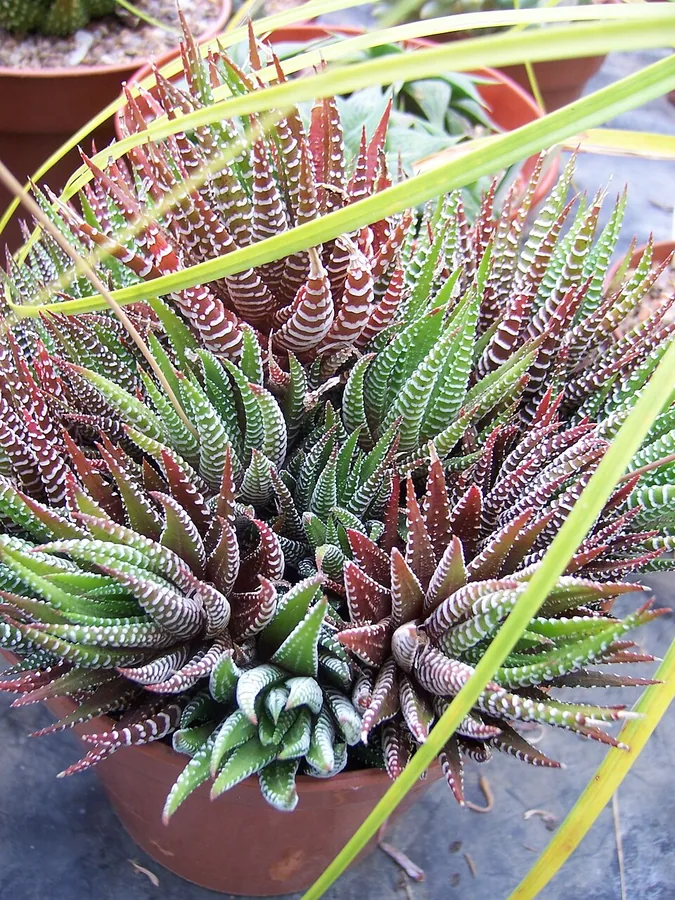
Up close, the zebra haworthia shows its name plainly: dark green leaves ridged with raised white bands that run in rows like an animal's stripes. Each leaf is stiff, thick, and tapers to a firm point, and the leaves pack tightly into a low rosette. The whole plant holds this compact shape for life and rarely stretches past 4 to 6 inches (10 to 15 cm) across.
The plant sits in the Asphodelaceae and comes from South Africa, where it grows in the light shade of taller plants rather than open desert. That origin is why bright indirect light keeps the foliage firm and dark rather than scorched. When a mature plant flowers, it pushes up a thin stalk topped with small tubular white blooms in spring or summer, a slight, pale contrast to the heavy striped leaves below.
Run a finger across a leaf and the reason for the striping becomes clear: those pale bands are raised tubercles studding the firm surface. The thick leaves are swollen with stored water, which is why the plant stays plump through a missed watering and prefers to dry out hard between drinks. The one thing that undoes that firm flesh is standing wet soil, which softens the leaves to rot.
Care
The short version: keep the striped leaves in bright indirect light, plant in a gritty fast-draining mix, and soak the roots only once the soil has dried out completely. Water even less in winter, and the firm rosette holds itself together.
Light
Set the striped rosette in bright indirect light, near a window but clear of the full midday beam. It holds up in partial sun and medium indirect light, but harsh direct rays scorch the leaf surface and bleach the dark green and white to a washed-out pale.
Water
Soak the mix through, then let it dry out completely before the next drink, a gap that usually runs every 14 to 21 days. The thick leaves are already swollen with their own water, so a dry spell suits them far better than a wet one. Cut right back in winter, when lingering moisture softens the firm flesh into rot.
Soil
Root it in a gritty cactus or succulent mix that drains fast and never holds water around the base. A pH of 6.0 to 7.5 is fine, so the coarse, open feel of the mix counts for far more than its chemistry.
Temperature
Ordinary room warmth keeps the leaves firm, ideally between 50°F and 77°F (10°C to 25°C). Keep it clear of frost and cold drafts, which the fleshy leaves cannot survive.
Humidity
This is a low-humidity plant whose thick leaves need no moisture in the air. There is nothing to mist and no number to hit, and damp, stagnant air only softens and spoils the firm foliage.
Feeding
It draws little from feeding. Across spring and summer, a dilute, half-strength low-nitrogen cactus or succulent fertilizer, given now and then, is plenty. Withhold it through autumn and winter while the rosette sits still.
Pruning
Pruning stays minimal. Peel away the shriveled outer leaves once they dry and brown, and clip the thin spent flower stalk at the base. Beyond that, the firm rosette needs no cutting.
Repotting
Repot only every 2 to 3 years, or sooner once new rosettes crowd the surface. The signs are pups pressing at the rim, pale roots pushing from the drainage holes, and a mix that dries out almost the moment it is watered.
Size & spacing
The plant stays small, its rosette reaching about 4 to 6 inches (10 to 15 cm) tall and roughly as wide. A single rosette fills a small pot, and a cluster of pups packs neatly into one shallow dish.
Troubleshooting
Nearly every problem writes itself onto the leaves and the rosette, in a change of color, firmness, or shape. Watch the plant closely, match what the foliage is showing to the notes below, and act before the damage deepens.
Lower leaves turning soft, mushy, and see-through
When the firm lower leaves go soft, translucent, and brown, the plant has root and crown rot, set off by water lingering in a mix that drains too slowly. Stop watering, slide the plant free, and cut every soft, brown root back to firm tissue with a clean blade. Let the cut surfaces dry and callus, settle it into dry gritty mix, and give only a light drink once it has taken hold again.
Fix:
- Stop watering immediately
- Remove the plant and cut away all soft, rotted tissue with a clean blade
- Allow cut surfaces to callus, then replant in fresh dry gritty mix
- Resume watering sparingly only once re-established
Pale, stretched growth with gaps opening between the leaves
When the leaves pale and stretch, with visible gaps opening along the rosette, the plant is showing etiolation, a reach for light it is not getting. The once-tight rosette loosens and tilts toward the window. Move it into steady bright indirect light and turn the pot now and then so it packs back into shape evenly.
Fix:
- Move to a brighter location with bright indirect light
- Rotate the pot periodically for even growth
Leaves flushing red, orange, or bleaching to white
A red, orange, or bleached-white cast across the leaves is sunburn, showing on whichever face meets the strongest light, usually just after a move somewhere brighter. Slide the plant back into bright indirect light and screen it from harsh midday sun. To brighten its spot later, raise the light little by little over a week or two so the leaf surface can harden to it.
Fix:
- Move to bright indirect light
- Shade from intense midday sun
- Acclimate gradually to brighter spots over one to two weeks
Toxicity
Behind its firm, striped leaves the zebra haworthia hides nothing harmful, and it is non-toxic and pet-safe around cats, dogs, and the whole household. It does not appear on the ASPCA toxic list, and the leaves hold no compound that would poison a curious animal. At most, the sheer bulk of that firm flesh might leave a determined chewer with a brief, mild stomach upset.
Safe for
People · Cats · Dogs · Horses · Rabbits · Livestock · Birds
Cats None
Cats take no toxic harm from the striped leaves. One that gnaws through a leaf or two may get a brief upset stomach, the same as with any plant it should leave alone.
Dogs None
Dogs face no poisoning from it. A dog that bites into the firm rosette may drool or vomit a little from the dense bulk, but nothing in the tissue does harm.
Horses Safe
The leaves hold nothing toxic to horses, and as a small windowsill rosette the plant seldom comes near one.
Rabbits Safe
Rabbits are safe with it. The thick, tough leaves carry no toxins, and their firmness makes them a poor mouthful anyway.
Livestock Safe
Grazing animals such as cattle, goats, and sheep are unharmed, since the fleshy leaves contain no troubling compounds.
Birds Safe
Pet birds are safe beside it, the tissue holding nothing toxic, and the dense leaves are far too firm for most to peck at.
People Safe
The plant is harmless to people, children included. It is not grown to be eaten, but a curious bite into the firm flesh brings nothing worse than a possible mild stomachache.
Varieties
Only a few forms appear in cultivation, and they are told apart by exactly where the white tubercles sit on the leaf. They are easily muddled, not least with the unrelated plant that shares the name. These are the ones you are likely to see.
Haworthiopsis attenuata var. attenuata
This is the standard form, its raised white tubercles running in clear bands across both the upper and lower faces of each leaf.
Haworthiopsis attenuata 'Concolor'
On this one the white tubercles scatter evenly across the leaf surface instead of lining up into the crisp stripes most people picture.
Haworthiopsis fasciata (true zebra haworthia)
True fasciata keeps its inner leaf faces smooth, with tubercles set only on the outer surface, yet nearly every plant sold under that name turns out to be H. attenuata.
How to propagate
Once a plant fills out, it clusters small new rosettes around its own base, and these are the key to making more. You can lift those pups, or split a crowded clump apart at the roots when you repot.
Offsets & pupsEasy
Spring to summer during active growth · 4 to 8 weeks to root once potted
The readiest route is the offsets, the small firm pups clustered around the base of the parent rosette. Lift them in spring or summer while the plant is growing, let each cut surface dry and callus, then press each pup into dry gritty mix. A light drink once it anchors brings roots along in about 4 to 8 weeks.
DivisionEasy
At repotting in spring or summer · 4 to 8 weeks
A mature clump can also be pulled apart at repotting in spring or summer. Tease it into separate rooted rosettes, hold each one dry until it establishes, and it firms back into place over roughly 4 to 8 weeks.
Myths
The zebra haworthia and the zebra plant, Aphelandra, are one and the same.
They are unrelated plants that only share a nickname. This one is a small Asphodelaceae succulent whose striped, fleshy leaves coil into a firm rosette, while Aphelandra squarrosa is a leafy Acanthaceae plant known for its large veined leaves and yellow bracts.
Zebra haworthia is a cactus built for full desert sun.
It is a succulent in the Asphodelaceae, not a cactus at all, and in the wild it usually sits in partial shade. Indoors it keeps its firm dark leaves best in bright indirect light, since harsh direct sun scorches the surface.