Houseplant · Asphodelaceae
Gasteria
Gasteria
Under bright indirect light and a dry rest between waterings, this tough little succulent shows off its thick, speckled tongues.
Bright indirect
Every 10–21 days
50–77°F · 10–25°C
USDA 10–12
Overview
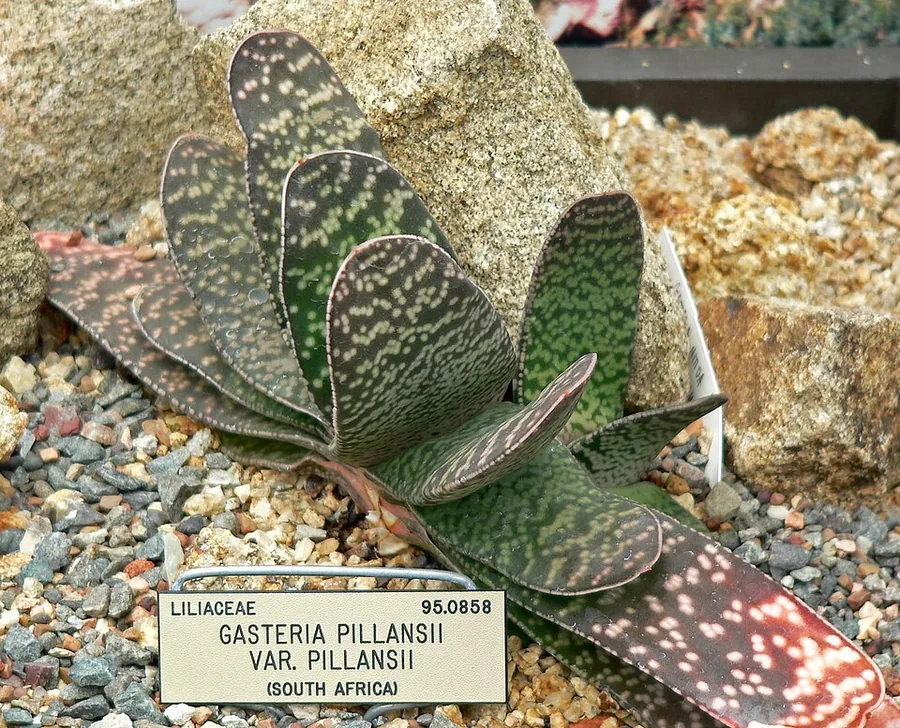
Gasteria is a small South African succulent, and its thick, tongue-shaped leaves are the reason for names like ox tongue and cow tongue. Each leaf is firm and fleshy, blunt at the tip, and the surface is often speckled or scattered with raised white bumps you can feel under a fingertip. The leaves rise stacked in two flat ranks or arranged in a low rosette, and the whole plant stays small, rarely reaching past a foot.
It belongs beside aloe and haworthia in the same family, and the kinship reads in the plump, juice-filled leaves and the arching flower spikes. In spring and summer a slender stem lifts above the foliage, hung with curved, pinkish tubular blooms that dangle like little swollen pipes. The plant grows slowly and lives for years, packing on a clump of offsets at its base until the pot brims with rosettes.
For all that detail, it asks very little. Gasteria holds its deep green color in lower and indirect light where other succulents fade, shrugs off a forgotten watering, and rarely strains its pot. The single thing it cannot stand is soggy soil, so keeping those firm, water-filled leaves plump comes down to letting the roots run dry between drinks.
Care
The short version: bright indirect light, a gritty fast-draining mix, and water only once the soil has dried out completely, kept nearly dry through winter.
Light
Gasteria keeps its richest color and tightest form in bright indirect light, though it also holds up in medium light or partial shade, unlike sun-hungry succulents. Keep it clear of harsh midday sun, since strong rays sear brown patches into leaves that had no time to adjust. In dim light the plump leaves stretch thin and pale and the rosette loses its neat, low profile.
Water
Let the soil dry out completely between waterings, then water deeply, usually every 10 to 21 days while it is growing, so the fleshy leaves stay firm and full. Through winter keep it nearly dry, giving only enough to stop the leaves puckering and shriveling. The plant rots easily, so water at the base and never let it sit in the cupped center of the rosette.
Soil
Plant it in a gritty cactus or succulent mix, coarse and open, that drains fast and leaves no standing water around the roots. That sharp, sandy drainage keeps the rot-prone roots sound, so blend in extra perlite or coarse grit if the mix feels dense and heavy.
Temperature
It stays comfortable between 50°F to 77°F (10°C to 25°C), the warmth of an ordinary room. It carries no frost tolerance, and cold blackens and mushes the firm leaves, so bring it in well before the first cold nights.
Humidity
Gasteria wants low humidity and dry leaf surfaces, and plain indoor air suits it. Skip the misting, which beads water across the bumpy leaves and in the rosette center and opens the door to fungal spotting.
Feeding
Feed lightly from spring into early autumn while it is growing, about once a month, to keep the leaves fat and deep green. Use a dilute, low-nitrogen liquid cactus feed, and stop through winter when growth pauses.
Pruning
There is little to trim. Peel away any dead, shriveled, or damaged leaves at the base, where they turn papery and brown, and cut back the spent flower stalk once the last tubular bloom has dropped.
Repotting
Repot every 2 to 3 years, or sooner once offsets have packed the pot rim to rim. Move it into fresh gritty mix when roots push out the drainage holes or the soil dries almost the moment you water it.
Size & spacing
This is a small, low plant, reaching only 4 to 12 inches (10 to 30 cm) tall with a spread of about 6 to 12 inches (15 to 30 cm) as the rosette widens. Its compact size fits a windowsill, a shelf, or a grouped succulent dish.
Troubleshooting
Nearly every mark on a gasteria traces back to water or light. Leaves gone soft and see-through mean too much water, while pale, stretched growth means too little light, and a few pests leave their own tells. Match what you see on the leaves below, then fix the cause behind it.
Soft, see-through, mushy leaves
When the firm leaves turn soft, translucent, and squishy to the touch, that is rot, and it almost always starts with too much water sitting in soil that drains poorly. Check the roots, and where they are soft and blackened, cut away every rotted part and repot into fresh gritty mix. Then hold off watering and let the soil dry out completely before the next drink.
Fix:
- Stop watering and allow the soil to dry out
- Remove rotted tissue and repot into fresh gritty, fast-draining mix
- Resume only sparing watering once the soil is fully dry
White cottony spots or fine webbing on the leaves
Tufts of white cottony fluff signal mealybugs, and fine silky webbing signals spider mites, and both wedge deep into the leaf bases where the rosette hides them. Lift them off with a cotton swab dipped in rubbing alcohol and set the plant apart from its neighbors. If they creep back, treat with insecticidal soap or horticultural oil.
Fix:
- Wipe pests off with isopropyl alcohol on a cotton swab
- Isolate the affected plant
- Treat with insecticidal soap or horticultural oil as needed
Brown or reddish scorched patches on the leaves
Dry brown or reddish patches burned across the leaf surface are sunburn, the mark of a plant grown in softer light and then set straight into hot, direct sun. Move it back to bright filtered light and the clean new leaves come in unmarked. To add sun later, step it up over a week or two so the leaves can toughen first.
Fix:
- Move the plant to bright filtered or indirect light
- Acclimate gradually before increasing sun exposure
Stretched, pale, leggy growth
In low light the tight rosette pulls open and the leaves stretch out thin, pale, and leaning toward the nearest window. This is etiolation, and the loose, floppy growth never firms back into its compact shape. Move the plant somewhere brighter, going gradually so the softened leaves do not scorch on the way.
Fix:
- Move gradually to brighter, indirect light
Toxicity
For anyone with pets, gasteria is non-toxic and safe around cats, dogs, and children. It is absent from the ASPCA toxic list, and there is nothing poisonous in the firm, fibrous flesh of the leaves. The most a determined nibbler risks is a mild, passing stomach upset from that tough tissue.
Safe for
People · Cats · Dogs · Horses · Rabbits · Livestock · Birds
Cats Safe
Gasteria holds no toxin, so a cat that bites a leaf will not be poisoned. The firm, fibrous flesh is hard to digest, though, and a cat that chews off a good mouthful may drool or bring it back up.
Dogs Safe
Dogs can gnaw the thick leaves with no risk of poisoning. The most a real mouthful of that fibrous tissue brings is a brief upset stomach.
Horses Safe
Nothing in gasteria harms horses. It is a small windowsill succulent rather than pasture grazing, so its firm little leaves rarely come within reach.
Rabbits Safe
The leaves are safe for rabbits and carry no toxins. Their thick, fibrous flesh is not part of a rabbit's normal diet, though, so it is best left as the odd taste rather than a regular green.
Livestock Safe
Goats, sheep, and cattle face no poisoning risk from gasteria. As a slow-growing potted succulent with tough leaves, it is hardly something they would ever reach.
Birds Safe
Gasteria poses no toxic threat to birds. A pecked leaf is harmless, and its tough, water-filled flesh holds little a bird would want.
People Safe
The plant is non-toxic and safe around children. Its firm leaves are not grown to eat, so there is no reason to bite one, but a stray nibble does no harm.
Commonly regarded as pet-safe; even so, ingestion of fibrous succulent leaves may cause mild, transient gastrointestinal upset or vomiting in cats and dogs.
Varieties
Gasteria spans a range of species and hybrids, and a handful stand out for the look and feel of their leaves. These are the ones worth knowing by name.
Gasteria gracilis
A small clumping species whose slender, tongue-shaped leaves taper to a point and earned it the common names cow tongue and ox tongue.
Gasteria carinata var. verrucosa
The warty keeled ox tongue, its leaves crusted with raised white tubercles that give the surface a rough, pebbled feel under a finger.
Gasteria glomerata
A compact species that builds tight clusters of short, stubby, grey-green leaves packed close together.
Gasteria 'Little Warty'
A popular hybrid prized for leaves that are bumpy and marbled with pale mottling and a pronounced warty texture.
How to propagate
Gasteria is one of the simplest succulents to multiply, and the plant hands you the material itself, ringing its base with small offset rosettes ready to lift and pot on.
Offsets & pupsEasy
Spring to summer during active growth · 4-8 weeks to root
The easiest way to multiply gasteria is to lift the small offset rosettes, or pups, ringing the base of the clump and pot each one on its own. Do it in spring or summer during active growth, and the little divisions push out roots in about 4 to 8 weeks.
DivisionEasy
When repotting in spring · 2-4 weeks
When a clump fills its pot with crowded rosettes, split it into rooted sections at repotting time in spring. Each piece already carries its own roots, so it settles in fast and is usually growing again within 2 to 4 weeks.
Leaf cuttingsModerate
Spring to summer · Several weeks to a few months
You can also root a single whole leaf taken in spring or summer. Let the cut end dry to a callus for a few days, lay it on gritty mix, and wait, since it can take from several weeks to a few months and is slower and less reliable than working with offsets.
SeedDemanding
Spring in warm conditions · Many months to years to reach size
Seed is the slow road, sown in spring in warm conditions. Germination drags and the tiny seedlings take many months to years to swell to any real size, so it mostly serves to raise new variation rather than to bulk up plants quickly.
Myths
Gasteria is the same plant as the snake plant called mother-in-law's tongue.
The two share only a folk name. Gasteria is a distinct Asphodelaceae succulent with thick, bumpy tongues, while mother-in-law's tongue is a tall, flat-leaved Sansevieria, now folded into Dracaena, so the plants and their care are unrelated.
Like its relative aloe, gasteria is toxic to pets.
Aloe sits on the ASPCA toxic list, but gasteria does not. Its toxicity has never been established, and it is widely kept as a pet-safe succulent.
Misting keeps gasteria healthy.
This plant comes from dry country and wants low humidity with dry leaves. Misting only lets water pool on the bumpy surface and in the rosette, exactly where fungal spotting and rot get started.