Shrub · Bignoniaceae
Trumpet Vine
Campsis radicans
The trumpet vine hangs clusters of orange-red trumpets along woody, clinging stems all summer.
Full sun
Every 7–14 days
730–1095 days
USDA 4–9
Overview
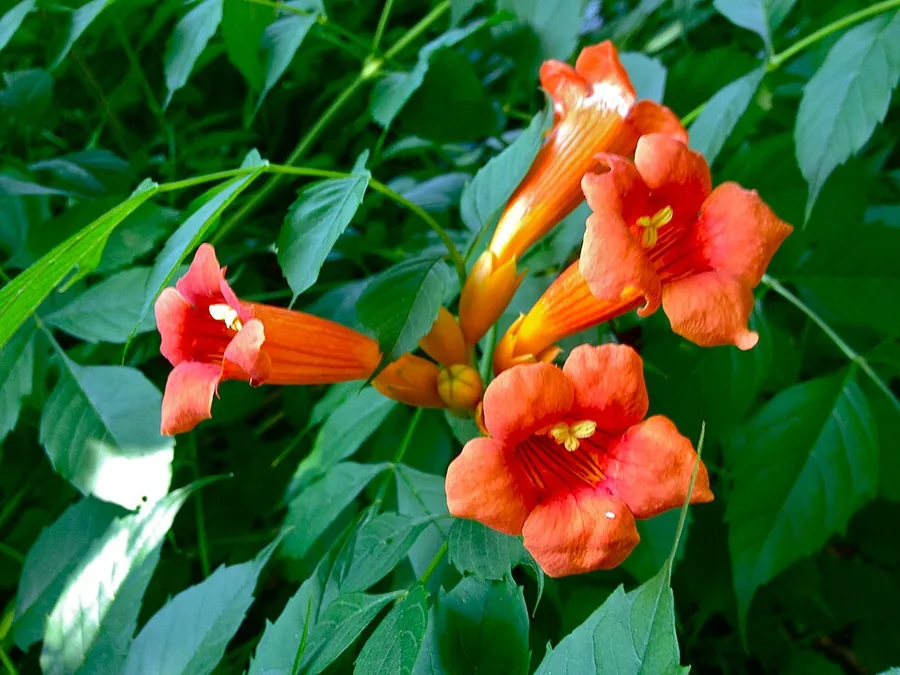
Up close, the trumpet vine is defined by its flowers: narrow orange-red trumpets that flare at the mouth and hang in clusters along the stems from midsummer into fall, the blooms hummingbirds probe for nectar. This is a fast, woody climber from the eastern United States, and its stems thicken into hard wood as they age. On its own it can stretch 25 to 40 feet (7.5 to 12 m), green foliage clothing the length of every climbing stem.
Run a hand along a stem and you meet the reason it climbs: rows of short aerial rootlets, the holdfasts that press into bark, mortar, wood, and the finest cracks and refuse to let go. Those same woody stems pile on real weight over the years. Where the plant is left to itself, it thickens into dense stands, new shoots pushing up from the ground well away from the first.
After the flowers fade, they give way to long, bean-like seed capsules that dry, split, and spill their seed. Handle any part of the plant and the sap can leave skin red and itching, the trait behind the name cow itch vine. The whole plant reads as hard and hard-driving up close, from the woody stems to the gripping rootlets to those bright, flaring trumpets.
Care
The short version: full sun, lean soil, and a very sturdy support. Water young plants until the roots take, then leave them mostly alone, skip the fertilizer, and prune hard in late winter to keep the woody stems in check.
Light
In full sun, six or more hours a day, the plant covers itself in trumpets. In partial sun or light shade it keeps growing, but the color thins out and the stems carry far more green leaf than flower.
Water
Young plants take regular water while the roots spread and grip. Once established the vine turns drought tolerant, drawing what it needs from rain across dry to moist soils, so a settled plant shows no thirst even in a dry stretch.
Soil
The roots take hold in clay, sand, loam, or thin poor ground, across a pH from 5.5 to 8.0. Lean soil keeps the plant flowering, since rich ground swells the leafy growth and hides the trumpets, and the roots ride out spells from dry to occasionally wet.
Temperature
The woody stems come through a wide swing of weather, from -29°F to 100°F (-34°C to 38°C), which sets it in zones 4 through 9. Deep winter cold and high summer heat both leave the plant standing.
Humidity
The air around it makes no visible difference. Plain outdoor humidity is enough, and the plant looks the same across a broad stretch of climates.
Feeding
Fed on rich ground, the plant answers with more leaf than flower, the trumpets lost behind a wall of green. Kept lean and unfed it flowers harder, and the thin soil also slows the reach of those woody stems.
Pruning
The woody stems are cut back hard in late winter or early spring, down to a framework. Because the trumpets open on new growth, that hard cut costs no flowers, and thinning the old wood and pulling the ground suckers each year keeps the stems off nearby surfaces.
Repotting
This is a ground plant with far-reaching roots, not a potted one, so repotting seldom applies. In a container, the tells are roots packed against the walls and suckers pushing out the drainage holes.
Size & spacing
The stems climb 25 to 40 feet (7.5 to 12 m) and the plant fans 5 to 10 feet (1.5 to 3 m) across, a broad, heavy mass of wood and leaf. It wants a strong frame and open ground, set clear of anything the stems could wrap and cover.
When to plant
The trumpet vine moves through the year at its own pace. Plants go into the ground in spring after frost, or in fall in mild zones, and the woody stems are cut back hard in late winter before new shoots break. Then the orange trumpets open in clusters through summer, from June into September, on the fresh green wood.
Northern hemisphere
Southern hemisphere
Typical months for a temperate climate: start earlier in warm zones, later where spring frosts linger.
- Sow: Late winter to early spring; seed needs cold stratification, though the plant is usually propagated from root cuttings or suckers rather than seed.
- Plant: Spring after frost, or fall in mild zones
- Harvest: Summer (June to September)
Hardiness
USDA hardiness zones: 4–9
Temperature: down to -34°C
Troubleshooting
Most of what goes wrong with a trumpet vine shows on the plant itself rather than in pests or disease. Shoots surface far from the base, the woody stems and their rootlets bear down on whatever holds them, and sometimes the plant runs to green leaf with no trumpets at all. The close-up signs below point to each one.
Rootlets and stem weight scarring the surface beneath
The damage comes from the plant's own grip: clinging aerial rootlets that work into mortar, wood, and hairline cracks, plus the dead weight of thick woody stems that can bend a fence or snap a light trellis. Peel the vine away and the surface lifts with it. Set it on a heavy freestanding support such as a metal arbor or masonry, off the house, and cut the stems back hard each year to hold down the weight.
Fix:
- Grow only on a very sturdy freestanding support such as a heavy metal arbor or masonry, not on house walls or wooden structures
- Keep the vine off buildings, gutters, and weak fences by pruning back hard
- Avoid clinging vines on wood, which can be damaged or rot from trapped moisture
New shoots pushing up far from the woody base
This is aggressive suckering, written into how the plant grows. Runners travel underground and the dried bean-like pods scatter their seed, so fresh green shoots and seedlings break the surface well away from the main stems and can bury whatever grows nearby. Dig or pull each sucker as it shows, mow the ones that reach turf, and cut the pods off before they dry and split.
Fix:
- Dig or pull root suckers as soon as they appear, removing as much root as possible
- Mow suckers repeatedly where the plant adjoins lawn to exhaust them
- Remove spent flowers and seed capsules before they split to limit self-seeding
- Site it near concrete or mowable areas to make suckers easier to control
A wall of green leaf with no trumpets
A trumpet vine thick with leaf but bare of flowers is usually young, shaded, or overfed. A young plant can spend several years all in green before the first trumpets show, and shade or rich, nitrogen-heavy soil pushes leaf ahead of bloom. Move it into full sun, hold back the fertilizer, and give it time, since the flowering fills in as the plant ages.
Fix:
- Site or relocate in full sun (6 or more hours)
- Be patient; allow the plant to mature, as blooming improves with age
- Avoid nitrogen-rich fertilizer and grow in leaner soil
- Root-prune or restrict the roots slightly to encourage flowering
Toxicity
The trumpet vine looks tougher than it is toxic. The clearest mark shows on skin: contact with the leaves, flowers, or sap can leave a person red and itching, the reaction behind the name cow itch vine. A pet that chews the foliage meets only mild irritation, so bare hands are the thing to guard against, and gloves keep the sap off.
Toxic to
Cats · Dogs · Horses · Rabbits · Livestock · People
Safe for
Birds
Cats Mild
A cat that bites into a leaf or flower may drool or turn briefly queasy, and the sap can leave its mouth or skin reddened. Nothing like real poisoning takes hold.
Dogs Mild
A dog chewing the foliage tends to show only some drool and a short-lived upset stomach, with a patch of mouth or skin irritation where the sap touched.
Horses Mild
A horse mouthing the vine may pick up light irritation on the lips or skin and a slight gut upset, but the plant poses it no real danger.
Rabbits Caution
How a rabbit reacts is barely recorded, so it is safer to keep them off the plant than to let them nibble the leaves.
Livestock Caution
Grazing stock mostly leave the foliage alone, and a stray mouthful brings only mild irritation, but the plant is better fenced away than grazed.
People Caution
Bare skin against the leaves, flowers, or sap can flush red and itch, sometimes blistering, with the eyes stinging too, exactly the reaction behind the name cow itch vine, so gloves and long sleeves go on before pruning.
Birds Safe
Birds take no harm from it and come for the nectar in the trumpets rather than the leaves, hummingbirds most of all, hovering at the open flowers.
Not internally poisonous to pets, but the leaves, flowers, and sap can cause contact dermatitis with skin redness, itching, and eye irritation in sensitive people who handle the plant (hence the folk name cow itch vine). Wear gloves and long sleeves when pruning or handling.
Helpline numbers

United States
ASPCA Animal Poison Control: (888) 426-4435 (fee applies)
Poison Control: (800) 222-1222



Canada
Poison Centres: 1-844-764-7669
Varieties
The color of those trumpets is not fixed. A few named forms and one close Asian relative shift the flowers along the orange-to-red range and change how hard the plant grips. The ones below stand out.
'Flava' (Yellow Trumpet, f. flava)
On this form the trumpets drop the orange-red and open in clear yellow to orange-yellow instead.
'Madame Galen' (Campsis × tagliabuana)
A cross of C. radicans and C. grandiflora, its trumpets run cantaloupe-orange to salmon-red, and it still throws suckers and seed, if a little less freely than the straight species.
Campsis grandiflora (Chinese trumpet creeper)
The Asian species opens large orange-and-yellow flowers on a plant that grips with fewer aerial rootlets and climbs far more gently, leaning on added support to stand.
How to propagate
Nearly any piece of this plant will grow again, whether a cut stem, a rooted sucker, a seed from the pods, or a stem lying on the soil. For most growers the work is cutting it back, not raising more.
Stem cuttingsEasy
Summer (softwood) cuttings · 4 to 8 weeks to root
A softwood cutting taken in summer roots fast, striking in about 4 to 8 weeks, one of the easiest woody stems to turn into a new plant.
DivisionEasy
Dormant season or early spring · One season
The plant sends up its own rooted suckers, so lifting one in the dormant season or early spring and replanting it is the simplest route, and it settles in within a single season.
SeedModerate
Spring after cold stratification · Several years to first bloom
Seed shaken from the dried bean-like pods sprouts readily after a cold spell, sown in spring once stratified, though the seedlings can stay green and flowerless for several years before the first trumpets.
LayeringEasy
Spring to summer · One season
A stem left lying on the soil from spring through summer sets its own rootlets and nodes into the ground, and the layered length is ready to cut free within a season.
Myths
Trumpet vine is poisonous and badly harms a dog or cat that chews the leaves.
The plant is far less toxic than it looks. Campsis radicans is off the ASPCA toxic-plant lists, and eating it barely registers, so a chewing pet shows little beyond some drool or a mild stomach upset. The real mark is contact dermatitis, the redness and itch that rises on skin and eyes from handling the foliage or sap, not any poisoning within.
It is a tidy, well-behaved climber for the side of a house.
Its own growth says otherwise. Runners and self-seeding thicken it into dense stands, and the gripping rootlets and heavy woody stems can score siding, mortar, wood, gutters, and any weak support. Give it a strong support of its own and cut it back hard each year, and keep those stems off the house.