Shrub · Bignoniaceae
Crossvine
Bignonia capreolata
A woody native climber hung with trumpet-shaped spring flowers that hummingbirds dip into.
Full sun
Every 7–14 days
USDA 5–9
30–50 ft · 9.1–15.2 m
Overview
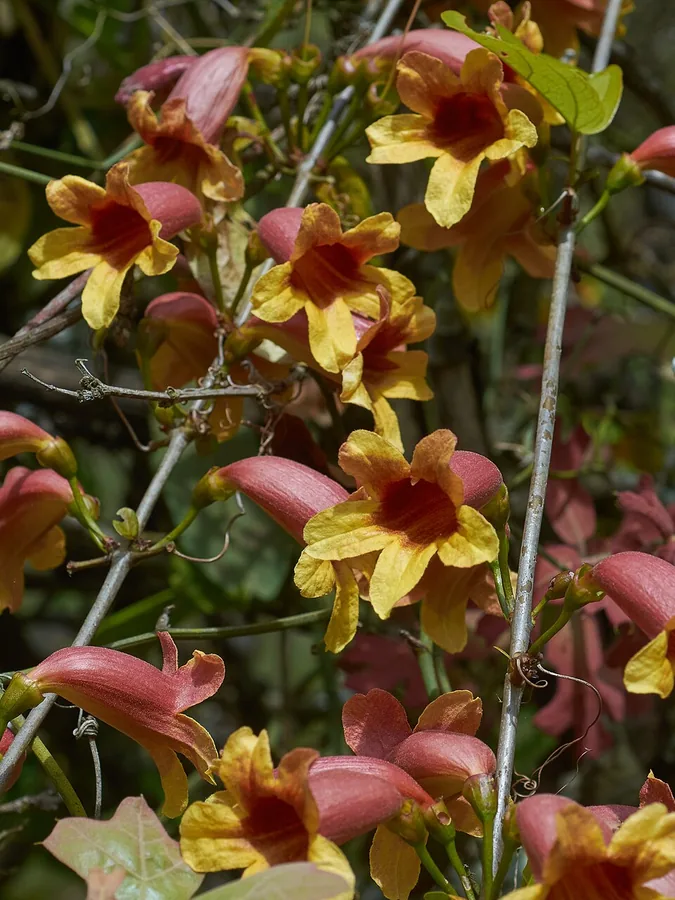
Crossvine is a woody, fast-growing climber from the southeastern United States, and its name lives inside the plant itself: slice across an older stem and a pale cross-shaped pattern sits in the cut face. The vine hauls itself up fences, walls, and arbors on slender tendrils tipped with small adhesive disks that press flat against a surface and hold. In early spring the stems load up with trumpet-shaped flowers, narrow at the base and flaring open at the mouth, and hummingbirds push their bills inside.
It is an easy, unfussy plant beneath the show. The vine grows in full sun or deep shade, roots into poor ground, carries on through drought once established, and stays woody and alive across zone 5 to zone 9. What stands out is sheer reach. Stems run 30 to 50 feet when left alone, and fresh shoots, the suckers, push straight up out of the soil away from the base, so the plant wants a strong frame and a yearly cut.
Set beside the trumpet creeper it is often sold with, crossvine looks the tamer of the two. Its flowers open earlier in the year, its growth holds together more tightly, and its foliage and sap leave bare skin alone where the cousin's can leave it itching.
Care
The short version: full sun fills the vine with the most flowers, a sturdy frame carries its climbing stems, deep watering matters only while the roots take hold, and a hard cut right after the spring bloom keeps the woody growth in check.
Light
Crossvine grows in anything from full sun to full shade, which keeps it easy to place. Sun packs the stems with denser leaves and far more of the spring trumpets. In deep shade the growth runs long and thin between leaves and the flowers grow scarce.
Water
While the roots take hold, the soil should stay evenly moist around the young plant. Once established the vine is genuinely drought tolerant, so a deep soak is worth giving only through a long dry stretch. Rainfall keeps it going the rest of the year.
Soil
The roots are not particular. Average, well-drained loam or sandy ground suits the vine, and it spreads through a wide range, holding at a pH of 6.0 to 8.0. Rich, organic soil grows the fullest plant, but the roots take almost anywhere.
Temperature
The woody stems are cold-hardy, riding out roughly -20°F to 100°F (-29°C to 38°C) across zones 5 through 9. Hard winter cold does not split them, and summer heat does not scorch the leaves.
Humidity
Average outdoor humidity is all the foliage asks, so there is no figure to track. Air movement counts for more, since crowded leaves in still, damp air pick up the occasional spotting.
Feeding
The vine takes little feeding. A light dose of balanced fertilizer or compost in spring keeps this vigorous native full, while heavy nitrogen pushes leafy growth and leaves the flowers behind.
Pruning
A hard cut lands best right after the flowers fade, since cutting before the bloom takes off the buds set on the stems. Suckers rise straight from the soil over the season, and lifting them as they appear keeps the vine from creeping outward.
Repotting
Crossvine is a climber built for the open ground and seldom holds long in a pot. Where one does sit in a container, it needs a larger pot only once it has plainly outgrown the old one, marked by roots circling or pushing out, soil that dries fast, and top growth that stalls.
Size & spacing
The vine needs real room for its stems. They climb 30 to 50 feet (9 to 15 m) tall and spread 6 to 9 feet (180 to 275 cm) wide, so it belongs where a large, fast climber fits, held up by a strong arbor or fence.
When to plant
Crossvine holds up from zone 5 to 9, and it goes into the soil in spring or fall, while the air is mild and the roots can take hold before the heat or cold sets in. The trumpet flowers open from late winter into early spring, slipping toward May or June where the colder zones warm later.
Northern hemisphere
Southern hemisphere
Typical months for a temperate climate: start earlier in warm zones, later where spring frosts linger.
- Plant: spring or fall
- Harvest: late winter to early spring (May to June in colder zones)
Hardiness
USDA hardiness zones: 5–9
Temperature: down to -29°C
Troubleshooting
Crossvine meets almost no pests or disease, so its leaves and stems mostly stay clean. The trouble it shows comes from its own vigorous reach, a shaded spot, or a cut made at the wrong time. Match the look of the plant below and act early.
The vine outgrows its support and swallows nearby plants
Crossvine climbs fast, and the small adhesive disks on its tendrils press onto any surface they touch and pull the stems over it. Shade drives it harder, stretching the growth long and thin as it reaches for light. A hard cut right after the trumpets fade, with the vine held to a sturdy arbor or fence sized for a 30 to 50 foot climber, keeps the stems in check.
Fix:
- Prune hard after flowering to reduce size
- Provide a sturdy, large support such as an arbor or fence
- Site in full sun for denser, more floriferous growth
New shoots popping up in the lawn away from the main plant
Those upright shoots breaking the soil are root suckers, the vine running underground and surfacing some distance off. Pulling or digging them as they show, and mowing any that rise in the grass, takes them out. A sunken root barrier, or a contained bed, pens the roots where they should stay.
Fix:
- Pull or dig up root suckers as soon as they are spotted
- Mow or cut suckers in lawn areas
- Install a root barrier if confining the plant
A leafy, healthy vine that barely flowers
Full green leaves with few trumpets usually trace to too much shade. A cut at the wrong moment adds to it, since trimming before the spring bloom shears off the buds along the stems. More sun on the foliage, less nitrogen, and a cut only once the flowers finish bring the trumpets back.
Fix:
- Move or train the vine into more sun
- Prune only after the spring bloom, not before
- Avoid excess nitrogen fertilizer
Dark spots scattered across the leaves
Discrete dark marks on the foliage are most often fungal leaf spot, a surface blemish on a plant that otherwise stays clear of pests and disease. Thinning the leaves for moving air, stripping the worst-marked ones, and watering at the base rather than over the foliage clears it. Crossvine has no serious insect or disease problems, so the spotting rarely spreads.
Fix:
- Improve air circulation by thinning growth
- Remove and dispose of badly affected leaves
- Avoid overhead watering
Toxicity
For households with pets or children, the picture is clear: crossvine is not toxic. It is not on the ASPCA's list of poisonous plants and is treated as safe for cats, dogs, and people. It is not trumpet creeper, the related vine whose sap can irritate skin.
Safe for
People · Cats · Dogs · Horses · Rabbits · Livestock · Birds
Cats Safe
Crossvine is not on the ASPCA toxic list, so a cat mouthing a leaf comes to no harm. A large mouthful of any plant may bring a little drooling or a soft stool, but nothing past that.
Dogs Safe
Dogs can chew the leaves without harm. The most that follows is mild stomach upset if one swallows a large amount, and it clears on its own.
Horses Safe
No toxin in the vine reaches horses. They graze around it safely, though no animal should feed on a single plant alone.
Rabbits Safe
Rabbits can crop the leaves without risk. New greens go in slowly, since a sudden pile of fresh foliage can loosen a rabbit's gut.
Livestock Safe
Cattle, goats, and sheep take no harm from this vine. It holds none of the compounds that make some pasture plants a worry.
Birds Safe
Crossvine is no threat to birds. Its spring trumpets draw hummingbirds, which dip into the flowers for nectar without harm.
People Safe
This is the well-behaved crossvine, not its prickly cousin the trumpet creeper, so its foliage and sap leave handling skin alone. It is safe around children and pets alike.
No special handling required; as with any plant, large quantities of ingested foliage may cause mild, non-specific GI upset.
Varieties
A few named selections stand apart in the color of their trumpets and the shape of their growth, and these turn up most often at a nursery.
Tangerine Beauty
Tangerine Beauty is the most planted selection by far, the stems sheeted in warm tangerine to apricot-orange trumpets that come more freely than on the species.
Atrosanguinea
Atrosanguinea is a shorter, more compact grower, its flowers a darker purplish-red above narrow, lance-shaped leaflets.
Dragon Lady
Dragon Lady stands out for the deep red-orange of its flowers.
How to propagate
Crossvine increases without much help, and often on its own, dropping seed that sprouts and rooting from low stems that lie against the soil.
SeedModerate
Fall or spring after pods mature · 1 to 2 growing seasons
The seed sits in long, bean-like pods, and once they ripen it sows in fall or spring. Crossvine self-sows readily, dropping its own seed so volunteers come up unbidden. A sown plant spends a season or two settling its roots before the stems run.
Stem cuttingsModerate
Summer · Several weeks to root
Softwood cuttings taken in summer strike roots over several weeks. Root cuttings take as well and are a documented method for this species, a way to copy the exact look of a favorite selection.
LayeringEasy
Spring to summer · One season
Layering is the easiest route by far. A low stem pinned against the soil in spring or summer sends down its own roots within a season, the same way the sprawling vine roots where it lies.
Myths
Crossvine and trumpet vine are the same plant.
They sit in one family but are two different vines. Crossvine grips with tendrils tipped in small adhesive disks, opens its trumpets in early spring, and holds a tighter, more compact growth. Trumpet creeper is the aggressive one, flowering in summer, and its foliage and sap can leave bare skin itchy.