Ornamental · Melanthiaceae
Large-flowered Trillium
Trillium grandiflorum
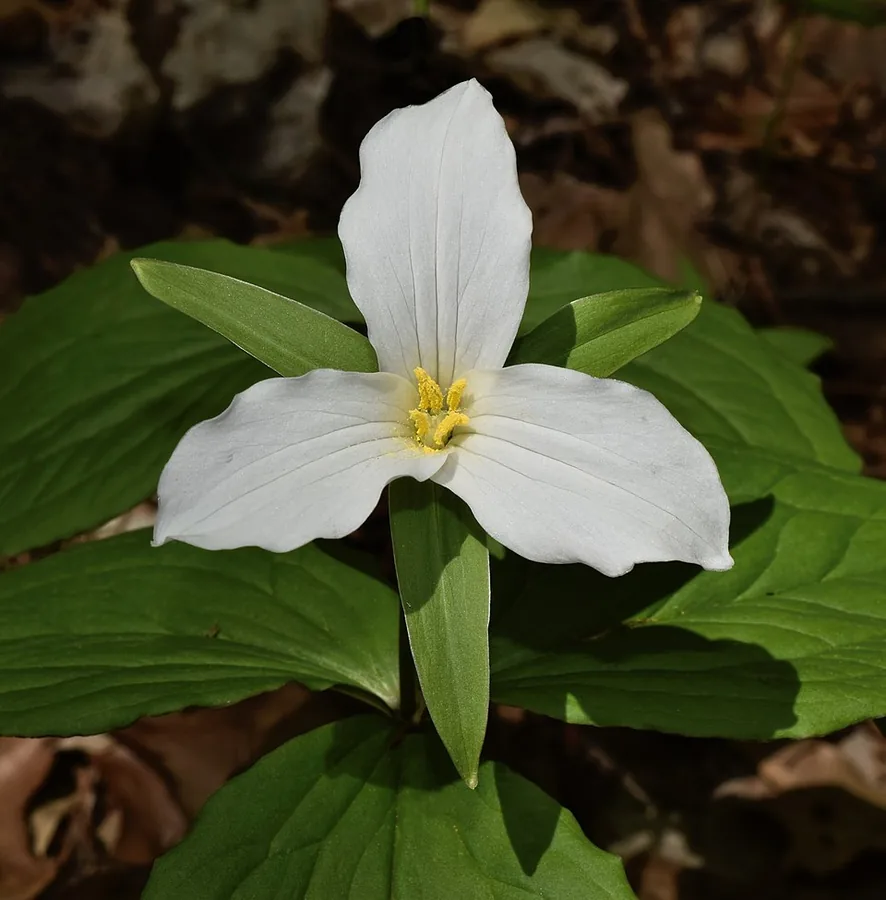
One white flower fading to soft pink, poised above three broad leaves on the shaded forest floor.
Partial shade
Every 3–7 days
USDA 4–8
8–18 in · 20–46 cm
Overview
Up close, large-flowered trillium is all clean geometry: a single white flower held on a short stalk above a whorl of three broad leaves. The petals are pure white when they first open, and the whole bloom sits low over the shaded forest floor of eastern North America, where the plant grows wild among its lily kin. As the flower ages, that crisp white softens and warms into a gentle pink.
Below the leaves, the plant rises from a rhizome, a creeping underground stem that spreads slowly year by year. Above ground the pace is just as unhurried: a seed takes close to a decade to build itself into a flowering plant. Over time the single stems multiply into a low, leafy clump that settles into a lasting colony.
The plant asks for cool shade, damp ground, and dark, crumbly leaf soil, the conditions of the forest floor it belongs to. Left alone in that setting, the broad leaves and low clump return spring after spring. One rule protects them: never lift a plant from the wild.
Care
The short version: give it the forest-floor conditions it knows, shade from dappled to full over deep, dark, humus-rich soil, keep that soil evenly damp through spring, then leave the settled clump be.
Light
Trillium belongs to the dim understory and thrives in partial to full shade. Under bare-branched deciduous trees the early flowers catch a soft, dappled light before the branches above fill with leaves, and once that cover closes the plant sits easily in the deeper shade.
Water
Keep the soil evenly moist but freely draining, watering through dry spells while the spring leaves and flower are working. By late summer the foliage fades and dies back to nothing above ground, and the rhizome below rests on far less.
Soil
Root it in deep, dark, humus-rich soil, crumbly with organic matter and quick to drain. It takes any pH from 5.0 to 7.0, the soft acid-to-neutral range of leaf-mold woodland ground.
Temperature
This is a hardy woodlander, unbothered from -29°F to 84°F (-34°C to 29°C). Its bloom depends on a real winter chill to break dormancy, so it has no place in hot, frost-free ground.
Humidity
There is no humidity figure to hit here, as plain outdoor air suits it. What the plant reads instead is the ground: a cool, shaded, moist site under leaf mulch means far more than any gauge.
Feeding
The dark, leafy soil feeds the plant almost on its own. Each fall a thin skin of leaf mulch or leaf mold, no more than 2 inches, laid over the surface rots down like the natural forest floor and keeps the ground rich.
Pruning
No blade is needed here. After the flower drops, the broad leaves stay on to feed the rhizome for next year before fading and dying back on their own, and cutting them off green only robs the plant.
Repotting
Trillium is rarely disturbed, since lifting it checks the plant hard. Dig into the clump only when crowding has thinned its leaves and flowers, and even then the low mound is slow to knit back together.
Size & spacing
Full grown, the leafy stem stands 8 to 18 inches (20 to 46 cm) tall and the clump spreads 9 to 12 inches (23 to 30 cm) across. A little gap around each lets the slow mound of foliage fill out cleanly.
When to plant
Trillium keeps to the forest's own clock. The dormant rhizomes go into the ground in fall, and the flowers break open in spring, bright white against the shaded floor, any time from April to June before the leaf canopy thickens overhead.
Northern hemisphere
Southern hemisphere
Typical months for a temperate climate: start earlier in warm zones, later where spring frosts linger.
- Plant: Plant dormant rhizomes in fall; sow fresh seed outdoors in fall
- Harvest: Blooms April to June
Hardiness
USDA hardiness zones: 4–8
Temperature: down to -34°C
Troubleshooting
A settled trillium stays clean and trouble-free, and when something is wrong it usually reads on the leaves, in a chewed edge or a discolored patch. Look closely, match what marks the foliage, and act while the damage is small. The one deeper problem is not on the leaves at all: it follows any move of the plant.
A plant that shrinks and fades after it is dug up
When a trillium is lifted, its roots take the shock, and transplant shock shows as a plant that wilts, shrinks, and may not return, since it loathes disturbance. The safest course is to never move it. If a clump must be split, wait until the leaves have died back, drop the rhizome in again at the same depth, and hold the soil damp while new roots take. A nursery-grown plant skips the ordeal and saves you from wrecking a clump from the wild that rarely recovers.
Fix:
- Leave established plants undisturbed where possible
- If dividing, do so after foliage dies back and replant rhizomes promptly at the same depth
- Keep newly set plants evenly moist while they re-establish
Ragged, chewed holes torn through the leaves and petals, marked by slime trails
Those torn edges and glistening trails are the mark of slugs and snails, which slide out after dark in the damp shade to rasp holes in leaf and petal. Pick them off by hand at night or first light, rake away the sodden litter and any planks they hide beneath, and let the ground dry between waterings. When they swarm, a scatter of iron-phosphate bait clears them.
Fix:
- Hand-pick slugs and snails in the evening
- Reduce excess moisture and remove debris that shelters them
- Apply iron-phosphate slug bait if pressure is heavy
Dark spots, blotches, or a powdery film spreading over the leaves
Those marks, whether sharp spots, rusty pustules, or a sooty film, signal a fungal leaf spot, rust, or smut that grips foliage left wet in dead, still air. Strip off the blemished leaves and destroy them, thin the clump so a breeze can pass, and lay water on the soil rather than the leaves. A clean sweep of spent debris each fall clears the spores before spring.
Fix:
- Remove and destroy affected leaves
- Improve air circulation and avoid wetting foliage
- Clean up fallen plant debris at season end
Toxicity
The parts to watch are the fruit and the underground rhizome, both rich in saponins that can turn a stomach. Eaten by a person, a pet, or a grazing animal, they bring on a mild upset, though trillium is no systemic poison and it is absent from the ASPCA's list. Keep the berries and the rhizome out of reach, and never dig this protected wildflower from the wild.
Toxic to
Cats · Dogs · Horses · Rabbits · Livestock · Birds · People
Cats Mild
The saponins packed into the berries and the rhizome can rough up a cat's stomach, so a swallowed scrap may leave it drooling or bringing food back up. Most cats sniff and move on, and a small nibble comes to little.
Dogs Mild
A dog that bites the berries or roots out the rhizome may drool, vomit, or leave a loose stool. The bout is mild and fades on its own, but a determined digger is best fenced off from the roots.
Horses Mild
In a grazing horse those same saponins, held in rhizome and berry, work as a mild irritant on the stomach, no worse. Real harm is unlikely, since trillium keeps to shaded woodland well away from open pasture.
Rabbits Mild
A rabbit that eats its fill of the fruit or roots can end up with a queasy, unsettled gut from the saponins. The leaves are the milder part, while the berries and rhizome are the ones to fence off.
Livestock Mild
Grazing cattle, goats, and sheep that crop the rhizome or berries may show only a mild stomach upset from those saponins. Nothing worse than that is expected of the plant.
Birds Caution
Birds are pulled in by the ripe berries and carry the seed off to sprout elsewhere, yet those same berries hold saponins that irritate mildly. For a pet bird the fruit rates a caution, not a free snack.
People Caution
This plant is not food. Its berries and rhizome are loaded with saponins, and a swallowed mouthful can leave the stomach churning. Children in particular should be kept from the fruit, and it is never gathered to eat.
Keep fruits and rhizomes away from pets and children. This is a slow-growing native protected or restricted in some areas; source only nursery-propagated plants rather than digging from the wild.
Helpline numbers

United States
ASPCA Animal Poison Control: (888) 426-4435 (fee applies)
Poison Control: (800) 222-1222



Canada
Poison Centres: 1-844-764-7669
Varieties
Trillium grandiflorum is grown mostly as the plain white wild species, but one form breaks from that color now and then.
f. roseum
A wild color form, its petals opening a soft pink where the species shows clean white.
How to propagate
More plants come from two methods, splitting the creeping rhizome or sowing seed, and each moves at the plant's own slow speed.
DivisionModerate
After foliage dies back in late summer to fall · 1 to 2 years
Split it only in dormancy. Once the leaves have died back in late summer to fall, lift the clump and ease the rhizomes apart, then bed the pieces straight back in. Trillium bristles at disturbance, so each division sits quiet for 1 to 2 years before it pushes into growth again.
SeedDemanding
Sow fresh seed in fall outdoors · Several years to flowering
Seed is the long, patient road. Sow the fresh seed outside in fall and reckon on double dormancy, which holds germination back across two or more years, with several more before a plant is big enough to flower. Look closely at each seed and you will find a small fatty appendage that ants prize, and they haul it off to sprout somewhere new.
Myths
Plucking a trillium bloom in the woods, or lifting a whole plant for the garden, does it no harm.
Snap that bloom off and the three broad leaves go with it, the plant's only means of feeding itself, so the rhizome starves and the whole plant fades for years or dies outright. It resents transplanting too, and it is protected across much of its range. Buy nursery-propagated plants, and leave the wild ones standing.